
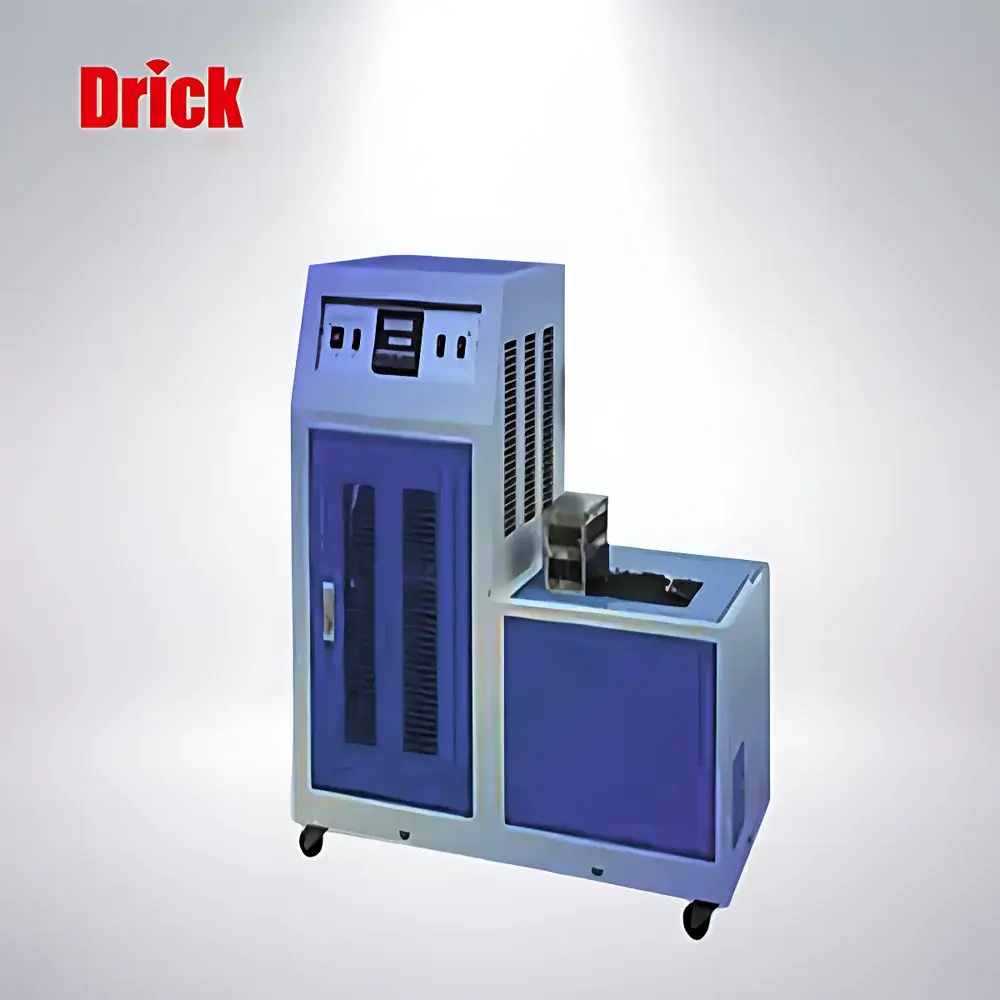
Drick DWC Series Cryogenic Impact Testing Chamber
| Brand | Drick |
|---|---|
| Model | DWC |
| Type | Cryogenic Cooling Bath for Charpy/Izod Impact Testing |
| Temperature Range | Ambient to –30 °C (DWC-30) / Ambient to –60 °C (DWC-60) |
| Temperature Stability | ±0.5 °C |
| Cold Chamber Volume | 120 × 120 × 80 mm |
| Sample Capacity | ≥60–120 standard Charpy specimens (10 × 10 × 55 mm) |
| Cooling Medium | Ethanol or other non-freezing cryogenic fluid |
| Power Consumption | 1.0 kW (DWC-30) / 1.5 kW (DWC-60) |
| Refrigeration System | Cascade compressor-based |
| Control System | Microprocessor-based digital PID controller with auto-timing and over-temperature alarm |
| Compliance | Fully aligned with temperature control requirements of GB/T 229–2007 |
Overview
The Drick DWC Series Cryogenic Impact Testing Chamber is a purpose-engineered thermal conditioning system designed exclusively to support standardized low-temperature Charpy and Izod impact testing of metallic materials. It operates on a cascade refrigeration principle—employing two-stage compression cycles with high-reliability imported compressors—to achieve stable, uniform, and reproducible sub-zero environments ranging from ambient down to –60 °C. Unlike generic laboratory chillers, the DWC chamber integrates tightly with pendulum impact testers (e.g., ZBC series, JB series) by maintaining precise thermal equilibrium across the entire cold chamber volume during specimen soaking and transfer. Its design directly addresses the critical thermal preconditioning phase defined in GB/T 229–2007, ASTM E23, ISO 148-1, and EN 10045-1—ensuring specimens remain within ±0.5 °C of target temperature for the full prescribed soaking duration (typically 5–30 minutes), thereby eliminating thermal drift as a source of measurement uncertainty in absorbed energy calculations.
Key Features
- Microprocessor-controlled digital PID temperature regulation with real-time display, adjustable setpoint resolution of 0.1 °C, and automatic soak timing up to 99 minutes.
- Cascade refrigeration architecture enabling rapid cooldown: ≤60 minutes from 20 °C to –60 °C (DWC-60 model); verified under load with 100 standard Charpy specimens.
- Stainless-steel cold chamber (120 × 120 × 80 mm internal dimensions) with optimized airflow distribution to minimize thermal gradients (<0.3 °C spatial deviation across chamber volume).
- Dual safety interlocks: over-temperature cutoff and compressor overheat protection; audible/visual alarm triggers if setpoint deviation exceeds ±1.0 °C for >30 seconds.
- Compatible with common low-viscosity cryogenic media—including anhydrous ethanol (CAS 64-17-5), ethylene glycol/water mixtures, or commercial non-freezing coolants—ensuring chemical compatibility with standard metal specimens and handling tools.
- Front-access transparent acrylic lid with gas-tight seal minimizes frost accumulation and enables visual verification of specimen immersion without thermal interruption.
Sample Compatibility & Compliance
The DWC chamber accommodates standard Charpy V-notch (10 × 10 × 55 mm), Charpy U-notch, and Izod specimens (10 × 10 × 75 mm) in upright or horizontal orientation. Its 120-mm cubic footprint supports batch cooling of ≥60 specimens (DWC-30) or up to 120 specimens (DWC-60) per cycle—reducing throughput bottlenecks in high-volume QC labs. All operational parameters meet the mandatory thermal performance criteria outlined in GB/T 229–2007 Section 6.3 (temperature uniformity, stabilization time, and hold-time accuracy), and are traceable to national metrological standards via optional NIST-traceable PT100 sensor calibration reports. The unit’s electrical design conforms to IEC 61010-1:2010 for laboratory equipment safety; CE marking documentation available upon request for EU shipment.
Software & Data Management
While the DWC operates as a standalone hardware subsystem, its digital controller logs timestamped temperature profiles (setpoint, actual, deviation) internally for up to 1,000 cycles. Optional RS-485 Modbus RTU interface enables integration into LIMS or MES platforms for automated data capture—supporting audit trails required under GLP and GMP frameworks (21 CFR Part 11 compliant when paired with validated SCADA software). Exportable CSV logs include soak start/end timestamps, peak deviation, and alarm events—facilitating root-cause analysis during CAPA investigations or accreditation audits (e.g., CNAS, ISO/IEC 17025).
Applications
- Preconditioning ferrous and non-ferrous alloys (carbon steels, stainless grades, aluminum 2024/7075, titanium Ti-6Al-4V) prior to dynamic fracture toughness evaluation.
- Supporting ductile-to-brittle transition temperature (DBTT) curve generation per ASTM E1921 or ISO 12737.
- Quality conformance testing in automotive, aerospace, pressure vessel, and pipeline manufacturing per ASME BPVC Section VIII, API RP 5L3, and EN 10228-3.
- Research-grade thermal embrittlement studies where controlled ramp rates (–1 °C/min) and multi-step isothermal holds are required.
FAQ
What standards does the DWC chamber comply with?
It fully satisfies the thermal control specifications in GB/T 229–2007, ASTM E23–22, ISO 148-1:2016, and EN 10045-1, including temperature uniformity, stabilization time, and soak duration accuracy.
Can the DWC be integrated with automated impact test systems?
Yes—via RS-485 Modbus RTU, it synchronizes temperature status and soak completion signals with programmable logic controllers (PLCs) or impact tester controllers for unattended batch operation.
Is ethanol the only acceptable cooling medium?
No—any low-viscosity, non-corrosive, non-freezing fluid with a pour point below the target test temperature may be used; material compatibility with stainless steel 304 and EPDM seals must be verified prior to deployment.
Does the DWC require external ventilation or exhaust?
No dedicated exhaust is needed; however, ambient operating temperature must remain between 10–30 °C with ≥500 mm clearance around condenser coils for optimal heat dissipation.
What maintenance intervals are recommended?
Compressor oil and refrigerant levels should be inspected annually; cold chamber interior and sensor ports require cleaning with isopropyl alcohol every 200 operating hours to prevent ethanol residue buildup and thermal contact resistance.



