
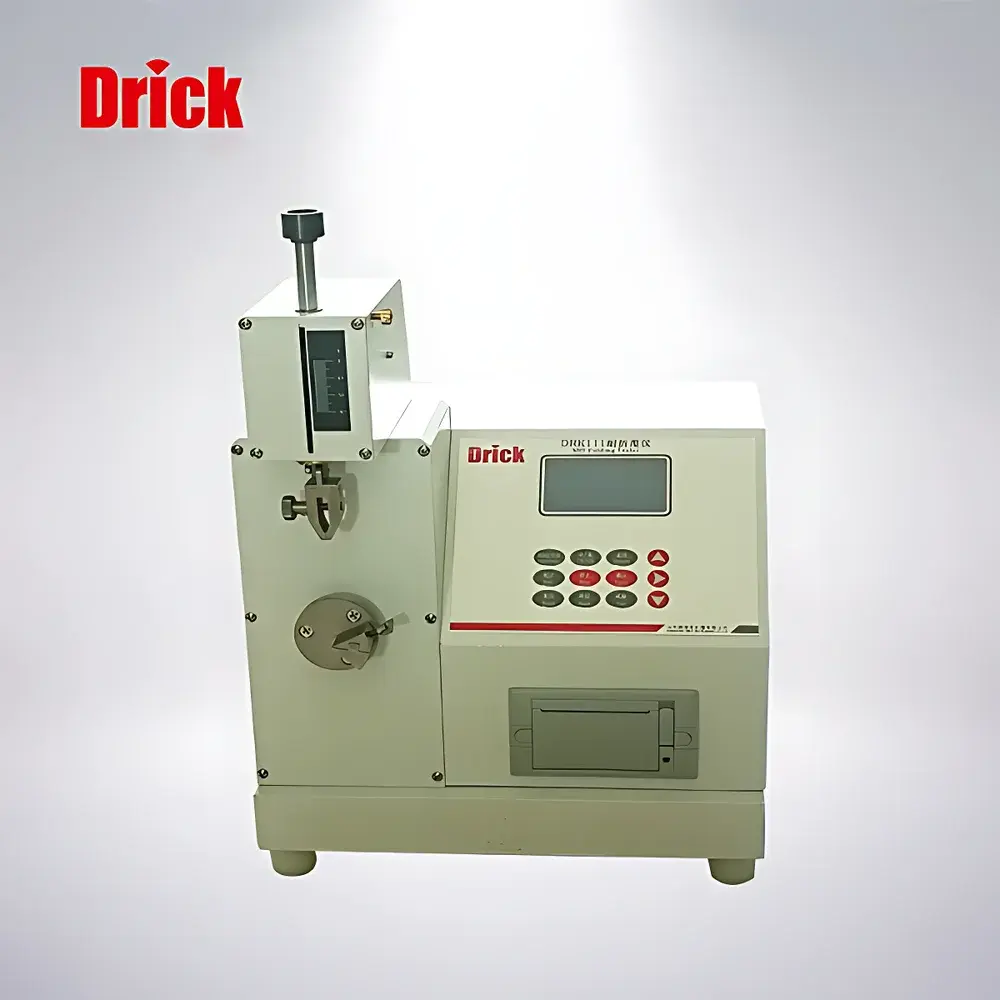
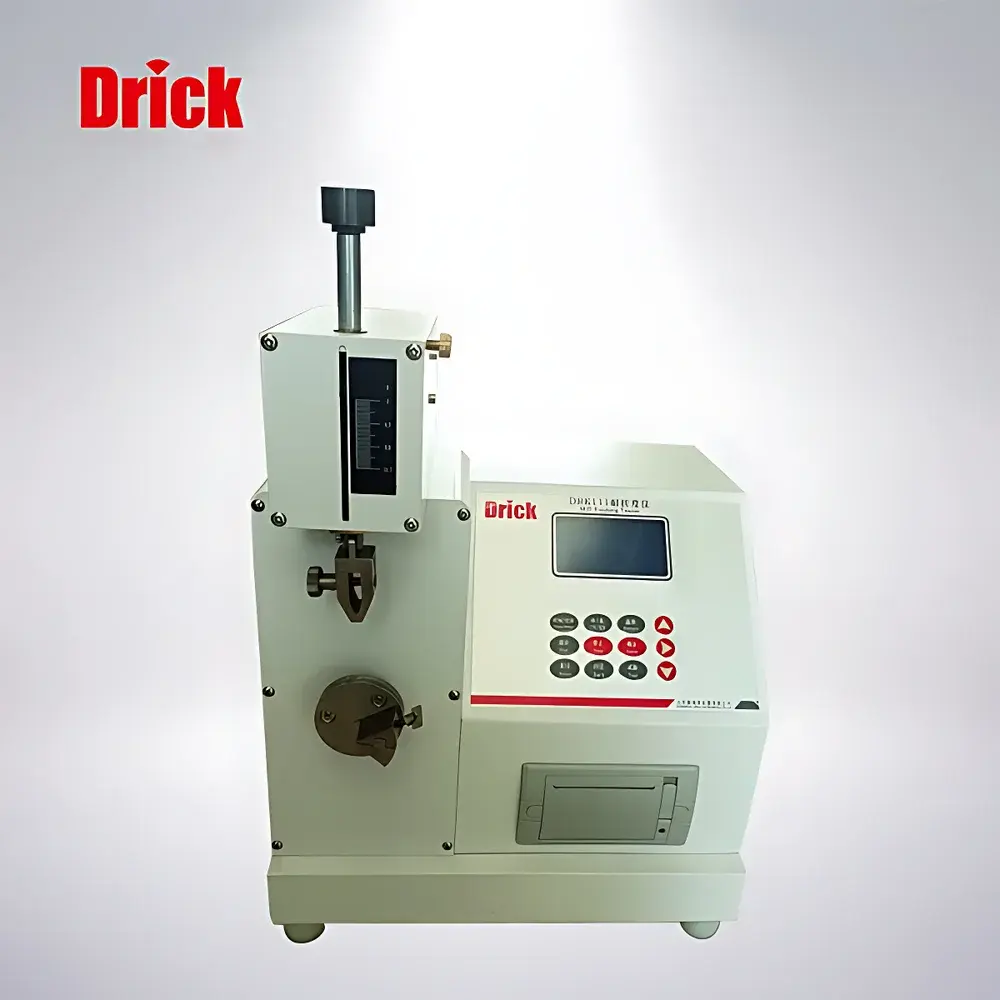
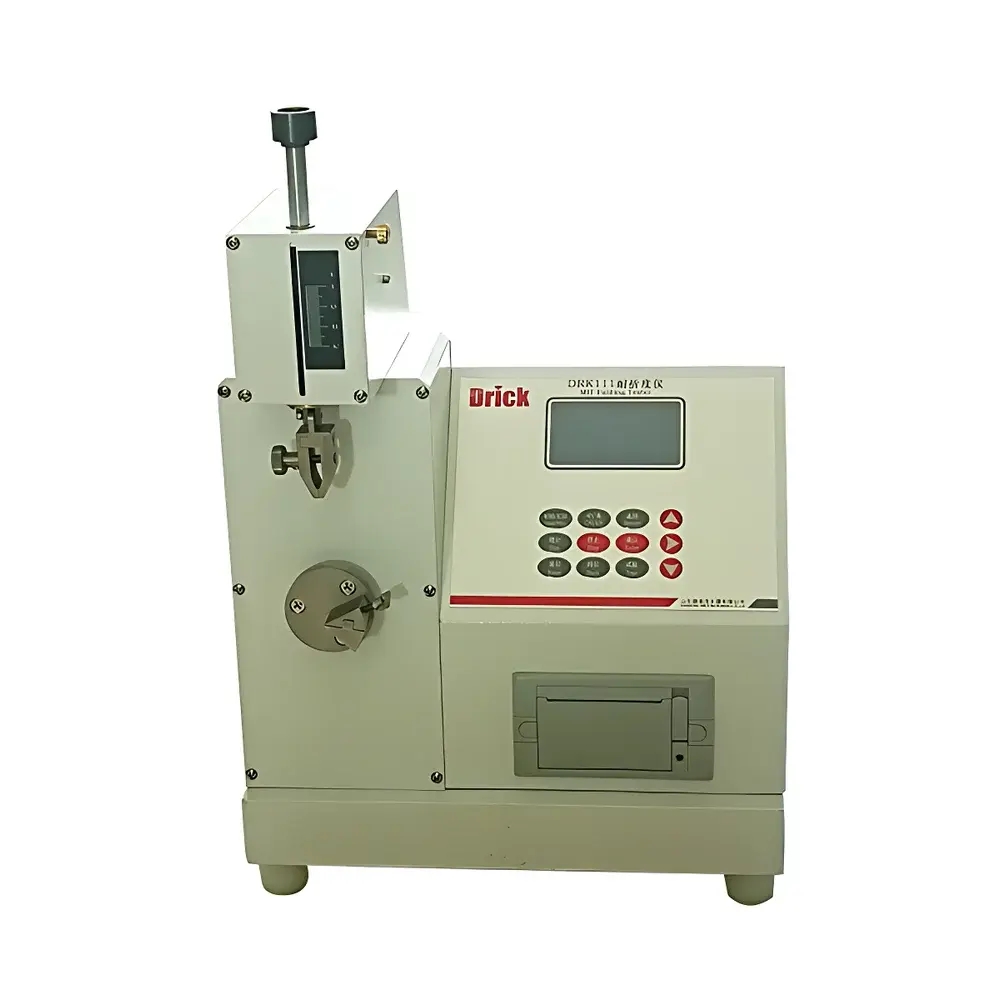
Drick DRK111 MIT-Style Folding Endurance Tester for Paper and Paperboard
| Brand | Drick |
|---|---|
| Origin | Shandong, China |
| Manufacturer Type | Direct Manufacturer |
| Model | DRK111 |
| Measurement Range | 0–99999 folds |
| Folding Angle | 135±2° |
| Folding Speed | 175±10 cycles/min |
| Folding Head Width (Upper) | 19±1 mm |
| Folding Head Radius | 0.38±0.02 mm |
| Spring Tension Range | 4.91–14.72 N |
| Tension Increment | 9.81 N compresses spring ≥17 mm |
| Fold Gap Options | 0.25 / 0.50 / 0.75 / 1.00 mm |
| Thermal Printer | Integrated module-type |
| Upper Clamp Thickness Range | 0.1–2.30 mm |
| Upper Clamp Width Range | 0.1–16.0 mm |
| Upper Clamp Contact Area | 7.8 × 6.60 mm (51.48 mm²) |
| Upper Clamp Torque Specification | 19.95:5.76–Wid 9.85 mm |
| Specimen Parallel Alignment Height | 16.0 mm |
| Lower Folding Head Width | 15±0.01 mm (adjustable 0.1–20.0 mm) |
| Lower Clamp Torque Specification | 11.9:4.18–Wid 6.71 mm |
| Repeatability | ≤10% (at 30 folds), ≤8% (at 3000 folds) |
| Specimen Length | 140 mm |
| Clamp Center Distance | 9.5 mm |
| Compliance Standards | GB/T 2679.5, GB/T 457–2008, ISO 5626 |
Overview
The Drick DRK111 MIT-Style Folding Endurance Tester is a precision-engineered instrument designed to quantify the folding fatigue resistance of thin sheet materials—primarily paper, paperboard, and other planar substrates such as copper foils used in printed circuit board manufacturing. It operates on the fundamental principle of repeated double-fold bending under controlled tension and angular displacement, conforming to the standardized MIT (Massachusetts Institute of Technology) method. This mechanical endurance test subjects specimens to cyclic 135° folding at a fixed frequency and defined clamping geometry, simulating real-world flexing stresses encountered during packaging handling, bookbinding, or electronic substrate deployment. The device integrates photoelectric position sensing to ensure automatic return-to-zero positioning of the folding head after each test cycle—minimizing operator intervention and enhancing procedural consistency across sequential measurements.
Key Features
- Electro-optical fold-counting system with automatic folding head reset after each test sequence
- Precision-machined folding heads with certified radii (0.38 ± 0.02 mm) and width tolerances (±0.01 mm)
- Four selectable fold-gap settings (0.25, 0.50, 0.75, 1.00 mm) to accommodate varying specimen thicknesses and compliance requirements
- Calibrated tension spring assembly with traceable verification points at 4.91 N, 9.81 N, and 14.72 N
- Integrated thermal printer for direct hardcopy output of fold counts, statistical summaries, and test metadata
- Dual-clamp torque calibration specifications (upper: 19.95:5.76–Wid 9.85 mm; lower: 11.9:4.18–Wid 6.71 mm) ensuring reproducible clamping force distribution
- Microprocessor-based control unit supporting automatic data logging, statistical analysis (max/min/mean/CV), and logarithmic conversion of fold counts
- Compliant mechanical architecture with verified friction loss (<0.25 N) and tension stability (<0.343 N variation over full rotation cycle)
Sample Compatibility & Compliance
The DRK111 accommodates specimens up to 140 mm in length and 2.30 mm in thickness, with adjustable upper clamp widths spanning 0.1–16.0 mm. Its design supports standardized testing of diverse sheet materials including kraft linerboard, corrugated medium, tissue, filter paper, metallized films, and flexible copper clad laminates (FCCL). The instrument meets the dimensional, kinematic, and metrological requirements specified in GB/T 2679.5–2022 (“Determination of Folding Endurance of Paper and Paperboard — MIT Method”), GB/T 457–2008, and ISO 5626:1993. While not certified to ISO/IEC 17025, its documented calibration procedures—including three-point spring tension verification, fold-angle validation, and friction-loss assessment—support laboratory quality assurance protocols aligned with GLP principles.
Software & Data Management
The embedded microcontroller performs real-time fold counting, stores up to 99 test records per session, and computes descriptive statistics including arithmetic mean, standard deviation, coefficient of variation (CV), and extreme values. All data are displayed via high-contrast LED numeric indicators and exported via built-in thermal printing. No external software installation or PC interface is required—ensuring operational simplicity in production QC labs or educational environments where IT infrastructure is limited. Audit trails are maintained through printed timestamps and manual operator ID entry (via keypad), satisfying basic documentation needs for internal process validation. For laboratories requiring electronic record retention, users may manually transcribe printed outputs into LIMS-compatible spreadsheets.
Applications
- Quality control in paper mills and converting facilities evaluating folding durability prior to corrugation or lamination
- Package development labs assessing crease performance of folding cartons and retail displays
- Academic research on fiber network integrity, pulp refining effects, and coating-induced brittleness
- Electronics manufacturing for qualification of flexible substrate bending reliability in dynamic flex circuits
- Regulatory testing by provincial and municipal inspection institutes conducting statutory compliance assessments per Chinese national standards
- Method transfer studies comparing MIT vs. Schopper-type folding behavior across fiber composition gradients
FAQ
What standards does the DRK111 comply with?
It conforms to GB/T 2679.5–2022, GB/T 457–2008, and ISO 5626:1993 for folding endurance measurement.
Can the DRK111 test materials thicker than 1 mm?
Yes—the upper clamp accommodates specimens up to 2.30 mm thick, though standard test methods typically specify ≤1.0 mm for paperboard applications.
How is tension calibration performed?
Using certified weights (4.91 N, 9.81 N, 14.72 N) applied to the tension lever; deviations are corrected via pointer repositioning or micrometer screw adjustment.
Is the folding speed adjustable?
No—the instrument operates at a fixed nominal speed of 175 ± 10 folds per minute, as mandated by referenced standards.
What maintenance is required for long-term accuracy?
Regular cleaning of folding head arcs with lint-free cloth, periodic verification of spring tension and fold-gap settings, and power disconnection during extended idle periods.



