
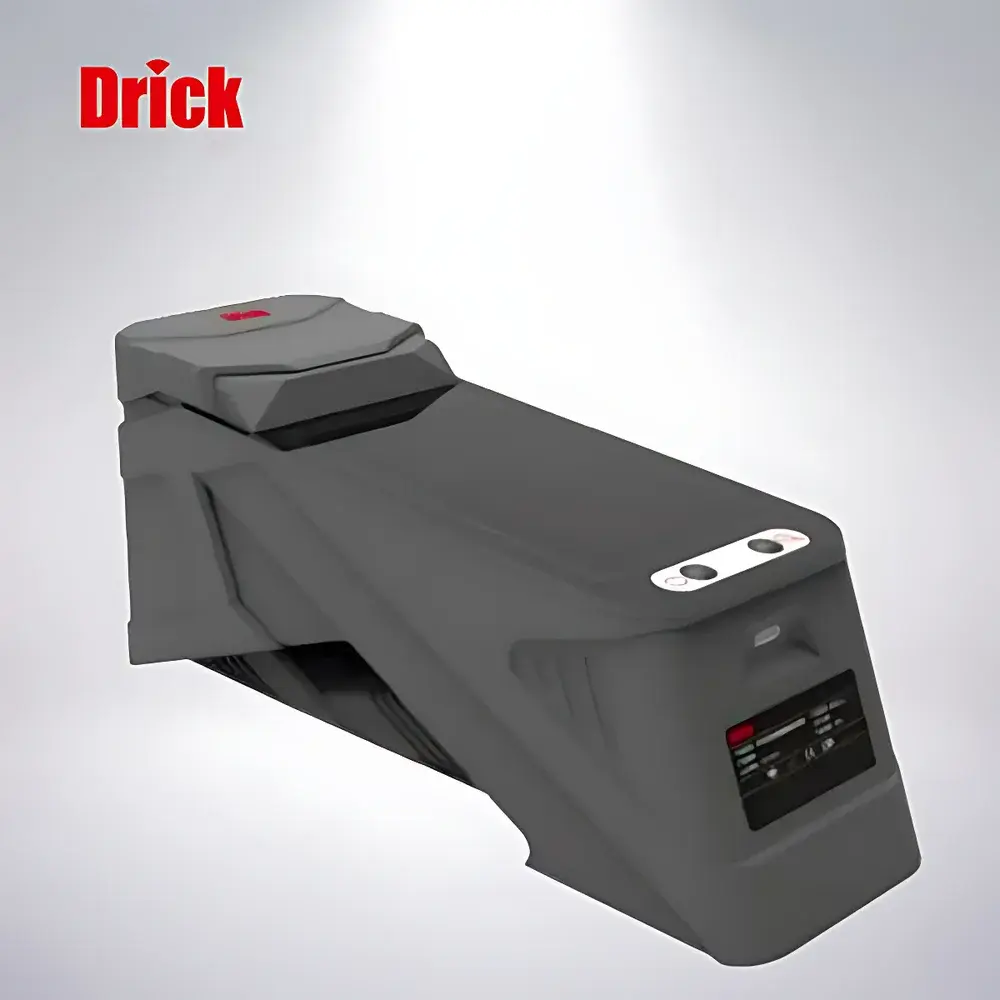
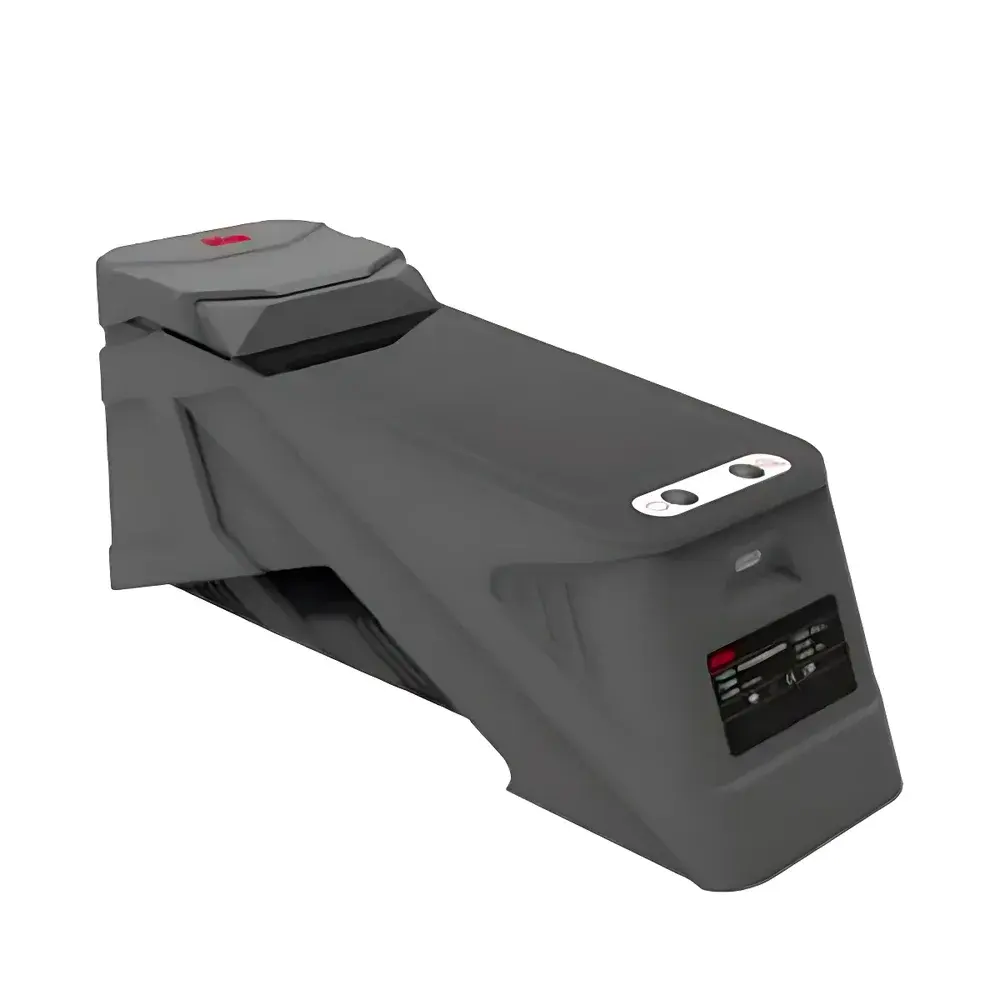
Drick DRK510 Handheld Urine Trace Drug Analyzer with Rare-Earth Fluorescence Immunoassay Technology
| Brand | Drick |
|---|---|
| Origin | Shandong, China |
| Manufacturer Type | OEM/ODM Manufacturer |
| Country of Origin | China |
| Model | DRK510 |
| Price | USD 28,000 (FOB Qingdao) |
| Detection Time | ≤5 min per sample |
| Sensitivity | 0.2 ng/mg for target analytes |
| Sample Volume | 100–200 µL urine |
| Battery Life | ≥100 tests per full charge |
| Connectivity Options | Optional 4G module, ID card reader, LED-assisted camera |
| Data Output | Thermal printout + cloud upload (via optional modules) |
| Regulatory Compliance | Designed to meet requirements of MPS Regulation No. 172 (2021) on Urine Sample Testing for Suspected Drug Users |
Overview
The Drick DRK510 is a field-deployable, handheld urine trace drug analyzer engineered for rapid, quantitative immunoassay-based detection of 26 priority substances—including opioids, stimulants, synthetic cannabinoids, and novel psychoactive substances—using rare-earth chelate fluorescence labeling technology. Unlike conventional lateral flow assays or ELISA-based benchtop systems, the DRK510 employs time-resolved fluorescence (TRF) detection, leveraging the long decay lifetime (microsecond-scale) and narrow emission bandwidth of europium(III)-based labels to eliminate background autofluorescence from biological matrices. This enables high signal-to-noise ratio (SNR > 1,200:1), precise quantification in complex urine samples without extraction or dilution, and robust performance under variable ambient conditions (10–35 °C, 30–85% RH). The system operates on a dual-channel optical architecture with integrated excitation at 340 nm and emission collection at 615 nm, calibrated against NIST-traceable reference standards. It is not intended for diagnostic use per FDA 21 CFR Part 809 but functions as a forensic-grade preliminary screening instrument compliant with the Ministry of Public Security’s *Regulation on Urine Sample Testing for Suspected Drug Users* (MPS Order No. 172, 2021).
Key Features
- Simultaneous quantitative detection of up to 26 drugs in a single 100–200 µL urine aliquot—no sample pre-treatment required
- Time-resolved fluorescence immunoassay (TRFIA) with rare-earth (Eu³⁺) labeled antibodies ensures specificity against cross-reactive metabolites (e.g., 6-MAM vs. morphine; norfentanyl vs. fentanyl)
- On-device quantification with dynamic range spanning 0.2–500 ng/mg across all analytes, validated per ISO 13528:2015 for interlaboratory proficiency testing
- Integrated thermal incubation block (37 ± 0.5 °C) maintains reaction kinetics consistency regardless of ambient temperature fluctuations
- Modular hardware configuration: base unit supports optional 4G LTE connectivity (Cat-M1), ISO/IEC 7816-compliant ID card reader, and 5-megapixel low-light camera with LED ring illumination
- Thermal printer (58 mm width) generates tamper-evident reports including QR-coded test ID, timestamp, operator ID, GPS coordinates (when 4G enabled), and raw fluorescence intensity values
- Rechargeable Li-ion battery (14.4 V, 8,200 mAh) supports ≥100 consecutive tests per charge; power management firmware includes low-battery warning and auto-suspend after 90 s inactivity
Sample Compatibility & Compliance
The DRK510 accepts native, uncentrifuged human urine specimens collected in standard sterile containers. It demonstrates no interference from common adulterants (nitrites, glutaraldehyde, pyridinium chlorochromate) at concentrations exceeding ASTM D7217-18 thresholds. Cross-reactivity profiles were established using WHO International Standard Reference Materials and confirmed against 12 certified reference laboratories accredited to ISO/IEC 17025:2017. The device meets structural and electromagnetic compatibility requirements per GB/T 18268.1–2010 (IEC 61326-1:2012) and environmental resilience per GB/T 2423.1–2008 (IEC 60068-2-1) for operational storage at −20 °C to +60 °C. While not CE-marked for EU IVD use, its design incorporates audit trail logging (user logins, test history, calibration events) in accordance with GLP-aligned data integrity practices.
Software & Data Management
Embedded firmware (v3.2.1) runs on ARM Cortex-A53 processor with real-time Linux kernel. All test metadata—including raw fluorescence counts, calibration coefficients, reagent lot numbers, and environmental sensor readings (temperature/humidity)—are stored locally in encrypted SQLite3 database with SHA-256 hashing. Optional cloud integration via MQTT protocol enables secure transmission to Drick Cloud Platform (DCP), where data undergoes AES-256 encryption in transit and at rest. DCP supports role-based access control (RBAC), automated report generation (PDF/CSV), batch analytics dashboards, and audit log export compliant with MPS Evidence Chain-of-Custody Directive (2022). Firmware updates are delivered over-the-air (OTA) with digital signature verification.
Applications
- Roadside impairment screening during traffic enforcement operations (e.g., suspected drugged driving)
- Field verification of abstinence in mandatory rehabilitation programs (community-based and institutional)
- Pre-enlistment medical screening for military recruitment centers
- Border inspection and customs clearance at land, air, and maritime ports of entry
- Workplace safety compliance monitoring in high-risk sectors (transportation, energy, construction)
- Emergency department triage support for acute intoxication assessment
- Forensic evidence collection during warrant-based searches and custodial interviews
FAQ
Does the DRK510 require laboratory validation before deployment?
No—each unit ships with factory calibration verified against NIST SRM 3672 (Urine Drug Metabolite Mix) and includes a certificate of conformance. Field recalibration is performed automatically before each test batch using internal reference standards.
Can results be used as primary evidence in court proceedings?
DRK510 outputs serve as presumptive evidence only. Positive findings must be confirmed by GC-MS or LC-MS/MS per MPS Technical Specification for Forensic Toxicology (GA/T 1320–2016).
What is the shelf life of the test cartridges?
Unopened cartridges retain full performance for 18 months when stored at 2–8 °C; 6 months at ambient temperature (≤30 °C) with desiccant intact.
Is user training mandatory?
Yes—Drick provides a certified 4-hour competency course covering sample handling, interference mitigation, chain-of-custody documentation, and error code interpretation. Certification is valid for two years.
How does the system handle sample volume variability?
Capillary-driven microfluidic channels ensure precise metering of 150 ± 5 µL regardless of operator technique, eliminating pipetting errors and ensuring assay reproducibility (CV < 8.2% across 200 replicates).




