
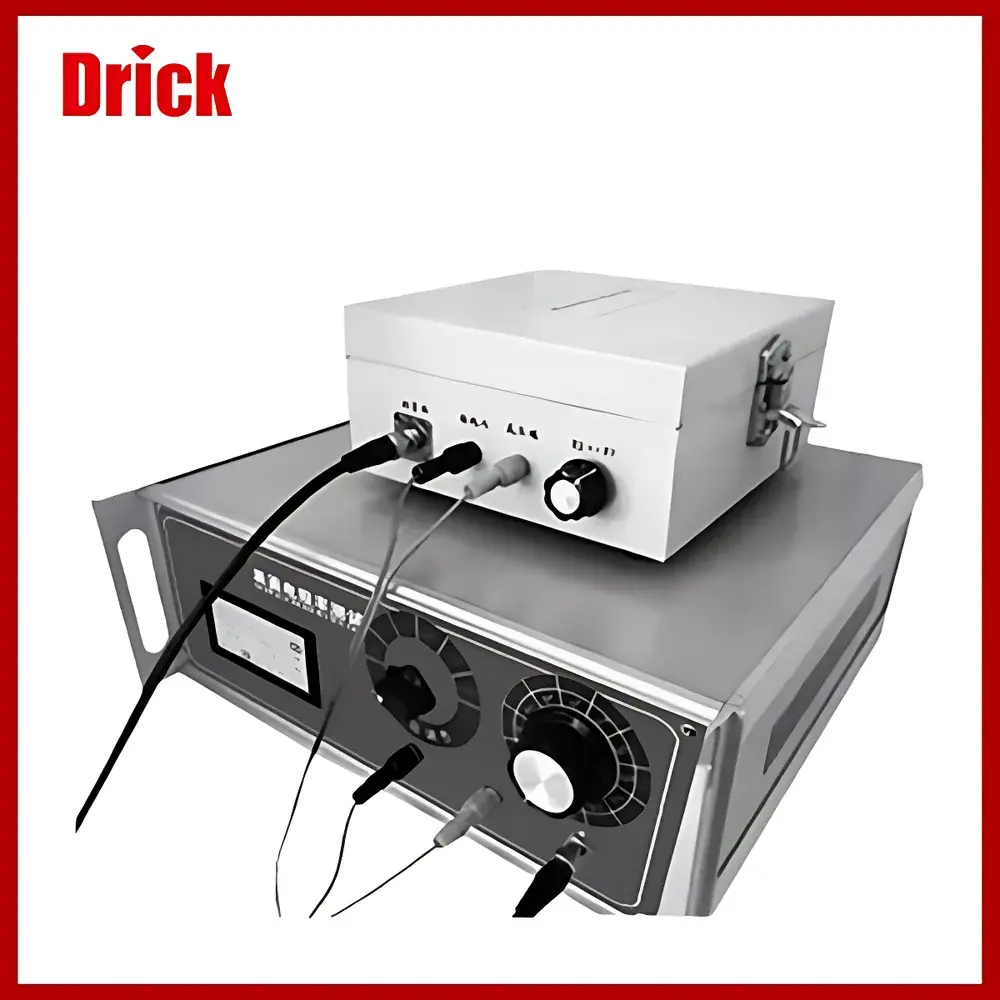
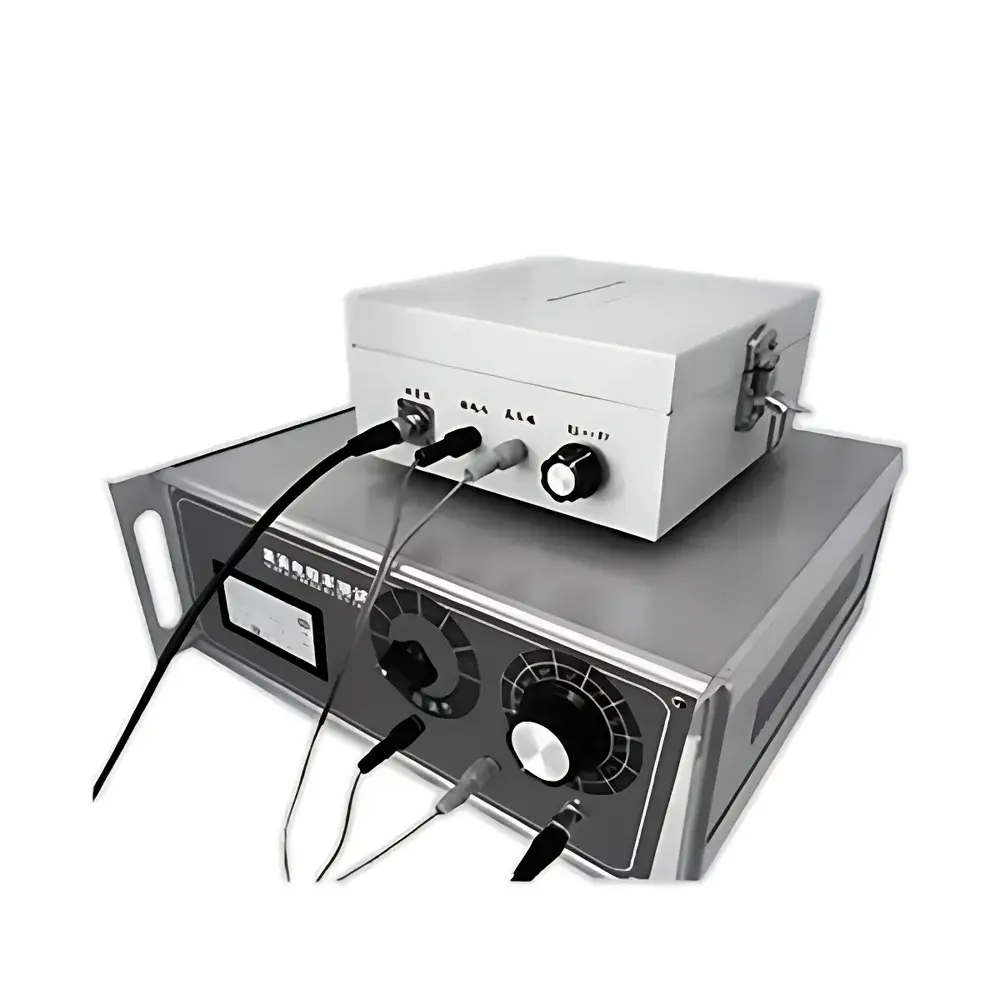
Drick DRK321B-II Surface Resistivity Tester
| Brand | Drick |
|---|---|
| Model | DRK321B-II |
| Measurement Range | 1×10⁴ Ω to 1×10¹⁸ Ω |
| Current Range | 2×10⁻⁴ A to 1×10⁻¹⁶ A |
| Test Voltages | 10 V / 50 V / 100 V / 250 V / 500 V / 1000 V |
| Accuracy | ±1% |
| Display | Color TFT Touchscreen |
| Sample Types | Solid, Powder, Liquid |
| Compliance | GB/T 1410-2006, ASTM D257-99, GB/T 10581-2006, GB/T 1692-2008, GB/T 2439-2001, GB/T 12703.4-2010, GB/T 10064-2006 |
Overview
The Drick DRK321B-II Surface Resistivity Tester is a precision electrometric instrument engineered for reliable, standardized measurement of surface resistivity and volume resistivity in insulating and antistatic materials. It operates on the principle of direct-current (DC) voltage application across defined electrode configurations—compliant with guarded two-terminal or three-electrode methods per IEC 62631-3-1 and ASTM D257—and measures resulting current to compute resistance and, subsequently, resistivity using geometric correction factors. Designed specifically for rubber, plastic, polymer composites, coatings, and textile materials used in ESD-sensitive manufacturing environments, cleanrooms, and automotive electronics assembly, the DRK321B-II supports both laboratory QA/QC workflows and R&D validation under controlled ambient conditions (0–40 °C, RH <80%). Its architecture integrates high-impedance electrometer circuitry with low-noise guarding, enabling stable measurement of ultra-high resistances up to 1 E18 Ω while resolving currents down to 100 aA (1×10⁻¹⁶ A)—critical for evaluating carbon-black-filled elastomers, conductive masterbatches, and static-dissipative packaging films.
Key Features
- Wide resistance measurement range: 1×10⁴ Ω to 1×10¹⁸ Ω, covering insulative polymers through static-dissipative grades
- Ultra-low current detection capability: 2×10⁻⁴ A to 1×10⁻¹⁶ A, supporting compliance with ASTM D257 Class I and II test requirements
- Multi-voltage DC source: Six selectable test voltages (10 V, 50 V, 100 V, 250 V, 500 V, 1000 V), each enabling direct readout of resistance and resistivity without manual scaling
- Integrated resistivity calculation engine: Automatically computes surface or volume resistivity upon entry of sample thickness and electrode geometry—eliminating post-test arithmetic errors
- Color TFT touchscreen interface: Intuitive navigation, real-time dual-parameter display (resistance + current), and on-screen unit conversion (Ω, MΩ, GΩ, TΩ, PΩ)
- Onboard data handling: Stores up to 500 test records with timestamp, voltage setting, and material ID; supports USB export for CSV-compatible analysis
- Compliance-ready operation: Built-in adherence to electrode spacing, guard ring implementation, and dwell time protocols specified in GB/T 1410-2006 and ASTM D257-99
Sample Compatibility & Compliance
The DRK321B-II accommodates solid sheets, pellets, powders, and liquids—enabling comparative evaluation of raw resins, compounded compounds, and finished parts. For solids, standard circular electrodes (diameter ≥100 mm) are recommended per GB/T 1410-2006; smaller specimens require custom electrode fixtures (available separately). Powder testing follows GB/T 10581-2006 methodology using compression die sets; liquid measurements utilize concentric cylindrical electrodes per ASTM D257 Annex A4. All test modes enforce standardized preconditioning (24-hr conditioning at 23 °C/50% RH per ISO 291) and minimum stabilization times (60 s minimum dwell per USP ). The instrument’s firmware embeds clause-mapped test templates aligned with GB/T 12703.4-2010 (textile electrostatic assessment), GB/T 2439-2001 (rubber conductivity), and GB/T 1692-2008 (vulcanized rubber resistivity), facilitating audit-ready documentation for GLP and ISO/IEC 17025-accredited labs.
Software & Data Management
The embedded operating system provides full traceability: every measurement logs voltage, current, elapsed time, operator ID (via optional RFID badge integration), and environmental metadata (if external温湿度 sensor is connected). Exported datasets include raw analog-to-digital converter (ADC) counts, applied voltage, measured current, computed resistance, and derived resistivity—all tagged with ISO 8601 timestamps. Data files conform to ASTM E1447-22 structural conventions for electrical property reporting and support import into LIMS platforms via standard USB mass storage mode. Audit trail functionality complies with FDA 21 CFR Part 11 requirements when paired with user authentication modules and electronic signature protocols—ensuring integrity during regulatory submissions or third-party certification reviews.
Applications
- Quality control of antistatic polyolefin films used in medical device packaging
- Development of conductive thermoplastic elastomers (TPEs) for automotive interior trim
- Validation of carbon nanotube (CNT)-loaded epoxy adhesives in aerospace bonding applications
- ESD qualification of cleanroom garments per ANSI/ESD S20.20
- Resistivity mapping of extruded silicone tubing for pharmaceutical fluid handling systems
- Comparative screening of flame-retardant additives’ impact on base polymer insulation performance
FAQ
What standards does the DRK321B-II directly support?
It implements test logic and parameter defaults aligned with GB/T 1410-2006, ASTM D257-99, GB/T 10581-2006, GB/T 1692-2008, GB/T 2439-2001, GB/T 12703.4-2010, and GB/T 10064-2006—including automatic selection of appropriate voltage levels and electrode correction factors.
Can the instrument measure both surface and volume resistivity simultaneously?
No—it requires manual selection of test configuration (surface vs. volume electrode setup) prior to measurement; however, the same hardware platform and software interface support both modes with dedicated calibration routines.
Is external calibration required before first use?
Yes. Initial calibration must be performed using NIST-traceable high-resistance standards (e.g., 10⁹ Ω, 10¹² Ω, 10¹⁵ Ω) and certified microcurrent sources; certificate of calibration is provided with shipment.
Does the DRK321B-II meet electromagnetic compatibility (EMC) requirements for lab environments?
It conforms to IEC 61326-1:2013 Class A emission limits and basic immunity per EN 61000-4 series, validated per CISPR 11 Group 1, Class B.
How is data integrity maintained during long-duration tests?
Internal watchdog timers monitor ADC stability; any deviation beyond ±0.5% over 30 s triggers automatic abort and error logging—preventing corrupted datasets from entering the record archive.




