
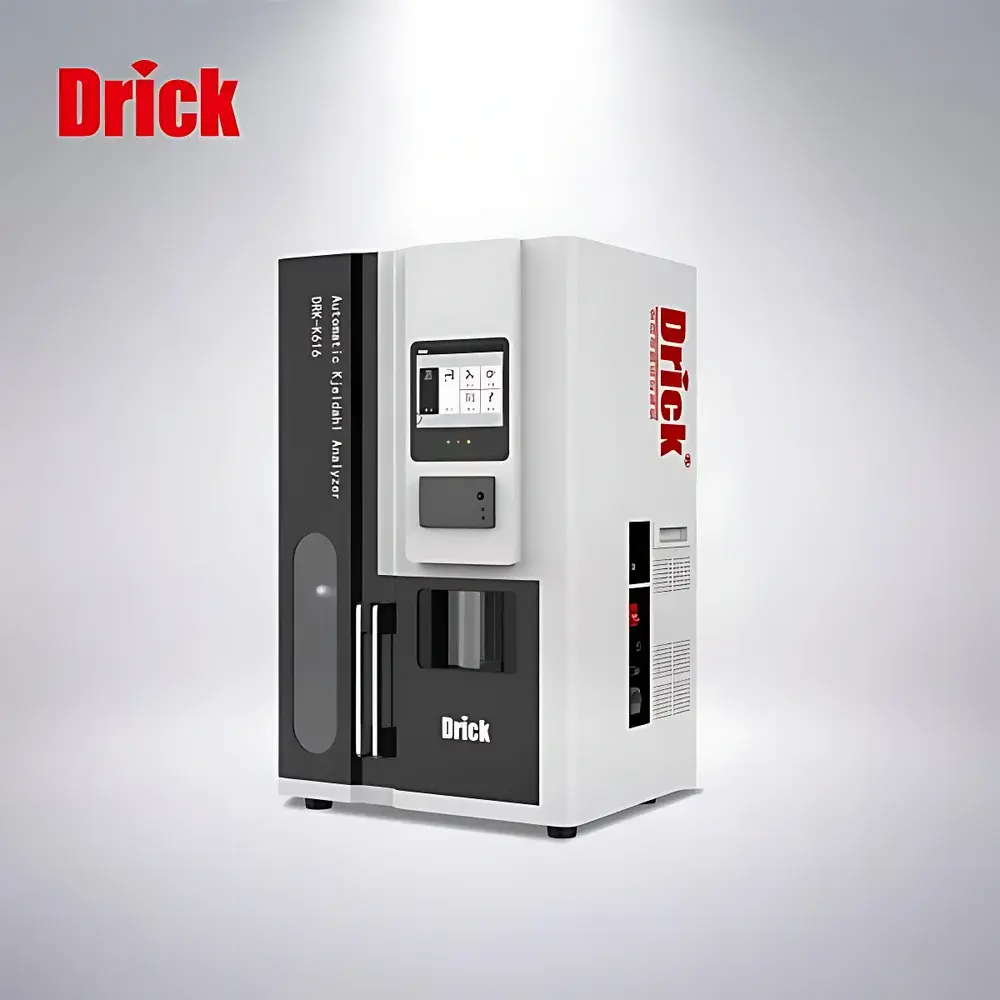
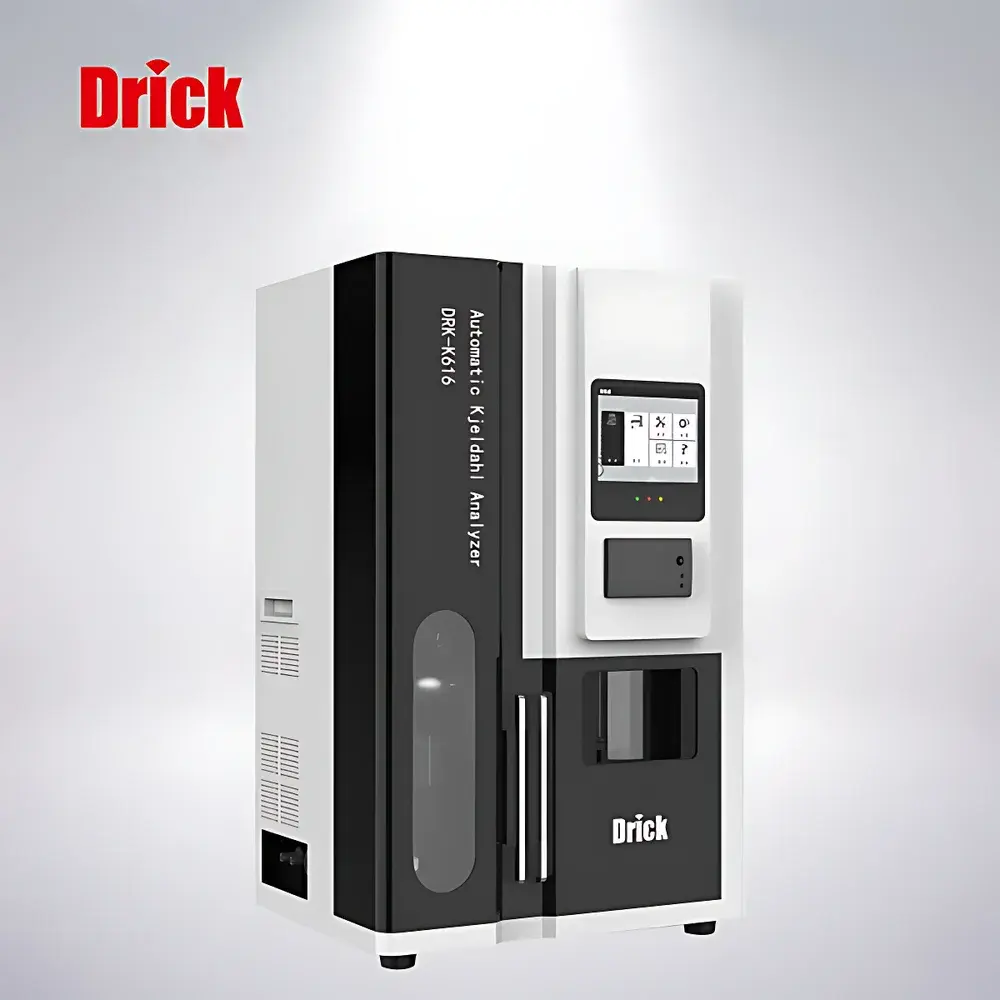
Drick DRK-K616 Fully Automated Kjeldahl Nitrogen Determinator
| Brand | Drick |
|---|---|
| Origin | Shandong, China |
| Manufacturer Type | Direct Manufacturer |
| Product Category | Domestic |
| Model | DRK-K616 |
| Instrument Type | Kjeldahl Nitrogen Determinator |
| Automation Level | Fully Automated |
| Nitrogen Determination Range | 0.1 mg – 280 mg |
| Sample Weight Capacity | Solid ≤ 5 g |
| Recovery Rate | ≥99.5% |
| Repeatability (RSD) | ≤0.5% |
| Titration Resolution | 1.0 µL/step |
| Cooling Water Consumption | 1.5 L/min |
| Data Storage Capacity | 1,800 test records |
| Power Supply | 220 V AC ±10%, 50 Hz |
| Rated Power | 2 kW |
| Dimensions (L×W×H) | 455 × 391 × 730 mm |
| Net Weight | 38 kg |
Overview
The Drick DRK-K616 Fully Automated Kjeldahl Nitrogen Determinator is an integrated analytical system engineered for precise, reproducible quantification of total nitrogen content in organic samples—based on the internationally standardized Kjeldahl digestion–distillation–titration methodology (ISO 8968-1, AOAC 984.13, ASTM D1122, and USP <467>). Unlike semi-automated or modular systems, the DRK-K616 implements end-to-end automation across all critical stages: alkaline addition, steam distillation, condensate collection, potentiometric titration with bromothymol blue/methyl red indicator, endpoint detection, stoichiometric calculation, and result reporting. Its core architecture incorporates a corrosion-resistant stainless-steel steam generator, real-time distillate temperature monitoring, dual-mode steam delivery (standard and gentle), and a linear-motor-driven micro-titration system delivering 1.0 µL per step resolution. Designed for routine high-throughput laboratories, the instrument ensures compliance with GLP/GMP data integrity requirements through full audit trail logging, user-access control, and electronic signature support.
Key Features
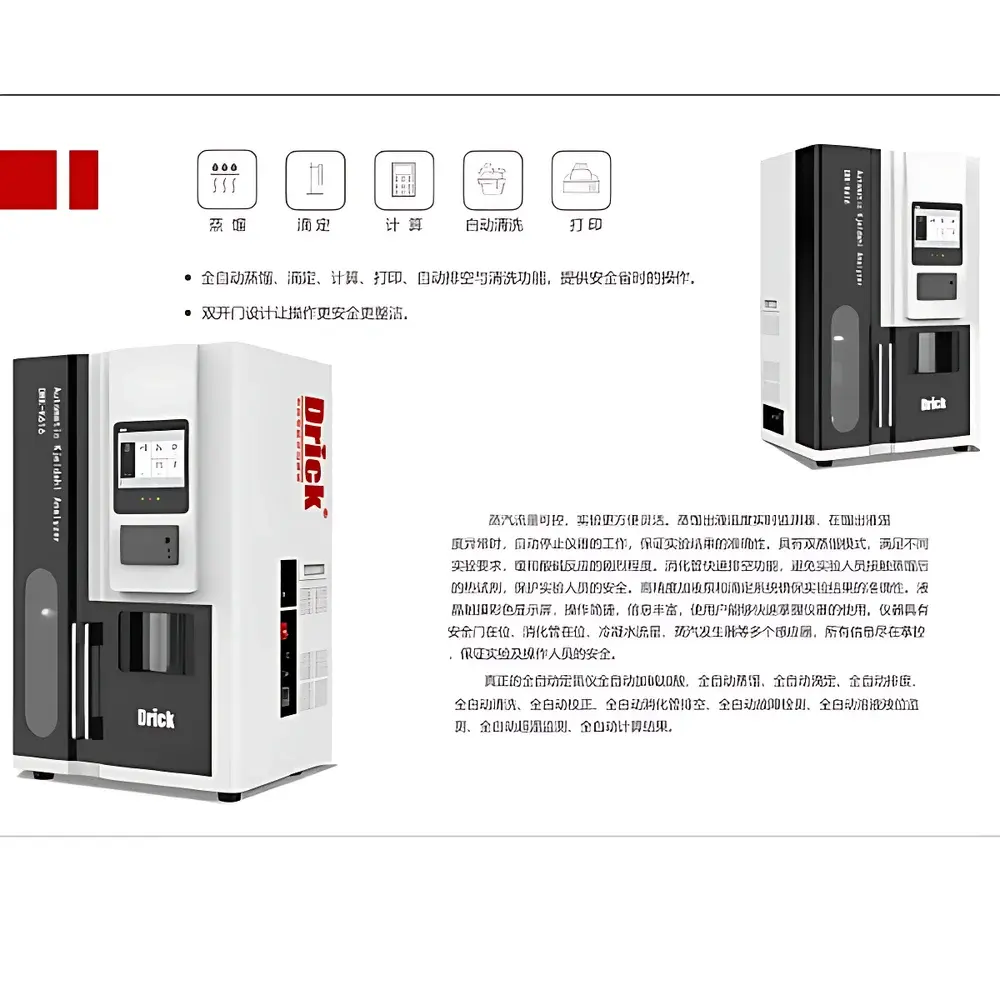
- Fully automated workflow: automatic reagent dosing (NaOH/H3BO3), steam generation, distillation, titration, waste evacuation, and cleaning cycles—eliminating manual intervention after sample loading.
- Real-time distillate temperature monitoring: triggers immediate system halt if condensate exceeds safe thermal thresholds, preventing ammonia loss and ensuring quantitative recovery.
- Dual-distillation mode: standard and “gentle” modes modulate steam flow to accommodate volatile or acid-sensitive matrices (e.g., dairy whey, fermented feed, or pharmaceutical excipients).
- Integrated safety architecture: interlocked safety door sensor, digestion tube presence detection, continuous cooling water flow verification, and overtemperature protection for steam generator and condenser.
- 42 mm digestion tube compatibility: aligns with international standard tube dimensions (e.g., Büchi, Gerhardt, FOSS), enabling seamless method transfer and consumable interoperability.
- High-precision fluid handling: chemically inert peristaltic pumps and a linear-motor-controlled burette ensure volumetric accuracy and long-term stability under repeated corrosive reagent exposure.
- 10.1-inch color capacitive touchscreen interface: supports multilingual operation (English, Spanish, Portuguese), contextual help, real-time status visualization, and intuitive method configuration without external PC dependency.
Sample Compatibility & Compliance
The DRK-K616 accommodates solid samples up to 5 g and liquid samples up to 20 mL—optimized for heterogeneous matrices including cereal grains, oilseed meals, animal feed, soil extracts, wastewater sludge, pharmaceutical intermediates, and botanical extracts. All wet chemistry steps conform to ISO 5983-1:2009 (Animal feeding stuffs), ISO 1871:2009 (Cereals and pulses), and AOAC Official Method 981.10. The system meets mechanical safety requirements per IEC 61010-1 and electromagnetic compatibility per IEC 61326-1. Data management supports 21 CFR Part 11-compliant audit trails when connected to validated LIMS environments; electronic records include operator ID, timestamp, method version, raw titration curves, and calibration logs.
Software & Data Management
Embedded firmware provides local storage for up to 1,800 complete analysis records—including raw titration curves, endpoint voltages, calculated %N and %Protein (using standard conversion factors: 6.25, 5.70, 6.38), and QC flagging. USB export enables CSV or PDF report generation compatible with laboratory informatics systems. Optional Ethernet/Wi-Fi module enables remote monitoring, scheduled maintenance alerts, and centralized fleet management. All software updates are digitally signed and validated prior to installation to maintain regulatory integrity.
Applications
The DRK-K616 serves as a primary nitrogen quantification platform in food safety labs (protein labeling compliance), agricultural research stations (fertilizer efficiency studies), contract testing organizations (AOAC-certified validation), environmental agencies (wastewater TN monitoring), and pharmaceutical quality control (residual ammonium salt assay in APIs). Its robustness and repeatability (RSD ≤0.5% at 10–200 mg N level) make it suitable for ISO/IEC 17025-accredited testing where measurement uncertainty budgets must be rigorously documented.
FAQ
What digestion units are compatible with the DRK-K616?
The instrument accepts standard 42 mm outer-diameter digestion tubes—compatible with common Kjeldahl digestion blocks from major global suppliers.
Does the system support method validation per ISO/IEC 17025?
Yes: built-in calibration routines, traceable reagent dispensing, endpoint reproducibility checks, and full electronic audit trails meet documentation requirements for accredited laboratories.
Can the DRK-K616 be integrated into a LIMS environment?
Via optional Ethernet interface and configurable ASCII/CSV output protocols, supporting bidirectional communication with major LIMS platforms.
Is the steam generator serviceable in-field?
The stainless-steel steam generator is designed for modular replacement with factory-trained technician support; no soldering or pressure vessel recertification required.
What maintenance intervals are recommended?
Daily: rinse cycle verification and waste tank inspection. Quarterly: titrant line purge, pH electrode calibration, and steam trap cleaning. Annual: full fluid path integrity check and firmware update validation.





