
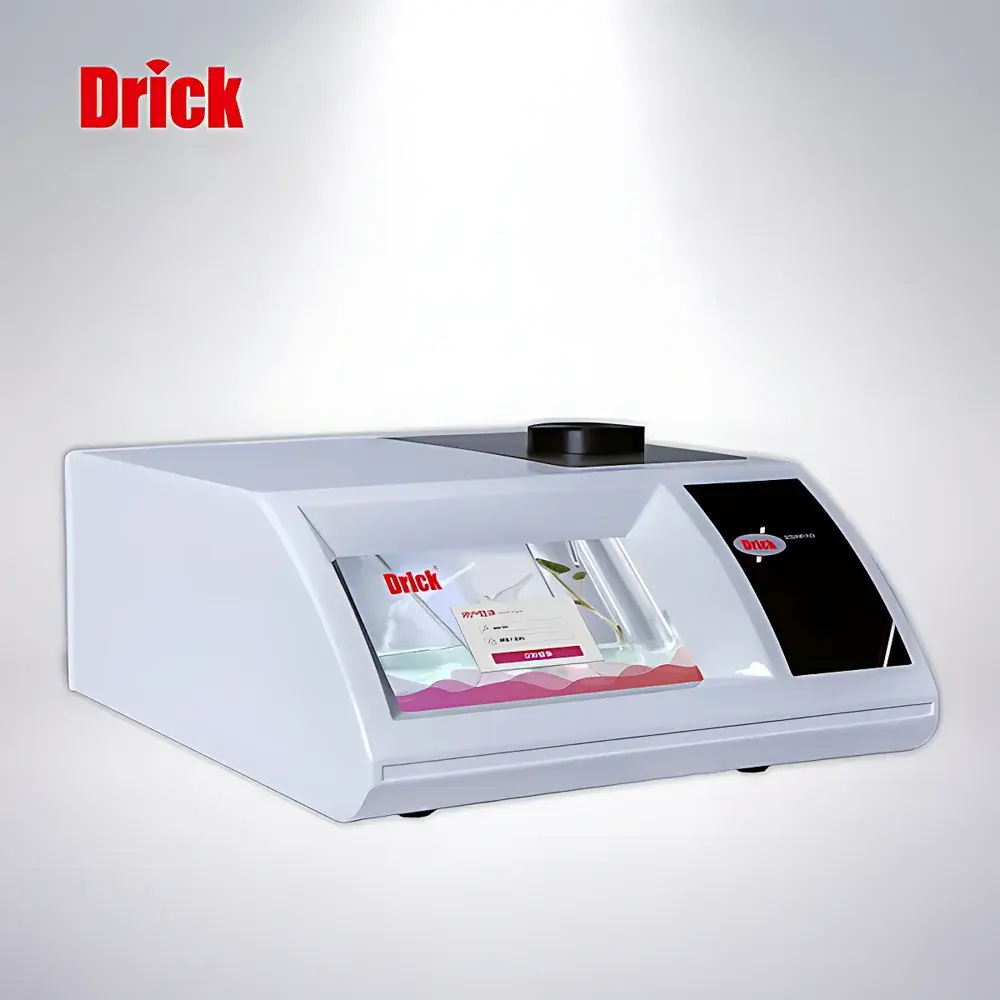
Drick DRK-Y85 Automated Digital Refractometer with Peltier Temperature Control
| Brand | Drick |
|---|---|
| Origin | Shandong, China |
| Manufacturer Type | Direct Manufacturer |
| Product Category | Domestic |
| Model | DRK-Y85 |
| Price Range | USD 11,200–14,000 (FOB) |
| Instrument Type | Benchtop Refractometer |
| Temperature Control | Integrated Peltier System (±0.1 °C stability) |
| Display | High-Resolution LCD with Real-Time nD Readout |
| Refractive Index Range | 1.30000–1.70000 (nD) |
| Accuracy | ±0.0001 nD |
| Repeatability | ±0.00005 nD |
| Sample Volume | ≤ 0.5 mL |
| Measurement Time | < 3 s per reading |
| Interface | RS-232 & USB-B for PC connectivity |
| Compliance | ISO 17025-compatible operation, ASTM D1218, ISO 2160, USP <781>, GLP-ready data logging |
Overview
The Drick DRK-Y85 Automated Digital Refractometer is a benchtop optical instrument engineered for high-precision measurement of refractive index (nD) across liquid and semi-liquid samples in quality control, R&D, and regulatory-compliant laboratories. It operates on the principle of total internal reflection at the prism-sample interface, where the critical angle of incidence is optically detected via a high-resolution CCD array and converted into a calibrated nD value using built-in reference algorithms traceable to NIST-traceable standards. The instrument integrates a thermoelectric (Peltier) temperature control system that maintains sample temperature within ±0.1 °C—critical for eliminating thermal drift in refractive index measurements, especially for temperature-sensitive formulations such as pharmaceutical syrups, fruit concentrates, and polymer solutions. Designed for routine analysis in food & beverage, pharmaceutical, chemical, and cosmetics industries, the DRK-Y85 delivers metrologically robust performance under ISO/IEC 17025-aligned workflows and supports audit-ready documentation for GLP and GMP environments.
Key Features
- Automated measurement cycle with single-button initiation and <3-second readout time
- Peltier-controlled prism block ensuring precise, programmable temperature regulation from 10 °C to 50 °C (±0.1 °C stability)
- High-accuracy nD measurement range of 1.30000–1.70000 with ±0.0001 nD accuracy and ±0.00005 nD repeatability
- 0.5 mL minimal sample requirement, reducing reagent consumption and enabling analysis of precious or limited-volume samples
- Backlit high-resolution LCD display with real-time nD, temperature, and status indicators
- RS-232 and USB-B interfaces supporting bidirectional communication with LIMS and laboratory data management systems
- Self-calibration function using certified reference fluids (e.g., distilled water, calibration oil)
- Robust stainless-steel housing with anti-static surface finish and IP20-rated enclosure for stable benchtop operation
Sample Compatibility & Compliance
The DRK-Y85 accommodates aqueous solutions, organic solvents, viscous liquids (e.g., honey, glycerol, syrup), emulsions, and low-turbidity suspensions—provided they are optically homogeneous and non-abrasive to the sapphire prism surface. Sample compatibility is validated per ISO 2160 (petroleum products), ASTM D1218 (hydrocarbon refractive index), and USP (refractometry in pharmaceutical excipients). The instrument’s firmware and data handling architecture support ALCOA+ principles: attributable, legible, contemporaneous, original, accurate, complete, consistent, enduring, and available. Audit trails, user access levels, and electronic signature capability (via optional software module) align with FDA 21 CFR Part 11 requirements when deployed in regulated manufacturing settings.
Software & Data Management
The DRK-Y85 is compatible with Drick’s proprietary RefraLink Pro v3.2 software (Windows 10/11, 64-bit), enabling method storage, batch reporting, statistical process control (SPC) charting, and export to CSV, PDF, or XML formats. All measurements include embedded metadata: timestamp, operator ID, temperature, nD value, instrument serial number, and calibration status. Data integrity safeguards include write-protected archives, automatic backup to network drives, and configurable retention policies. Software logs support full traceability for internal audits and external inspections under ISO 9001, ISO 13485, or ICH Q7 frameworks.
Applications
- Concentration determination of sucrose, glucose, fructose, and other soluble solids in food & beverage QC (Brix correlation per ICUMSA Methods)
- Quality verification of pharmaceutical excipients (e.g., propylene glycol, glycerin, polysorbates) per USP monographs
- Batch release testing of antifreeze coolants, brake fluids, and hydraulic oils per SAE J1940 and ISO 6743
- Monitoring polymerization degree in resin synthesis via nD trend analysis
- Verification of cleaning agent concentration in CIP validation protocols
- Stability studies involving thermal-induced refractive shifts in ophthalmic solutions
FAQ
What temperature control range does the DRK-Y85 support, and how is stability ensured?
The Peltier module regulates prism temperature from 10 °C to 50 °C in 0.1 °C increments, with closed-loop feedback maintaining ±0.1 °C stability over 30 minutes.
Is the instrument compliant with FDA 21 CFR Part 11 for electronic records?
Out-of-the-box, the DRK-Y85 meets technical prerequisites; full Part 11 compliance requires RefraLink Pro v3.2 with enabled audit trail, role-based access, and electronic signature modules.
Can the DRK-Y85 measure turbid or particulate-laden samples?
It is not recommended for highly turbid or suspended-particle samples, as scattering degrades critical angle detection; centrifugation or filtration is advised prior to analysis.
What calibration standards are required for daily verification?
Distilled water (nD = 1.3330 at 20 °C) and certified refractive index oil (e.g., nD = 1.4850 ±0.0001) are sufficient for two-point verification before each analytical session.
Does the instrument support custom Brix or concentration conversion tables?
Yes—RefraLink Pro allows import of user-defined polynomial or lookup-table correlations for non-sucrose matrices (e.g., dextrose, maltose, sodium chloride).






