
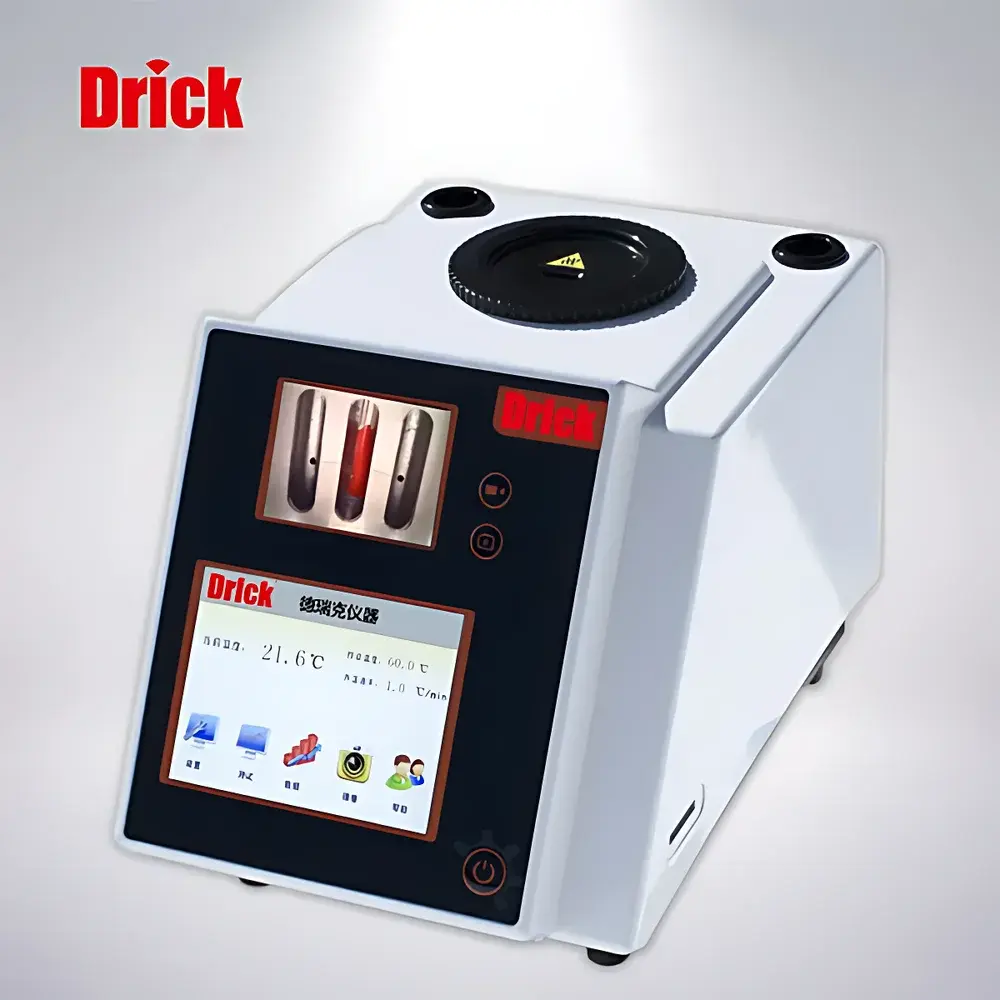
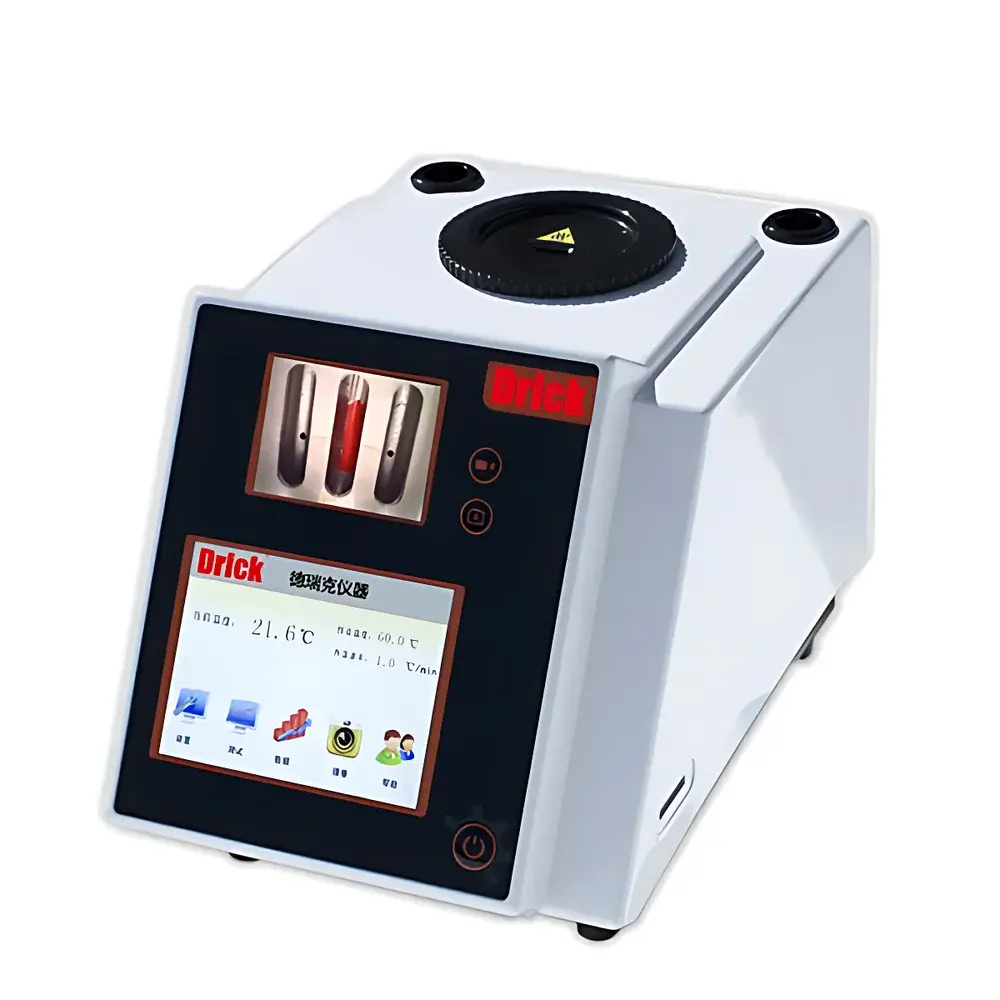
Drick DRK-QD400 Fully Automated Video Drop Point & Softening Point Analyzer
| Brand | Drick |
|---|---|
| Origin | Shandong, China |
| Manufacturer Type | Direct Manufacturer |
| Country of Origin | China |
| Model | DRK-QD400 |
| Temperature Range | Ambient to 350 °C |
| Heating Rate | 0.1–20 °C/min (200-step infinitely variable) |
| Temperature Repeatability | ±0.1 °C at 0.1 °C/min |
| Temperature Accuracy | ±0.3 °C (<250 °C) |
| Capillary Tube Dimensions | OD φ1.4 mm, ID φ1.0 mm |
| Sample Capacity | 4 samples per batch |
Overview
The Drick DRK-QD400 Fully Automated Video Drop Point & Softening Point Analyzer is a precision thermal analysis instrument engineered for standardized determination of drop point (ASTM D3954, ISO 4625, GB/T 4507) and softening point (ASTM D36, ISO 306, GB/T 1535) of thermoplastic materials, waxes, bitumens, resins, greases, and pharmaceutical excipients. It employs real-time high-resolution video imaging coupled with programmable temperature control to objectively detect the onset of flow or deformation under controlled thermal ramping. Unlike manual capillary methods, the DRK-QD400 eliminates observer bias by applying digital image processing algorithms to identify the precise moment a sample begins to sag, drip, or collapse—ensuring traceable, auditable, and operator-independent results. Its dual-function design conforms to both ASTM and ISO thermal transition test protocols, making it suitable for QC laboratories operating under GLP, GMP, or ISO/IEC 17025 accreditation frameworks.
Key Features
- Fully automated video-based detection system with 5-megapixel industrial camera and LED backlighting for high-contrast sample imaging.
- Programmable heating rate from 0.1 to 20 °C/min in 0.1 °C increments, supporting method-specific thermal ramps required by ASTM D36 (ring-and-ball), ASTM D3954 (drop point), and ISO 306 (Vicat softening).
- Four independent capillary holders enabling parallel testing of up to four samples per run—reducing throughput time without compromising inter-sample thermal uniformity.
- Precision PID-controlled heating block with platinum RTD sensor and active cooling assist, delivering temperature stability ≤±0.05 °C over extended dwell periods.
- Compliant capillary geometry: standardized 1.4 mm OD / 1.0 mm ID borosilicate glass tubes meeting ASTM E2318 and ISO 4625 dimensional specifications.
- Integrated calibration verification routine with NIST-traceable reference standards (e.g., pure indium, tin, and zinc) for periodic accuracy validation.
Sample Compatibility & Compliance
The DRK-QD400 accommodates solid or semi-solid organic and inorganic materials including petroleum waxes, polyolefin hot-melt adhesives, rosin esters, asphalt binders, polymer pellets, and lipid-based pharmaceutical formulations. Sample preparation follows standardized procedures defined in ASTM D36 (for ring-and-ball softening point), ASTM D3954 (for drop point using capillary tube method), and ISO 4625 (drop point of lubricating greases). The instrument’s hardware and firmware architecture supports audit-ready operation in regulated environments: temperature logs are timestamped and digitally signed; all method parameters, raw video frames, and event-trigger timestamps are stored in an immutable binary archive compliant with FDA 21 CFR Part 11 requirements when paired with optional electronic signature software modules.
Software & Data Management
The analyzer operates via Drick ThermalSuite™ v3.2—a Windows-based application featuring intuitive workflow-driven interface, customizable test templates, and multi-level user access control (administrator, analyst, reviewer). All thermal profiles, video snapshots at critical transition points, and calculated endpoints are exported in CSV, PDF, and proprietary .DTS binary formats. Data integrity safeguards include automatic checksum generation, encrypted local storage, and optional network backup to secure NAS or LIMS integration via OPC UA or HL7-compatible API. Audit trail functionality records every parameter change, result override, or calibration action—including operator ID, timestamp, and justification field—meeting ISO/IEC 17025 clause 7.7 and GLP Principle 5 documentation requirements.
Applications
- Quality control of wax blends in candle and packaging industries where narrow softening point tolerances dictate performance consistency.
- Characterization of bituminous binders in road construction materials to verify compliance with EN 14023 and AASHTO M226 specifications.
- R&D screening of thermoplastic elastomers during formulation development, correlating softening behavior with molecular weight distribution.
- Pharmaceutical excipient qualification per USP and Ph. Eur. 2.2.17, particularly for lipid-based sustained-release matrices.
- Regulatory submission support for REACH dossiers requiring OECD TG 113-compliant softening point data.
FAQ
What international standards does the DRK-QD400 support out-of-the-box?
It natively implements ASTM D36, ASTM D3954, ISO 306, ISO 4625, GB/T 4507, and GB/T 1535 test methods with preloaded parameter sets and pass/fail logic.
Can the system be integrated into a laboratory information management system (LIMS)?
Yes—via configurable CSV export, OPC UA server mode, or custom RESTful API extension (available under enterprise license agreement).
Is video recording storage included, and what is the retention policy?
Internal SSD stores ≥10,000 test sessions with full video archives; retention duration is user-configurable and supports automatic overwrite policies aligned with internal SOPs.
Does the instrument require annual recalibration by a certified third party?
While not mandatory, Drick recommends biannual verification using NIST-traceable reference materials; full metrological recalibration is available through Drick-certified service centers in Shanghai, Guangzhou, and Hamburg.
How is temperature uniformity across the four sample positions validated?
Each capillary holder undergoes thermal mapping per ASTM E740 using micro-thermocouples; factory certificate confirms ΔT ≤0.2 °C across all positions at 100 °C and 250 °C setpoints.



