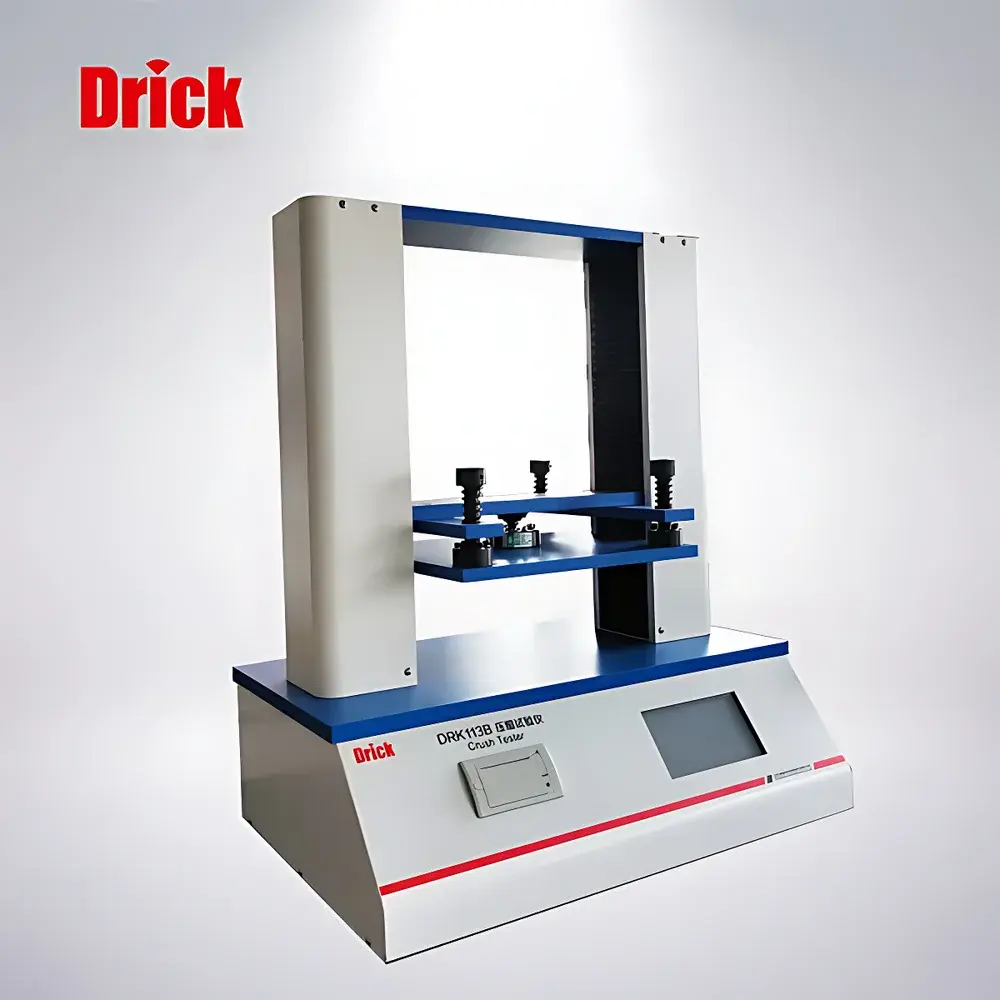
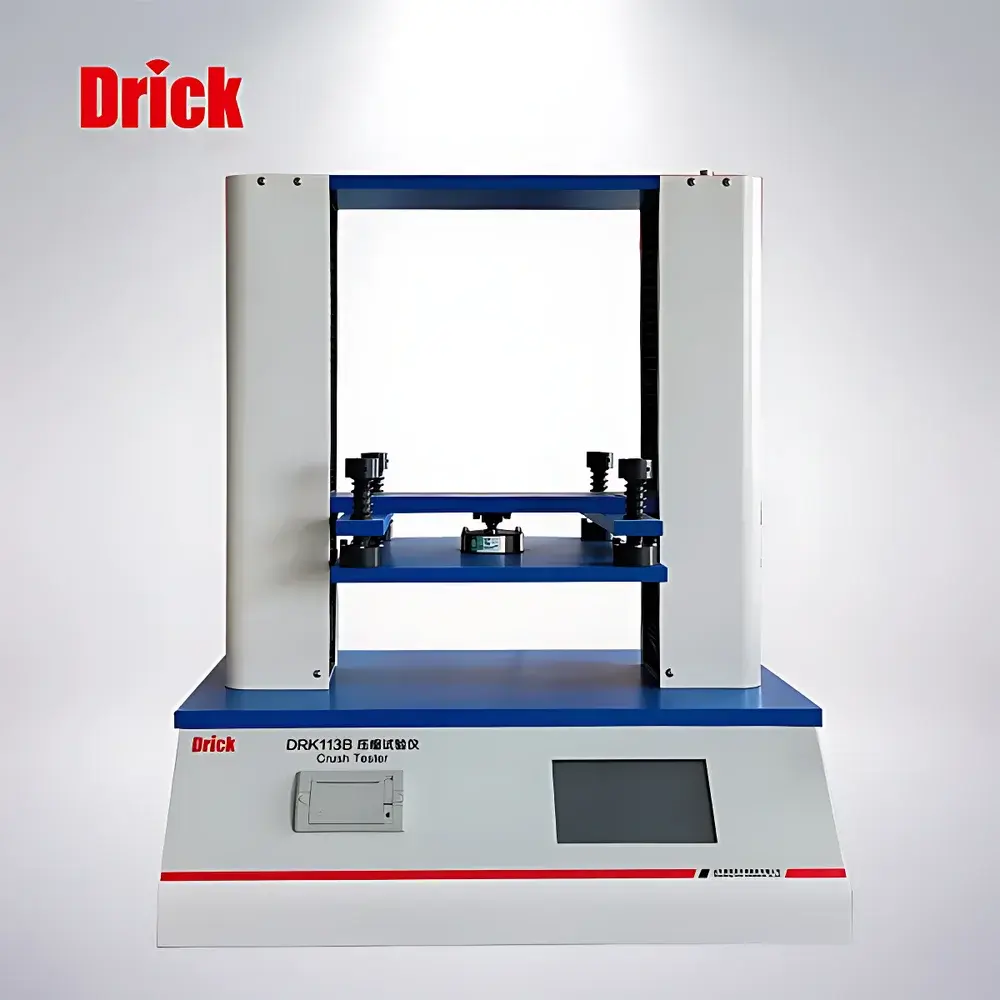
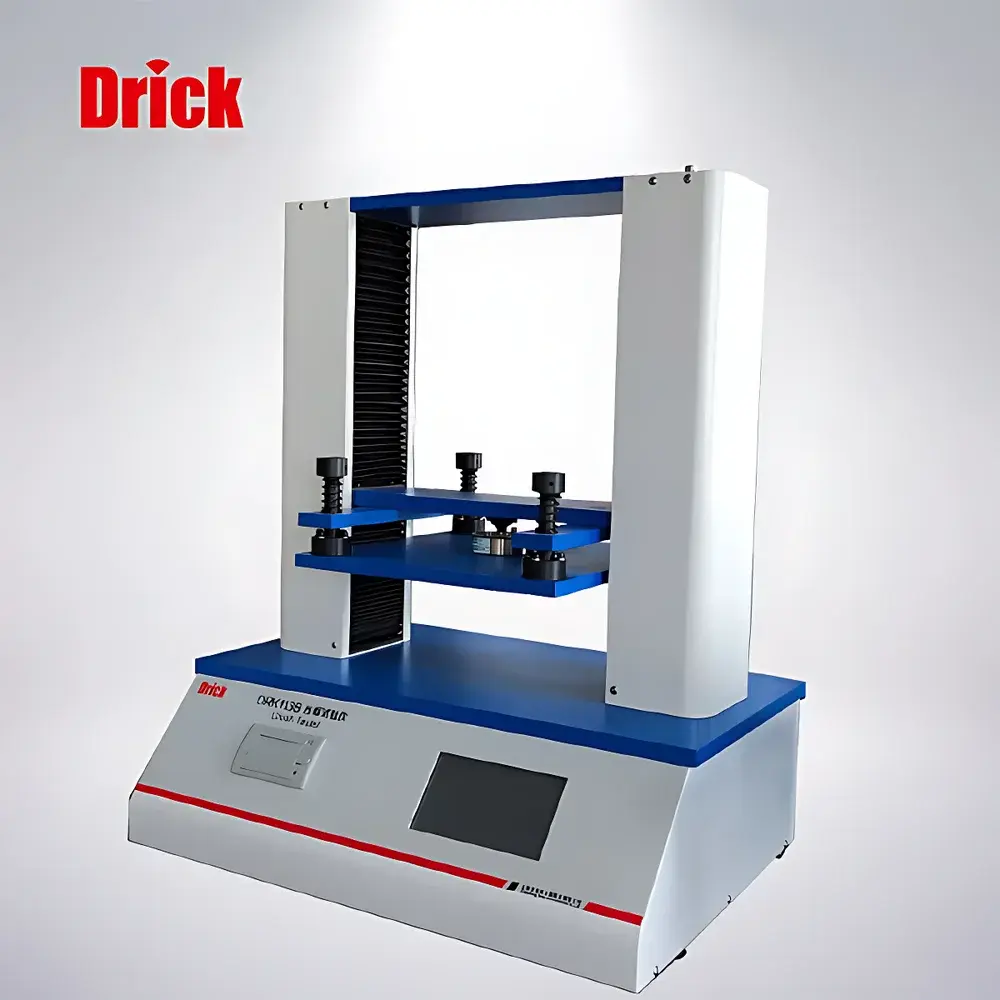
Drick DRK113 350 mm Compression Tester for Corrugated Box and Paper Container Testing
| Brand | Drick |
|---|---|
| Origin | Shandong, China |
| Manufacturer Type | Direct Manufacturer |
| Country of Origin | China |
| Model | DRK113 |
| Power Supply | AC 220 V ±10%, 2 A, 50 Hz |
| Indication Error | ±1% |
| Repeatability | <1% |
| Resolution | 0.1 N |
| Load Range | 5–5000 N |
| Platen Parallelism | ≤0.05 mm |
| Test Stroke | 1–300 mm |
| Test Speed | (12.5 ± 2.5) mm/min |
| Platen Size | 350 mm × 350 mm |
| Dimensions (W×D×H) | 770 mm × 350 mm × 1200 mm |
| Weight | 70 kg |
Overview
The Drick DRK113 350 mm Compression Tester is a precision-engineered mechanical testing instrument designed specifically for evaluating the compressive resistance and deformation behavior of corrugated fiberboard packaging, paper containers, and related lightweight structural materials. It operates on the principle of controlled axial loading under quasi-static conditions, conforming to standardized compression test methodologies defined in ISO 12048 (Packaging — Corrugated fibreboard — Determination of edge crush resistance), ASTM D642 (Standard Test Method for Determining Compressive Resistance of Shipping Containers), and GB/T 6543–2008 (Chinese national standard for corrugated boxes). The system integrates a robust dual-column frame architecture, high-stiffness load train, and microprocessor-based control with real-time force and displacement acquisition. Its 350 mm × 350 mm parallel platens ensure uniform stress distribution across large-area specimens such as full-size cartons or stacked samples—critical for replicating real-world stacking conditions encountered during warehousing and logistics.
Key Features
- High-accuracy load measurement system with ±1% indication error and 0.1 N resolution over a 5–5000 N range, enabling reliable quantification of both low-force cup/bowl collapse and high-load box stacking strength.
- Precision-machined 350 mm × 350 mm platens with parallelism maintained within ≤0.05 mm—essential for eliminating eccentric loading artifacts and ensuring compliance with ISO/ASTM platen flatness requirements.
- Adjustable crosshead speed of (12.5 ± 2.5) mm/min, aligned with standard test protocols for edge crush (ECT), flat crush (FCT), and container compression (CCT).
- Integrated LCD interface with Chinese-language display supporting parameter configuration, real-time curve plotting, data storage, unit conversion, and direct thermal printing—eliminating dependency on external PCs for routine QC operations.
- Modular accessory compatibility: supports interchange of platens and fixtures for CMT (Corrugated Medium Test), ring crush (RCT), and peel/adhesion evaluation when used with optional accessories including ring crush centering plates, edge crush sampling tools, and corrugated board delamination testers.
- Sturdy cast-iron base and reinforced steel frame deliver long-term dimensional stability and vibration damping—key for maintaining repeatability in high-volume production lab environments.
Sample Compatibility & Compliance
The DRK113 accommodates a broad spectrum of packaging substrates and geometries, including but not limited to: single- and double-wall corrugated boxes (up to 350 mm footprint), paper cups and bowls (diameter ≤350 mm), cylindrical paper tubes, small-diameter paper cores, honeycomb panels, and molded fiber trays. Its design enables direct implementation of standardized test methods referenced in ISO 3037 (edge crush test), ISO 7263 (ring crush test), and TAPPI T 811 (flat crush test). As a domestically manufactured instrument certified to GB/T standards, it meets essential electrical safety (GB 4793.1) and electromagnetic compatibility (GB/T 18268) requirements for laboratory equipment. While not inherently 21 CFR Part 11 compliant, its data logging functionality supports GLP-aligned documentation practices when paired with controlled procedural SOPs and manual audit trails.
Software & Data Management
The DRK113 employs embedded firmware—not PC-dependent software—ensuring deterministic response times and operational independence from operating system updates or driver conflicts. All test parameters (preload, target load, dwell time, speed, stop criteria) are programmable via the front-panel interface. Up to 100 test records—including peak load, deformation at yield, energy absorption, and full force–displacement curves—are stored internally with timestamp and operator ID tagging. Thermal printouts include sample ID, test date, method reference, and pass/fail status per user-defined thresholds. For integration into centralized LIMS or QA databases, exported CSV files can be generated via optional USB data transfer module (sold separately), preserving traceability without proprietary format lock-in.
Applications
This tester serves as a primary quality assurance tool across packaging R&D, production line validation, and third-party certification laboratories. Typical use cases include: verification of incoming corrugated board ECT/CCT performance prior to box fabrication; post-conversion validation of finished milk carton stack strength for dairy brands (e.g., Mengniu, Yili); comparative evaluation of alternative fiber blends or recycled content impacts on crush resistance; shelf-life stability assessment of paper-based food containers under simulated warehouse stacking loads; and failure mode analysis of crease-line integrity or corner buckling under vertical compression. Its adaptability to auxiliary fixtures also extends utility to adhesive bond strength screening and flute-specific compression modulus estimation.
FAQ
What standards does the DRK113 comply with for corrugated box testing?
It supports ISO 12048, ASTM D642, GB/T 6543–2008, and TAPPI T 811 through mechanical configuration and test speed calibration.
Can the DRK113 perform edge crush testing (ECT)?
Yes—when equipped with an edge crush sampling cutter and guide block, it measures ECT per ISO 3037 using the standard 15 mm × 100 mm specimen orientation.
Is calibration traceable to national metrology institutes?
Load cell calibration is performed using NIST-traceable deadweight standards; certificate of calibration is provided with each unit.
Does the instrument support automatic pass/fail judgment based on specification limits?
Yes—the threshold-based pass/fail logic is configurable per test program and printed directly on reports.
What maintenance is required to sustain measurement accuracy?
Annual verification of platen parallelism and load cell linearity is recommended; routine cleaning of guideways and lubrication of lead screws every 6 months ensures mechanical longevity.