
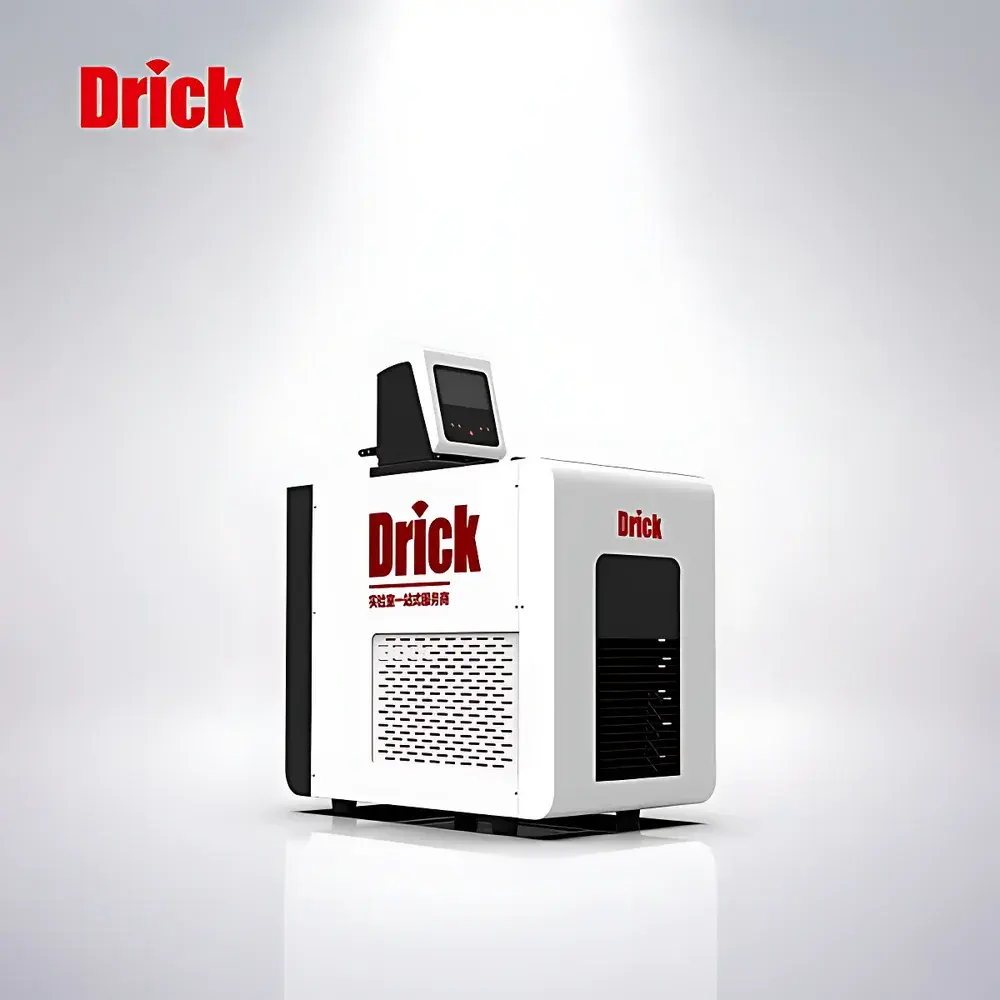
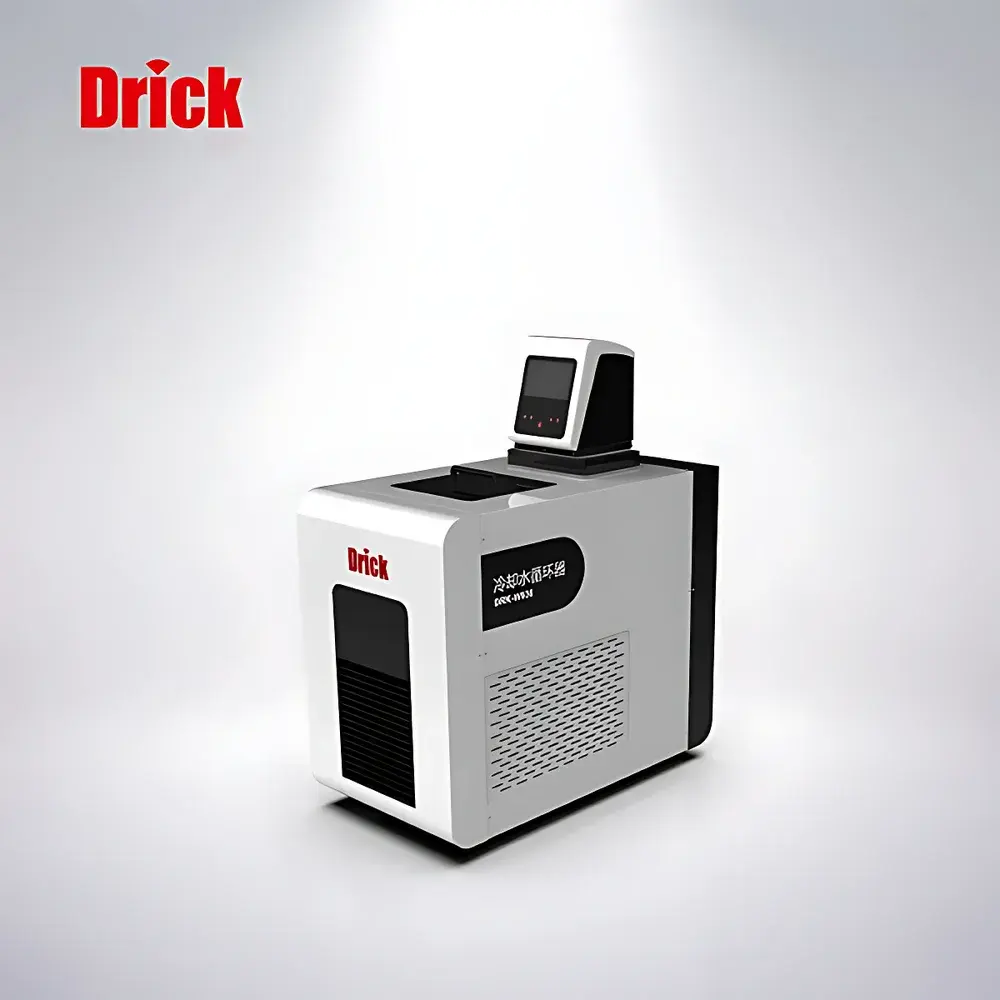
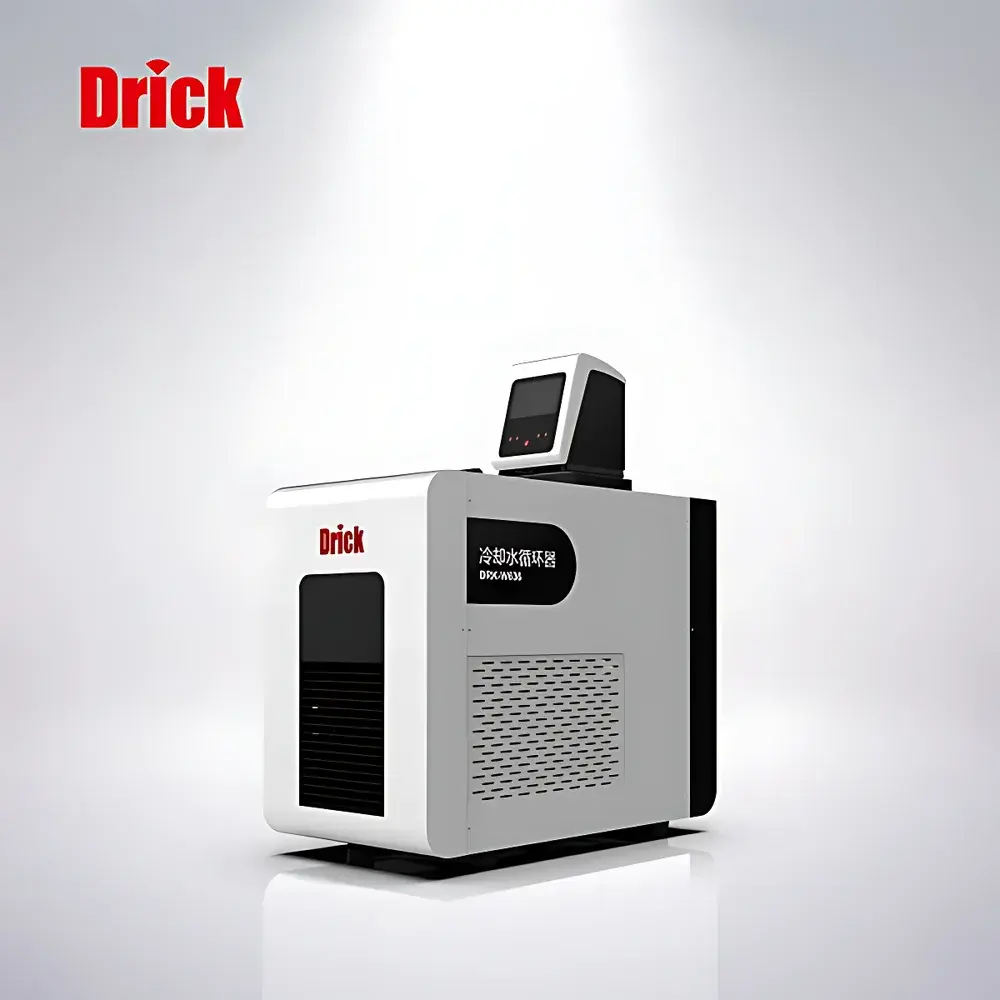
Drick DRK-W636 Compact Circulating Chiller
| Brand | Drick |
|---|---|
| Origin | Shandong, China |
| Manufacturer Type | Direct Manufacturer |
| Country of Origin | China |
| Model | DRK-W636 |
| Instrument Type | Integrated Unit |
| Cooling Method | Water-Cooled |
| Operating Principle | Compressor-Based Refrigeration |
| Temperature Control Range | 5°C to 100°C |
| Temperature Stability | ±0.05°C |
| Temperature Display Resolution | 0.1°C |
| Control Algorithm | Fuzzy PID |
| Temperature Sensor | PT100 |
| Heating Power | 2000 W |
| Refrigeration Capacity | 1500 W (at 20°C ambient) |
| Refrigerant | R134a |
| Pump Flow Rate | 10 L/min |
| Pump Pressure | 0.35 bar |
| Bath Volume | 10 L |
| Dimensions (L×W×H) | 555 × 350 × 750 mm |
| Power Supply | 220 V AC ±10%, 50 Hz |
| Ambient Operating Environment | 10°C to 25°C |
| Net Weight | 40 kg |
Overview
The Drick DRK-W636 Compact Circulating Chiller is an integrated, compressor-based temperature control system engineered for precision thermal management in laboratory and analytical environments. It operates on the principle of vapor-compression refrigeration—utilizing R134a refrigerant in a closed-loop cycle—to actively remove heat from process fluids. Simultaneously, its built-in electric heating element enables bidirectional temperature control across a wide operational range (5°C to 100°C), supporting both cooling and heating applications without external auxiliary units. The chiller circulates conditioned fluid via a sealed, magnetically coupled centrifugal pump delivering 10 L/min at 0.35 bar pressure, ensuring consistent flow under variable backpressure conditions typical in analytical instrumentation. Designed for direct integration with sensitive equipment—including atomic absorption spectrometers, ICP-MS systems, rotary evaporators, electrophoresis apparatus, and fermentation bioreactors—the DRK-W636 provides stable, uniform thermal environments essential for reproducible experimental outcomes and instrument longevity.
Key Features
- Integrated dual-mode thermal control: simultaneous compression-based cooling and resistive heating for precise setpoint attainment and maintenance.
- Fuzzy PID temperature regulation algorithm ensures rapid stabilization (<±0.05°C stability) and minimal overshoot during dynamic load changes.
- Corrosion-resistant 316 stainless steel bath tank formed via one-piece deep-drawing process—optimized for chemical compatibility and long-term durability.
- Hermetically sealed, brushless turbine pump with full electrical isolation (no water-contacting motor windings), rated for continuous operation at 10 L/min flow and 0.35 bar head pressure.
- 5.5-inch high-brightness color LCD display with intuitive menu navigation, real-time parameter visualization, and multilingual interface support (English default).
- Comprehensive safety architecture: overtemperature, low-level, overcurrent, high/low pressure, and dry-run protection with audible and visual alarm outputs.
- Modular front-access design with removable grille and drain valve—facilitating routine maintenance, bath cleaning, and fluid replacement without disassembly.
Sample Compatibility & Compliance
The DRK-W636 is compatible with aqueous solutions, glycol-water mixtures (up to 30% v/v), and other non-corrosive, non-viscous heat-transfer fluids commonly used in analytical and process laboratories. Its 316 stainless steel reservoir and internal wetted components meet material compatibility requirements for ISO 17025-accredited testing environments. While not certified to UL/CSA or CE for standalone medical device use, the unit conforms to IEC 61010-1:2010 safety standards for laboratory electrical equipment. Its temperature control performance supports GLP and GMP-aligned workflows where traceable, auditable thermal stability is required—particularly in method validation protocols governed by USP , ASTM E2877, and ISO 17025 clause 5.9.2.
Software & Data Management
The DRK-W636 operates autonomously via embedded firmware with no external PC dependency. All operational parameters—including setpoint, actual bath temperature, pump status, error logs, and alarm history—are stored in non-volatile memory with timestamped entries retained for ≥10,000 cycles. Optional RS485 Modbus RTU interface (standard on request) enables integration into centralized lab monitoring systems for remote setpoint adjustment, real-time telemetry, and automated event logging compliant with FDA 21 CFR Part 11 requirements when paired with validated SCADA software. Audit trail functionality includes user ID tagging (via optional password-protected access levels), change timestamps, and immutable record retention—supporting regulatory review in pharmaceutical QC and clinical research settings.
Applications
- Thermal stabilization of high-resolution spectroscopic instruments (AAS, ICP-OES/MS) to mitigate detector drift and wavelength calibration variance.
- Cooling condenser jackets in rotary evaporation and fractional distillation systems to maximize solvent recovery efficiency and prevent bumping.
- Temperature-controlled circulation for electrophoresis tanks, capillary electrophoresis modules, and microfluidic assay platforms.
- Process cooling in automated synthesis reactors and bioreactor jacket loops requiring ±0.1°C setpoint fidelity over extended runtimes.
- Calibration support for viscometers, rheometers, and DSC instruments where thermal gradient minimization directly impacts measurement repeatability.
- Environmental simulation in food science labs (e.g., accelerated shelf-life testing) and polymer characterization studies requiring programmable ramp-and-soak profiles.
FAQ
What is the maximum allowable ambient temperature for continuous operation?
The DRK-W636 is rated for uninterrupted service only within an ambient range of 10°C to 25°C. Operation above 25°C may compromise refrigeration capacity and trigger thermal overload protection.
Can the unit be used with ethylene glycol solutions?
Yes—up to 30% (v/v) ethylene glycol/water mixtures are supported; higher concentrations increase viscosity and reduce heat transfer efficiency, potentially affecting pump performance and temperature uniformity.
Is the PT100 sensor calibrated and traceable to NIST standards?
The factory-installed PT100 sensor is calibrated against reference standards traceable to national metrology institutes; full calibration certificate (including uncertainty budget) is available upon request at time of order.
Does the chiller support external temperature feedback from a sample probe?
No—the DRK-W636 regulates based solely on internal bath temperature. For sample-point control, a secondary external controller with cascade configuration is required.
What maintenance intervals are recommended for optimal performance?
Inspect coolant level and cleanliness every 3 months; replace heat-transfer fluid annually or after 2000 operating hours; clean condenser coils quarterly in dusty environments; verify pump seal integrity and sensor response annually using certified reference thermometers.



