
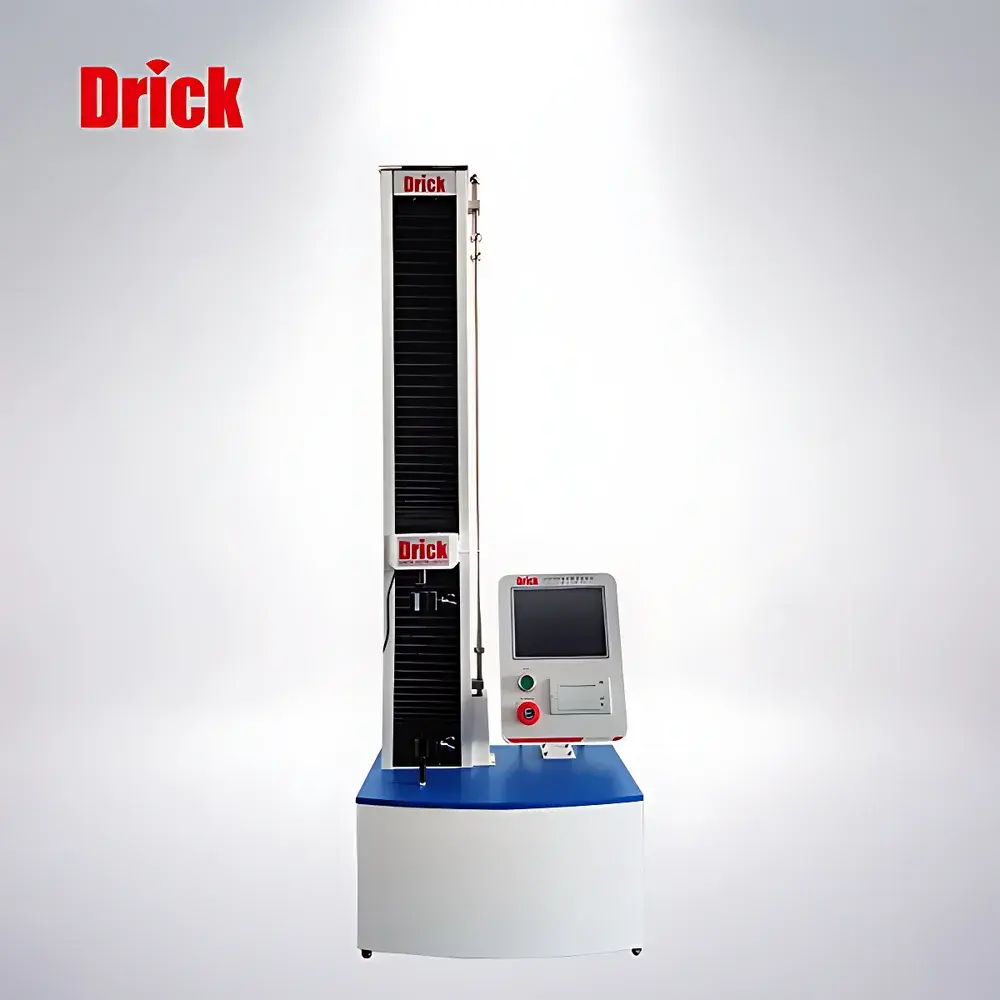
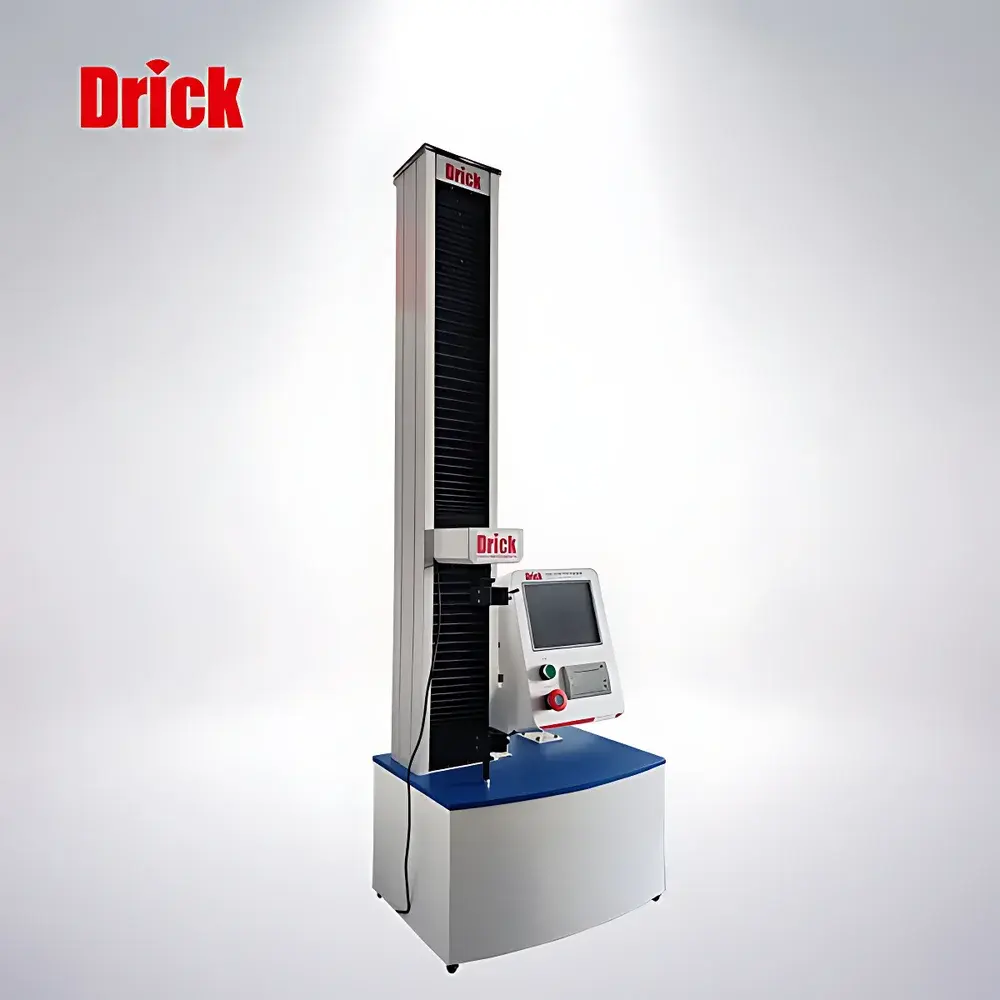
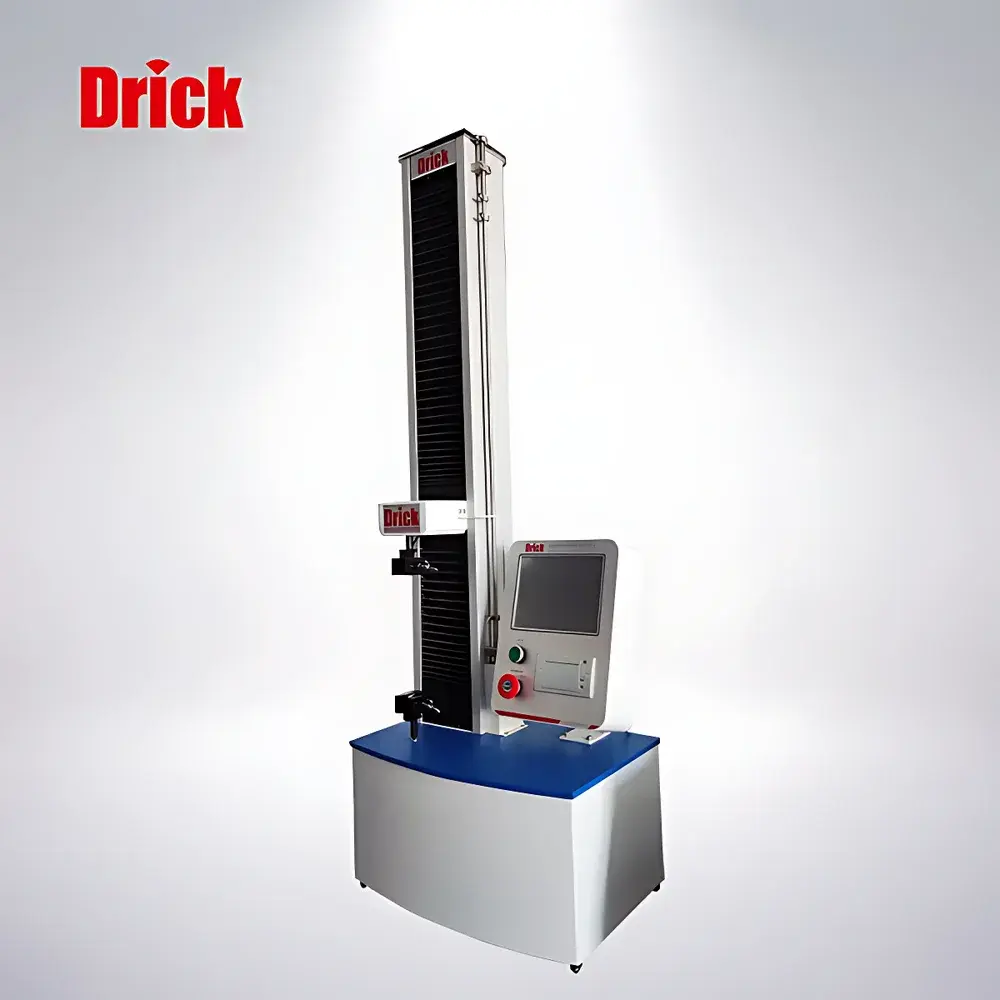
Drick DRK-101 Digital Tensile Testing Machine for Adhesive Tapes and Flexible Packaging Materials
| Brand | Drick |
|---|---|
| Origin | Shandong, China |
| Manufacturer Type | Original Equipment Manufacturer (OEM) |
| Model | DRK-101 |
| Instrument Type | Digital Tensile Testing Machine |
| Load Capacity | 0–5 kN |
| Force Accuracy | ±0.5% of reading |
| Test Speed Range | 1–500 mm/min |
| Effective Stroke | 700 mm (extendable to 1000 mm) |
| Displacement Accuracy | ±0.5% of reading |
| Data Output | Integrated thermal printer for test reports and stress–strain curves |
| Power Supply | AC 220 V, 50 Hz |
| Dimensions (W×D×H) | 550 × 450 × 1600 mm |
| Weight | 75 kg |
| Standard Configuration | Mainframe, digital controller, parallel jaw grips, branded industrial PC |
| Optional Accessories | A4 thermal printer, custom-designed grips (e.g., peel, shear, puncture, helical) |
Overview
The Drick DRK-101 Digital Tensile Testing Machine is an electromechanical force-testing system engineered for precision mechanical characterization of pressure-sensitive adhesives (PSAs), label stocks, flexible packaging laminates, and other thin, compliant materials. It operates on the fundamental principle of uniaxial tensile loading under controlled displacement rate, conforming to standardized test methods including ASTM D3330 (peel adhesion), ASTM D903 (bond strength), ASTM D882 (tensile properties of thin plastic sheeting), ISO 11339 (peel resistance of adhesive tapes), and GB/T 2792 (Chinese national standard for peel strength of pressure-sensitive tapes). The machine employs a high-resolution load cell with 5 kN full-scale capacity and closed-loop servo control to maintain constant crosshead velocity during testing—critical for reproducible determination of yield point, elongation at break, modulus, and peel initiation force.
Key Features
- High-accuracy dual-channel measurement architecture: simultaneous acquisition of load (±0.5% FS accuracy) and displacement (±0.5% reading accuracy) with 16-bit ADC resolution.
- Adjustable crosshead speed range from 1 mm/min to 500 mm/min, programmable in 0.1 mm/min increments—enabling compliance with low-speed peel (e.g., 300 mm/min per ASTM D3330) and high-speed tensile protocols.
- Modular grip interface supporting interchangeable fixtures: standard parallel-jaw clamps for tensile tests, 180° peel fixtures (with fixed-angle anvil), T-peel adapters, and optional shear or loop-tack configurations.
- Integrated thermal printer provides immediate hardcopy output of raw data tables, stress–strain curves, peak load annotations, and statistical summaries (n ≥ 3).
- Rigid C-frame construction with reinforced aluminum alloy uprights and precision-ground ball screws ensures minimal frame compliance and long-term calibration stability.
- Dedicated industrial PC preloaded with DrickTest v4.2 software—compliant with GLP documentation requirements, supporting user-defined test templates, audit trails, and electronic signature capability per FDA 21 CFR Part 11 (when configured with domain authentication and role-based access control).
Sample Compatibility & Compliance
The DRK-101 accommodates specimens ranging from 5 mm wide adhesive strips to 30 mm wide composite films and nonwovens. Its optimized stroke (700 mm standard; 1000 mm optional) supports both short-gauge-length tensile measurements (per ISO 527-3) and extended peel tests requiring large deflection. All mechanical components meet RoHS Directive 2011/65/EU material restrictions. The system supports traceable calibration via NIST-traceable force standards and is compatible with third-party accreditation to ISO/IEC 17025:2017 for testing laboratories. Routine verification follows ISO 7500-1 (static calibration of force-proving instruments) and ISO 9513 (extensometer verification).
Software & Data Management
DrickTest v4.2 delivers intuitive workflow management—from method setup and real-time curve monitoring to post-test analysis. Users define multi-step test sequences (pre-load hold, ramp-to-load, dwell, return), apply automatic yield detection algorithms (0.2% offset method), and export results in CSV, PDF, or XML formats. Audit logs record operator ID, timestamp, parameter changes, and raw data checksums. Data integrity safeguards include write-once storage mode, encrypted database backups, and configurable retention policies aligned with GMP Annex 11 and EU GMP Chapter 4 requirements.
Applications
- Quantitative peel adhesion evaluation of facestock–liner interfaces in self-adhesive labels.
- Tensile strength and elongation profiling of BOPP, PET, and metallized CPP films used in food packaging.
- Shear resistance assessment of acrylic and rubber-based PSAs under static load conditions (ASTM D3654).
- Loop tack and probe tack testing when equipped with optional spherical or flat probe fixtures.
- Mechanical screening of medical tape substrates (e.g., polyurethane foams, silicone-coated papers) per ISO 2555 and USP .
- Quality control of textile-reinforced conveyor belts and technical geotextiles.
FAQ
What standards does the DRK-101 support out-of-the-box?
The system includes preconfigured test methods for ASTM D3330, ASTM D882, ISO 11339, GB/T 2792, and ISO 2555—with editable parameters to accommodate lab-specific SOPs.
Can the DRK-101 perform creep or stress-relaxation tests?
Yes—via custom protocol scripting in DrickTest v4.2, users can define time-dependent loading profiles, including constant-load holds (creep) and constant-strain dwells (stress relaxation), with automated data logging intervals down to 100 ms.
Is third-party calibration certification available?
Drick provides optional UKAS-accredited calibration certificates (traceable to NPL) upon request, including as-found/as-left reports and uncertainty budgets per ISO/IEC 17025.
How is data security managed for regulated environments?
When deployed on a Windows domain with Group Policy enforcement, the software supports 21 CFR Part 11 compliance through electronic signatures, role-based permissions, and immutable audit trails—validated using IQ/OQ documentation packages.
What maintenance is required for long-term accuracy?
Annual verification of load cell linearity and crosshead alignment is recommended; routine checks include grip jaw surface inspection, lubrication of lead screws, and thermal printer ribbon replacement—documented in the included Preventive Maintenance Logbook.



