
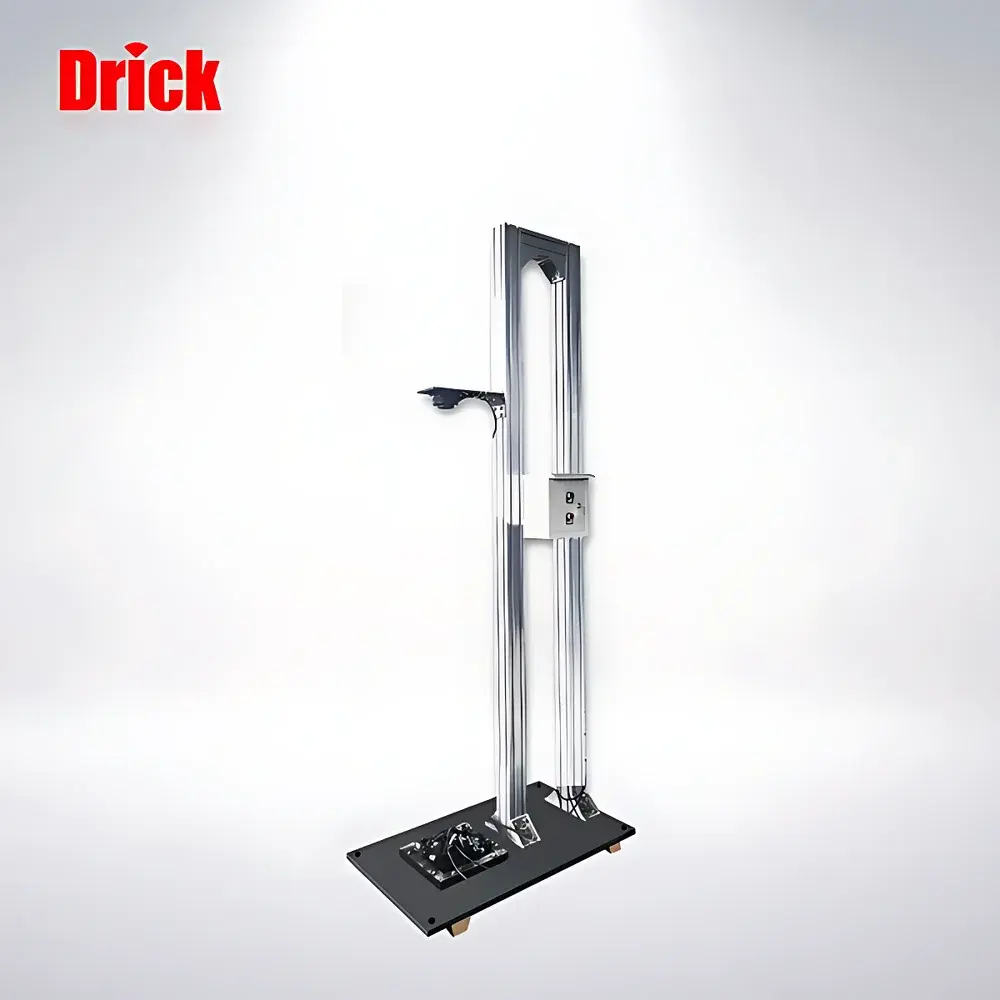
Drick DRK140 Stacked Laminate Large-Sphere Impact Tester
| Brand | Drick |
|---|---|
| Origin | Shandong, China |
| Manufacturer Type | Direct Manufacturer |
| Country of Origin | China |
| Model | DRK140 |
| Power Supply | 220/240 VAC @ 50 Hz or 110 VAC @ 60 Hz |
| Drop Height Range | Adjustable up to 2,500 mm (max) |
| Test Specimen Clamp Size | 270 mm × 270 mm |
| Base Plate | Solid Steel, 880 mm × 550 mm |
| Impact Sphere | 324 g ± 5.0 g, Ø 42.8 mm ± 0.2 mm |
| Release Mechanism | Electromagnetic Solenoid |
| Actuation | Foot Switch |
| Compliance | ISO 4586-2, EN 438-2:2005, AS/NZS 4266.27 (optional test module) |
Overview
The Drick DRK140 Stacked Laminate Large-Sphere Impact Tester is a precision-engineered mechanical impact testing system designed specifically for evaluating the resistance of high-performance laminated sheet materials—such as decorative high-pressure laminates (HPL), compact laminates, and engineered wood composites—to localized dynamic loading. It operates on the principle of controlled gravitational impact: a standardized steel sphere is released from a precisely adjustable height onto a horizontally clamped specimen, and the threshold height at which no visible indentation or surface damage occurs over five consecutive impacts is recorded as the material’s large-sphere impact resistance. This method directly correlates with real-world service conditions where laminates are subjected to accidental drops, tool contact, or mechanical handling stress. Unlike dart impact testers used for thin flexible films, the DRK140 employs a significantly heavier, larger-diameter sphere to simulate macro-scale impact events relevant to architectural, furniture, and transportation interior applications.
Key Features
- Robust structural frame with aluminum extrusion uprights and a solid steel base plate (880 mm × 550 mm) ensuring dimensional stability and vibration damping during repeated impact cycles.
- Electromagnetically actuated release mechanism with foot-switch control enables hands-free, repeatable sphere detachment—eliminating operator-induced variability in release timing or force.
- Adjustable vertical drop column with calibrated height scale (0–2500 mm) and locking vernier clamp allows precise, traceable height increments down to 1 mm resolution.
- Dedicated specimen clamping fixture (270 mm × 270 mm) with uniform pressure distribution ensures consistent boundary conditions across test samples, minimizing edge effects and improving inter-laboratory reproducibility.
- Standardized impact sphere: 324 g ± 5.0 g mass, 42.8 mm ± 0.2 mm diameter, manufactured from hardened stainless steel per ISO 4586-2 requirements—certified for hardness (≥ 60 HRC) and sphericity (≤ 0.02 mm deviation).
- Modular electrical architecture supports optional compliance upgrades, including AS/NZS 4266.27-compliant test modules and dual-voltage input (110 VAC / 220–240 VAC), facilitating global deployment without hardware modification.
Sample Compatibility & Compliance
The DRK140 accommodates rigid flat-sheet specimens up to 270 mm × 270 mm × 25 mm thick—including phenolic resin-bonded laminates, melamine-faced particleboard, aluminum composite panels (ACPs), and ceramic-coated metal sheets. All test procedures strictly adhere to ISO 4586-2 (Decorative laminates — High-pressure decorative laminates — Part 2: Determination of resistance to impact using a large sphere) and EN 438-2:2005 (Laminates — High-pressure decorative laminates — Part 2: Determination of resistance to impact). Optional AS/NZS 4266.27 test modules enable full conformance for Australian and New Zealand building product certification workflows. The instrument’s mechanical design and calibration protocol support GLP-compliant operation when integrated into quality control laboratories maintaining ISO/IEC 17025 accreditation.
Software & Data Management
While the DRK140 operates as a standalone mechanical tester, its height adjustment scale and pass/fail evaluation methodology are fully compatible with laboratory information management systems (LIMS) and electronic lab notebooks (ELN). Users may log impact height, number of successful impacts, and visual assessment outcomes (e.g., “no indentation”, “indentation < sphere diameter”, “crack formation”) in structured CSV or PDF test reports. For regulated environments, the device supports audit-trail documentation via external digital recorders or camera-based impact monitoring systems (not included). No proprietary firmware or embedded software is required—ensuring long-term maintainability and eliminating vendor lock-in risks associated with closed-platform instruments.
Applications
- Quality assurance of decorative laminates supplied to OEM furniture manufacturers and architectural fit-out contractors.
- Validation of impact performance claims under EU Construction Products Regulation (CPR) and CE marking pathways.
- R&D screening of new resin formulations, filler additives, or surface hardening treatments for improved dent resistance.
- Comparative benchmarking against competitive laminate grades during supplier qualification processes.
- Supporting technical documentation packages for LEED, BREEAM, or Green Star sustainability certifications where durability metrics influence point allocation.
FAQ
What standards does the DRK140 comply with by default?
ISO 4586-2 and EN 438-2:2005 are fully supported out-of-the-box. AS/NZS 4266.27 compliance requires installation of the optional test module.
Can the DRK140 test curved or non-planar laminates?
No—it is designed exclusively for flat, rigid specimens mounted on a horizontal plane. Curved or flexible substrates require alternative test methods such as ISO 6603-2 or ASTM D7192.
Is calibration certification provided with the instrument?
Yes—a factory-issued calibration certificate traceable to national metrology institutes (NMI) is included, covering height scale linearity, sphere mass, and diameter verification.
What maintenance is required to ensure long-term measurement consistency?
Annual verification of sphere geometry and hardness, plus inspection of electromagnet coil integrity and foot-switch response latency—both documented in the user manual’s preventive maintenance schedule.
Does the DRK140 meet FDA 21 CFR Part 11 requirements?
As a purely mechanical tester with no electronic data capture or user authentication, it does not fall under Part 11 scope; however, its output data may be entered into Part 11–compliant LIMS platforms.






