
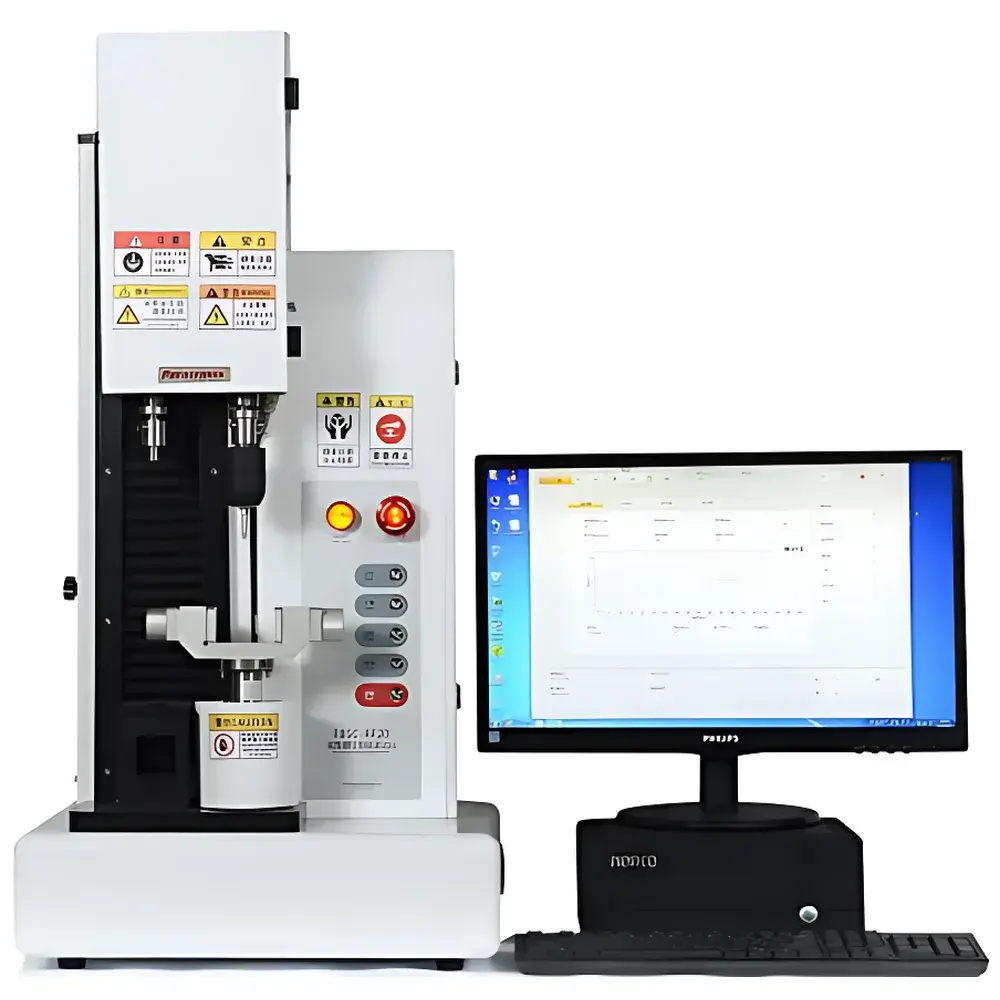
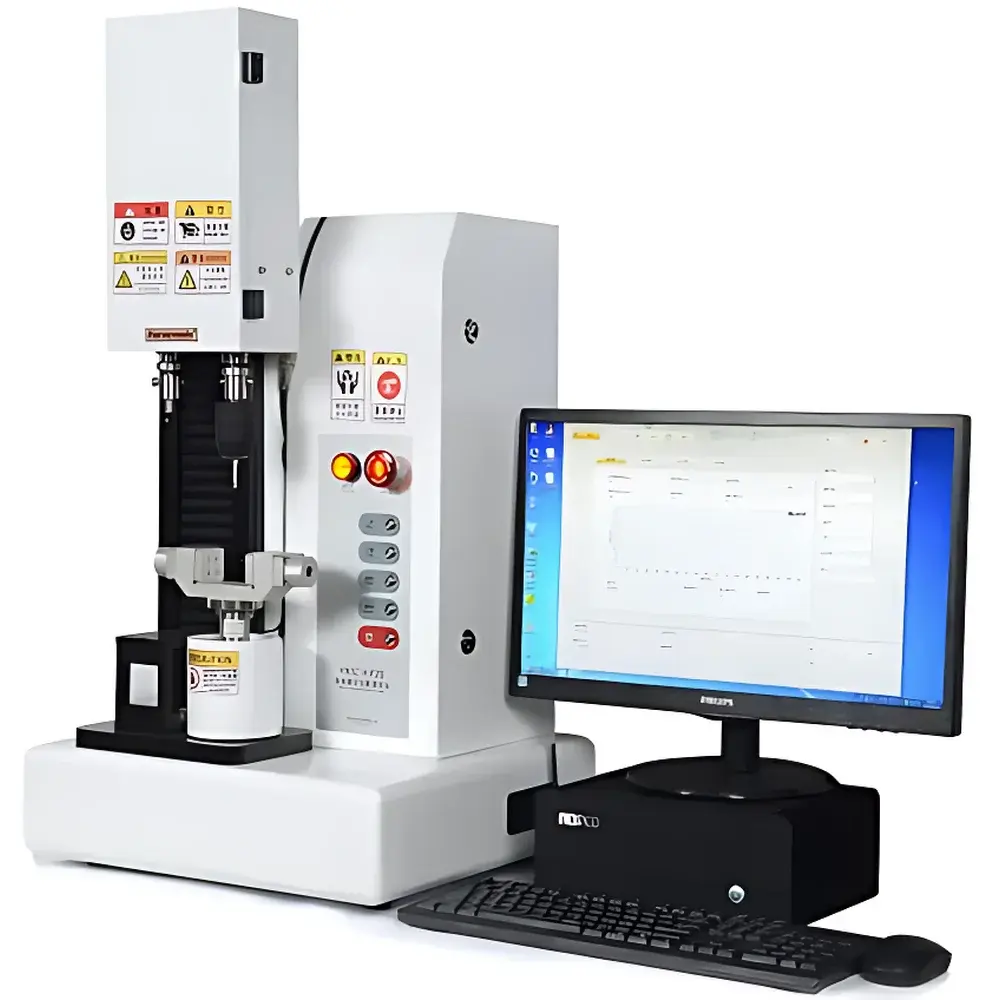
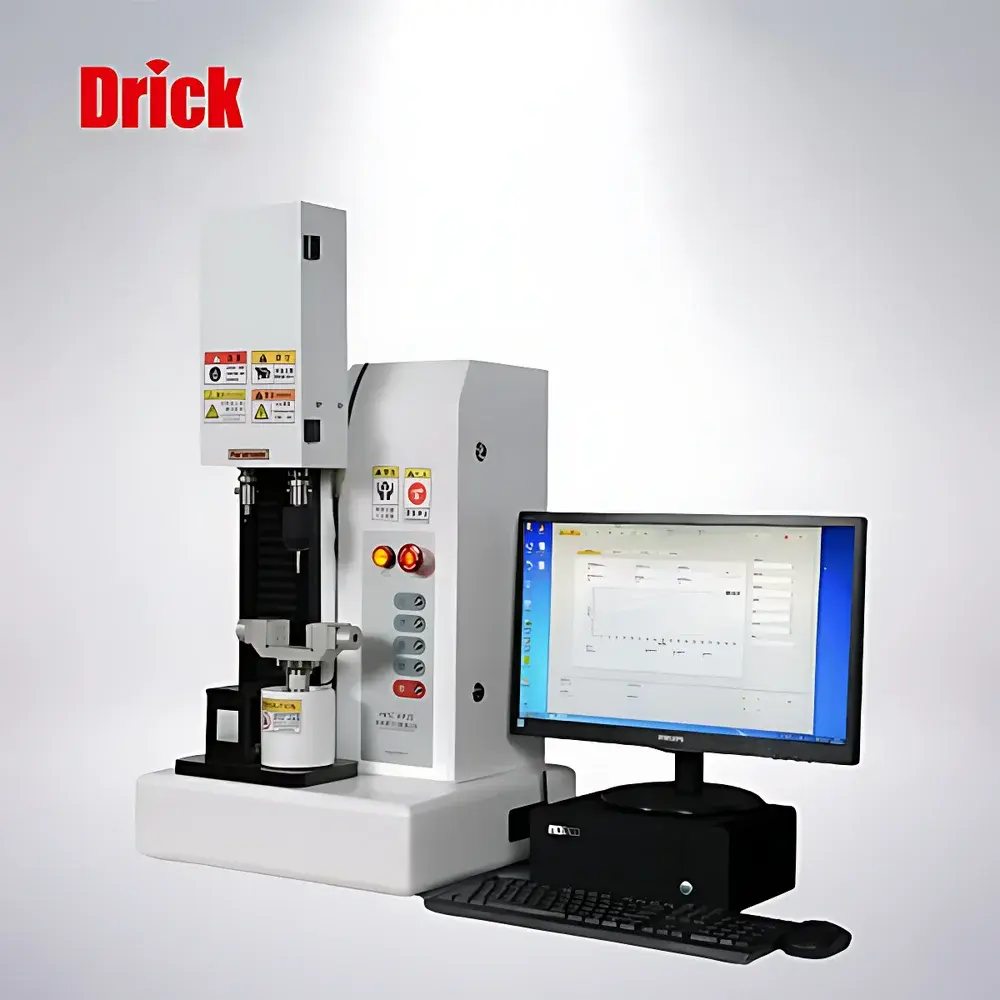
Drick RP-20 Orthopedic Bone Screw Performance Tester
| Brand | Drick |
|---|---|
| Origin | Shandong, China |
| Manufacturer Type | Direct Manufacturer |
| Product Category | Domestic |
| Model | RP-20 |
| Instrument Type | Electromechanical Tensile & Torque Testing System |
| Maximum Test Load | 50 kN |
| Force Measurement Range | 0–200 kgf (0–1.96 kN) |
| Force Accuracy Class | 0.5 |
| Stroke Travel | ≤300 mm |
| Displacement Resolution | 0.01 mm |
| Torque Measurement Range | 0–10 N·m |
| Test Speed | 1–300 mm/min (infinitely variable) |
| Dimensions (L×W×H) | 470 × 440 × 1000 mm |
| Weight | ~60 kg |
| Power Supply | AC 220 V ±10%, 50 Hz |
Overview
The Drick RP-20 Orthopedic Bone Screw Performance Tester is a dedicated electromechanical testing system engineered for the standardized mechanical evaluation of metallic bone screws used in orthopedic implant applications. It operates on dual-axis actuation principles—combining uniaxial tensile force control with coaxial rotational torque application—to simultaneously or independently assess critical performance parameters defined in ISO 5832-1, ASTM F565, and Chinese national standards YY 0018–2016, YY/T 1504–1506. Unlike general-purpose universal testers, the RP-20 integrates purpose-built fixtures, calibrated torque transducers, and synchronized motion control to replicate clinically relevant loading conditions—including axial pullout, self-tapping penetration, and insertion torque profiling—under repeatable, traceable, and audit-ready conditions.
Key Features
- Modular open-frame architecture with ergonomic access and tool-free fixture interchangeability for rapid transition between pullout, self-tapping, and torsional test modes.
- Precision micro-stepping motor drive system coupled with imported TBI ball screws, delivering smooth, low-noise actuation and positional repeatability within ±0.01 mm over full stroke (≤300 mm).
- High-sensitivity load cell (calibrated to 0.5 accuracy class per JJG 139–2014 / ISO 7500-1) and integrated torque sensor (0–10 N·m, resolution ≤0.02 N·m) mounted on a rigid, vibration-damped baseplate.
- Dual Panasonic servo motor control system with real-time closed-loop feedback for independent or coordinated linear/torsional motion profiles.
- Embedded industrial controller with bilingual (English/Chinese) GUI, preloaded test methods, automatic zeroing, and one-click execution of standardized protocols per YY/T 1504–1506.
- Built-in calibration verification routines compliant with ISO/IEC 17025 requirements—enabling third-party metrology labs to perform traceable field calibration without disassembly.
Sample Compatibility & Compliance
The RP-20 accommodates bone screws ranging from 2.0 mm to 6.5 mm nominal diameter, including cortical, cancellous, cannulated, and locking designs. Fixture sets conform to YY/T 1504 (axial pullout into synthetic bone blocks per ASTM F1839), YY/T 1505 (self-tapping resistance using standardized polyurethane foam layers), and YY/T 1506 (insertion torque measurement with torque-angle curve acquisition). All test sequences adhere to documented procedures required under China NMPA Class III implant regulatory submissions and support GLP-compliant data generation for FDA 510(k) and CE Mark technical files. The system meets electromagnetic compatibility (EMC) requirements per GB/T 18268.1–2010 and electrical safety standards per GB 4793.1–2007.
Software & Data Management
Control and analysis are performed via Windows-based software compatible with Windows 10/11 and Microsoft Office environments. The software supports automated report generation in PDF and Excel formats, with embedded metadata (operator ID, timestamp, environmental conditions, calibration status). Raw force/torque/time/displacement datasets are stored in ASCII-delimited .csv format for external statistical analysis (e.g., Minitab, JMP). Audit trail functionality logs all user actions—including method edits, calibration events, and result overrides—in accordance with FDA 21 CFR Part 11 requirements when configured with electronic signatures and role-based access control.
Applications
- Quantitative assessment of axial pullout strength in synthetic bone analogs (e.g., Sawbones® blocks) per YY/T 1504 and ASTM F565 Annex A2.
- Self-tapping performance evaluation—measuring peak torque, penetration work, and thread engagement stability during screw advancement into low-density foam substrates.
- Insertion torque profiling across full rotation cycles to identify yield points, thread stripping thresholds, and torque-angle hysteresis.
- Routine QC screening of incoming raw materials, in-process manufacturing lots, and final device release testing for ISO 13485-certified facilities.
- Supporting design verification (DV) and process validation (PV) activities for orthopedic implant manufacturers seeking regulatory clearance in APAC, EU, and North American markets.
FAQ
Does the RP-20 comply with international orthopedic testing standards beyond Chinese YY/T series?
Yes—it natively supports test logic aligned with ASTM F565, ISO 5832-1, ISO 6475, and EN 12010-1 through configurable parameter templates and calibrated transducer ranges.
Can the system export raw data for statistical process control (SPC) analysis?
Yes—time-stamped force, torque, displacement, and angle values are exported as comma-separated (.csv) files compatible with industry-standard SPC platforms.
Is third-party calibration supported without vendor intervention?
Yes—the built-in calibration verification module allows accredited metrology laboratories to validate force and torque channels using NIST-traceable reference standards per ISO/IEC 17025.
What is the maximum screw length accommodated by the standard pullout fixture?
The standard vertical configuration supports screws up to 120 mm in total length; extended-height fixtures are available upon request for longer implants.
Does the software provide pass/fail decision logic based on YY 0018–2016 acceptance criteria?
Yes—user-defined limits for minimum pullout force, maximum insertion torque, and self-tapping work thresholds can be programmed to trigger automatic pass/fail flags in reports.



