
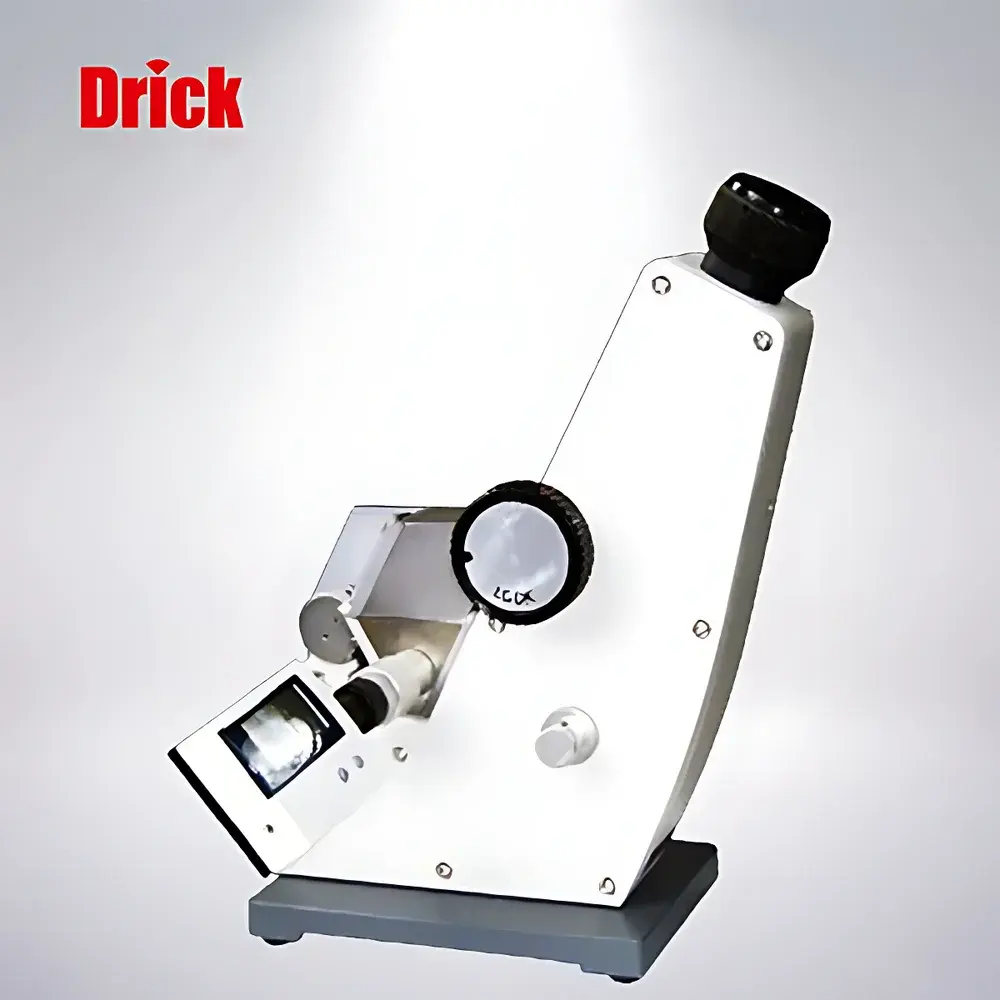
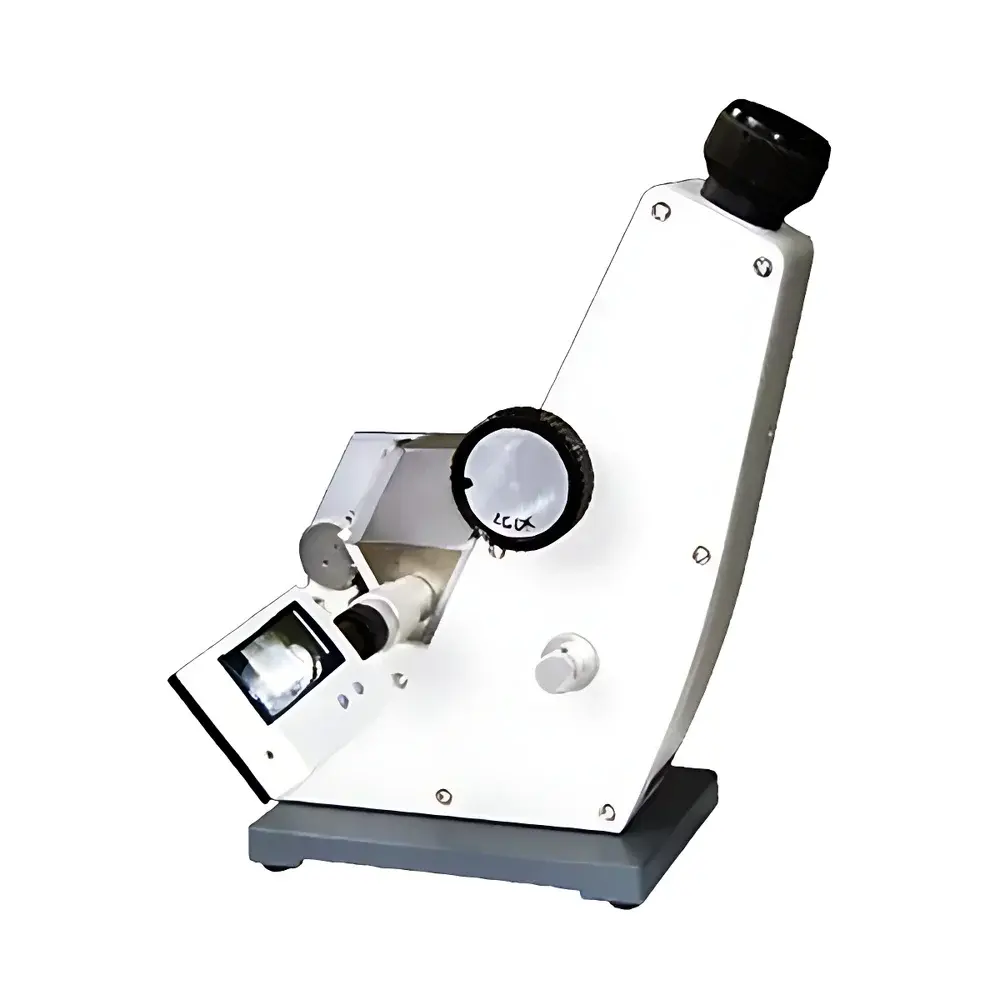
Drick DRK-WYA Abbe Refractometer
| Brand | Drick |
|---|---|
| Origin | Shandong, China |
| Manufacturer Type | Direct Manufacturer |
| Product Type | Benchtop Abbe Refractometer |
| Temperature Control | Yes |
| Digital Display | Yes |
| Refractive Index Range (nD) | 1.3000–1.7000 |
| Refractive Index Accuracy | ±0.0002 |
| Brix Range | 0–95% |
| Brix Resolution | 0.25% |
| nD Resolution | 0.0005 |
| Weight | 2.6 kg |
| Dimensions | 200 × 100 × 240 mm |
Overview
The Drick DRK-WYA Abbe Refractometer is a precision optical instrument engineered for the accurate determination of refractive index (nD) and mean dispersion (nF − nC) of transparent or translucent liquids and solids, as well as the quantitative measurement of soluble solids content—expressed as Brix (% w/w)—in aqueous sugar solutions. Based on the fundamental principle of total internal reflection at the prism-sample interface, the instrument employs a calibrated glass Abbe prism pair and collimated sodium D-line illumination (589.3 nm) to define the critical angle, which is directly correlated to the sample’s refractive index. This physical-optical relationship enables traceable, non-destructive, and rapid analysis without chemical reagents. Designed for routine quality control and research-grade applications, the DRK-WYA integrates mechanical robustness with metrological stability—making it suitable for environments requiring consistent repeatability under ambient or thermostatically controlled conditions.
Key Features
- Benchtop configuration with compact footprint (200 × 100 × 240 mm) and lightweight aluminum alloy housing (2.6 kg), optimized for laboratory bench space efficiency and long-term mechanical stability.
- Integrated temperature-controlled sample stage with Peltier-based regulation, enabling measurements at stabilized temperatures (typically 20 °C or 25 °C) to minimize thermal drift and ensure compliance with ISO 21542 and AOAC 932.12 reference conditions.
- Dual-scale optical eyepiece with simultaneous analog readout of nD (range: 1.3000–1.7000; resolution: 0.0005) and Brix (0–95%; resolution: 0.25%), supplemented by digital display for enhanced readability and operator consistency.
- High-precision Abbe prism assembly fabricated from optical crown glass (BK7), polished to λ/4 surface flatness, ensuring minimal wavefront distortion and high signal-to-noise ratio in critical angle detection.
- Manual focusing mechanism with fine-adjustment vernier scale, supporting precise alignment for both liquid films and solid samples (e.g., polymer sheets, optical glasses) via direct contact or immersion methods.
Sample Compatibility & Compliance
The DRK-WYA accommodates a broad spectrum of homogeneous, non-volatile, and optically clear samples—including sucrose, glucose, fructose, and invert sugar solutions; pharmaceutical syrups; fruit juice concentrates; glycerol-water mixtures; and low-viscosity organic solvents. It complies with standard methodologies referenced in ISO 21542:2021 (optical materials), AOAC Official Method 932.12 (Brix in beverages), and USP (Refractometry). While not inherently 21 CFR Part 11 compliant due to its analog-digital hybrid architecture, audit-ready documentation—including calibration certificates traceable to NIM (National Institute of Metrology, China) standards—and GLP-aligned operation logs can be maintained externally for regulated QC workflows in food, pharma, and chemical manufacturing.
Software & Data Management
The DRK-WYA operates as a standalone instrument with no embedded firmware or proprietary software suite. All measurements are recorded manually or via external lab notebooks. However, its digital display output (RS-232 optional interface available upon request) supports integration with third-party LIMS or Excel-based data capture systems using standard ASCII protocols. Calibration verification follows a two-point procedure using certified refractive index standards (e.g., distilled water at 20 °C: nD = 1.3330; bromonaphthalene: nD = 1.6580), with documented calibration intervals recommended every 6 months or per ISO/IEC 17025 internal audit schedules.
Applications
- Food & Beverage: Quantification of total soluble solids in raw cane juice, beet extract, soft drinks, honey, and jam formulations—supporting process optimization and shelf-life prediction.
- Pharmaceuticals: Verification of excipient concentration in oral solutions, syrups, and ophthalmic preparations per pharmacopoeial monographs (EP 2.2.2, USP ).
- Chemical Industry: Monitoring glycol concentration in heat-transfer fluids, ethylene glycol/water antifreeze blends, and polymerization reaction progress via refractive index trends.
- Academic Research & Teaching: Instructional use in physical chemistry labs for demonstrating dispersion relationships, partial molar volume estimation, and empirical correlations between nD and composition.
- Petrochemicals: Rapid screening of hydrocarbon mixture purity and aromatic/aliphatic ratio estimation where reference correlations exist.
FAQ
What is the wavelength of light used for nD measurement?
The instrument uses a built-in sodium D-line filter (589.3 nm) to ensure spectral consistency aligned with international refractive index conventions.
Can the DRK-WYA measure samples with suspended particles or high turbidity?
No—only optically homogeneous and non-scattering samples yield valid results. Centrifugation or filtration is required prior to analysis.
Is temperature compensation automatic or manual?
Temperature stabilization is active (Peltier-assisted), but compensation algorithms are not embedded; users must apply published nD-vs-T correction tables (e.g., ICUMSA Methods Book) for non-standard measurement temperatures.
Does the unit include calibration standards?
A set of two certified reference liquids (distilled water and bromonaphthalene) is optionally available—calibration verification is the user’s responsibility per ISO/IEC 17025 requirements.
What maintenance is required for long-term accuracy?
Daily prism cleaning with lens-grade tissue and anhydrous ethanol; annual verification of mechanical zero point and optical alignment by authorized service personnel.



