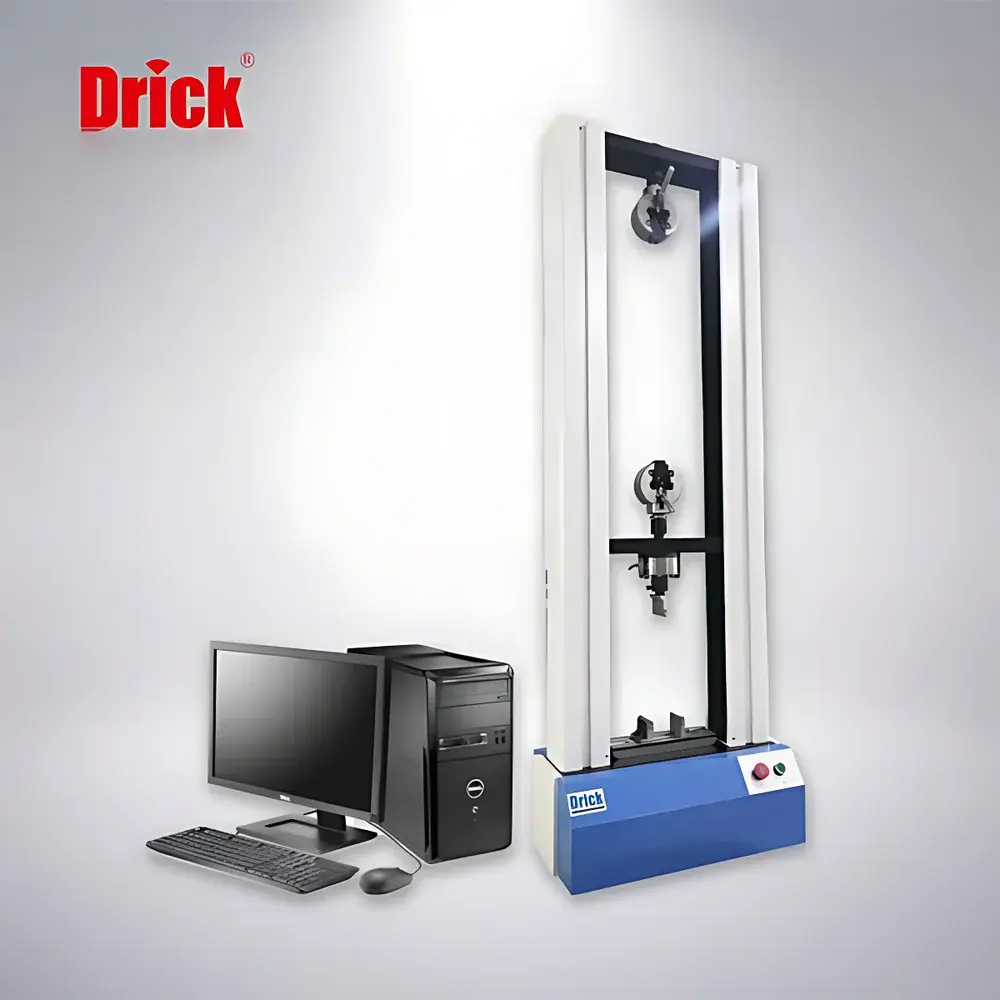
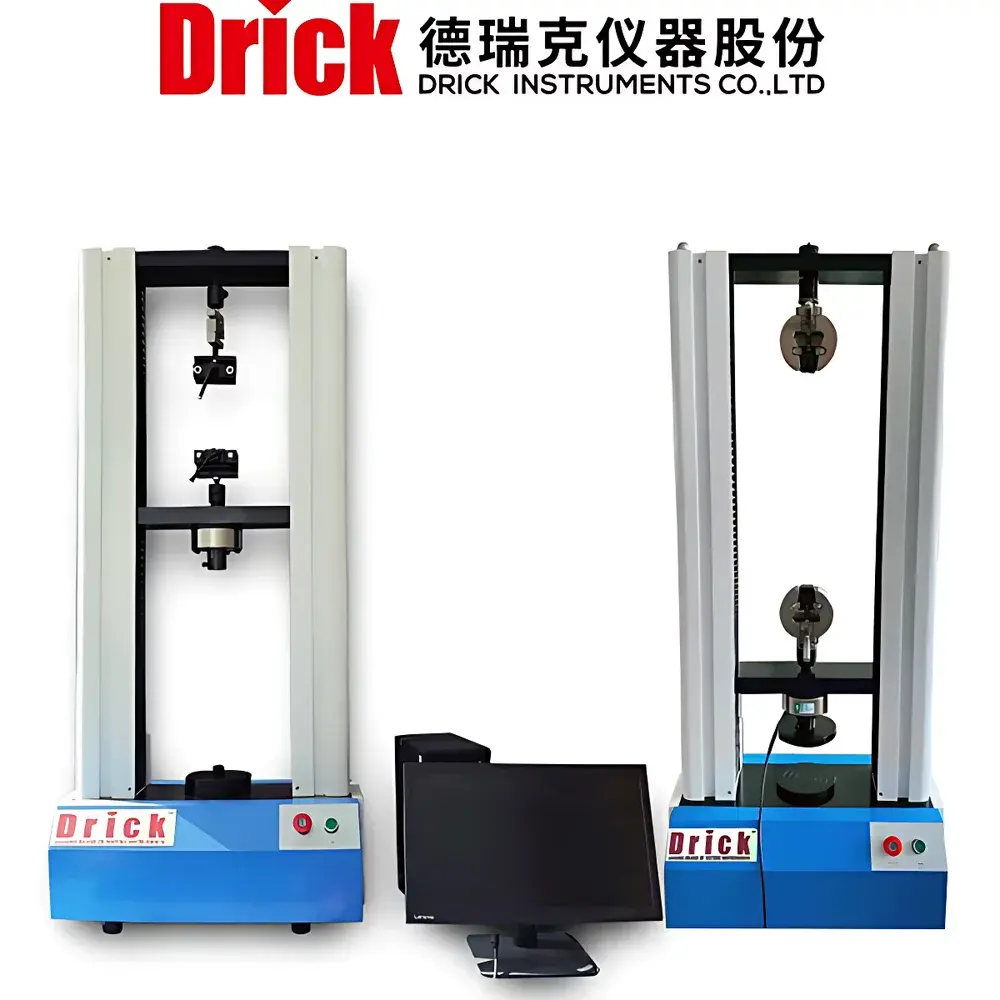
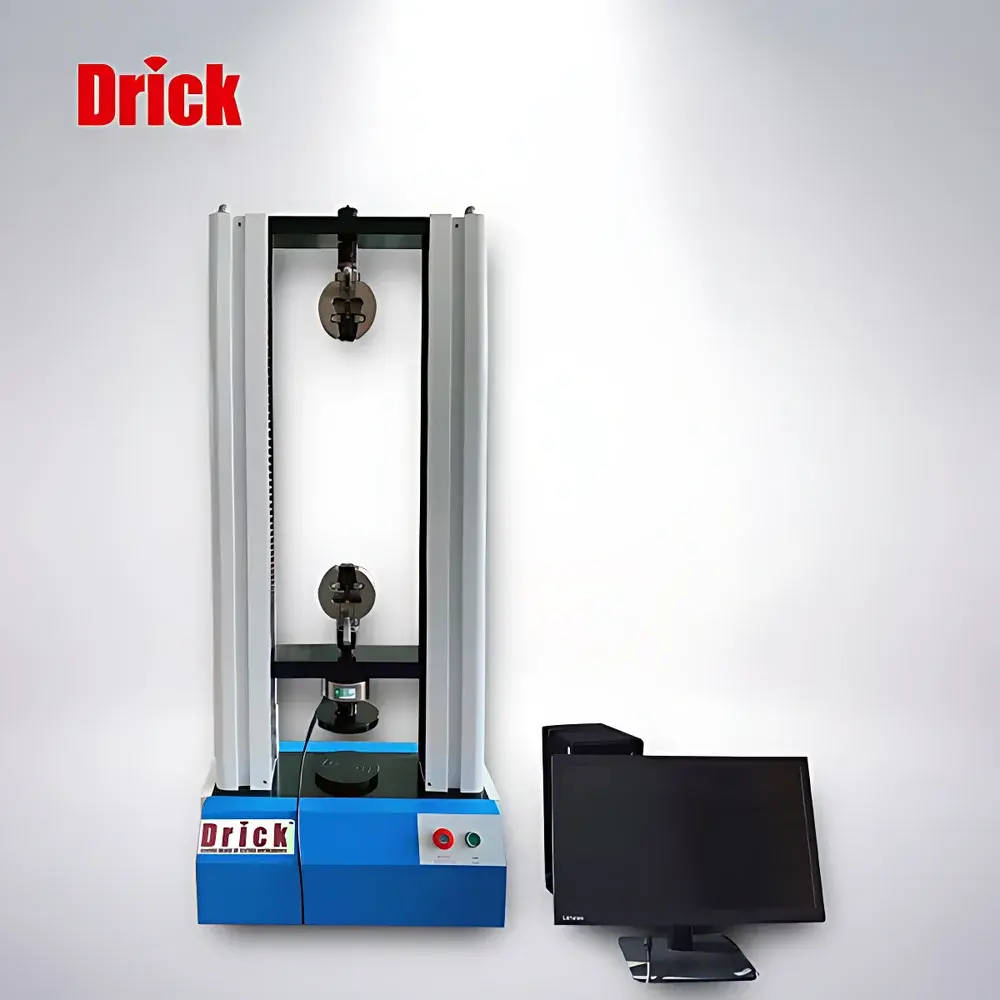
Drick DRK101 Microcomputer-Controlled Universal Testing Machine (≤20 kN)
| Brand | Drick |
|---|---|
| Origin | Shandong, China |
| Manufacturer Type | Direct Manufacturer |
| Product Origin | Domestic (China) |
| Model | DRK101 (≤20 kN) |
| Price | USD 7,000 (FOB Qingdao) |
| Load Capacity | Up to 20 kN |
| Force Range | 5 N – 20 kN (selectable) |
| Force Accuracy | ±1.0% of reading (or ±0.5% optional per customer specification) |
| Crosshead Speed | 0.1 – 500 mm/min (adjustable in 0.01 mm/min increments) |
| Effective Travel Distance | 600–900 mm (customizable) |
| Displacement Accuracy | ±0.5% of reading |
| Data Acquisition Rate | 50 Hz |
| Display | Large LCD with Chinese/English bilingual interface |
| Control System | Embedded microcomputer + servo motor drive |
| Force Sensor | High-precision load cell with 24-bit ADC (resolution up to 1:100,000,000) |
| Motion System | Precision preloaded ball screw assembly |
| Frame Finish | Zinc-plated + powder-coated steel |
| Dimensions (W×D×H) | 1100 × 785 × 2090 mm |
| Weight | 750 kg |
| Power Supply | AC 220 V, 50 Hz |
| Output | Thermal printer for real-time curve and statistical report (mean, SD, CV) |
Overview
The Drick DRK101 Microcomputer-Controlled Universal Testing Machine is an electromechanical static testing system engineered for precision mechanical characterization of polymeric, elastomeric, metallic, and composite materials under uniaxial loading conditions. Based on the fundamental principles of Hooke’s law and standardized force-displacement transduction, the DRK101 delivers repeatable tensile, compression, flexural, peel, tear, and shear measurements across a calibrated load range of 5 N to 20 kN. Its architecture complies with core mechanical testing standards including ISO 6892-1 (metallic tensile), ISO 527-1/-2 (plastics), ASTM D638/D790/D3039/D1876, and GB/T 228.1–2021. Designed for laboratory and quality control environments, the system integrates closed-loop servo control, high-resolution signal conditioning, and real-time kinematic feedback to ensure traceable, GLP-aligned test execution.
Key Features
- Structural rigidity: Heavy-duty welded steel frame with zinc plating and epoxy powder coating ensures long-term dimensional stability and corrosion resistance in industrial lab settings.
- Precision motion control: Preloaded recirculating ball screw transmission—selected over trapezoidal or acme screws—minimizes backlash and friction-induced hysteresis, enabling sub-micron positioning repeatability and superior load-path linearity.
- High-fidelity data acquisition: Dual-channel 24-bit analog-to-digital conversion (ADC) with 100 million-count resolution captures dynamic force and displacement signals at 50 Hz without aliasing or quantization error.
- Intelligent servo drive: Digital AC servo motor provides smooth acceleration/deceleration profiles, torque-synchronized speed regulation (0.1–500 mm/min), and automatic overload protection with emergency stop logic.
- Bilingual human-machine interface: 7-inch LCD display with intuitive menu navigation supports real-time plotting of F-t, F-δ, and F-L curves; built-in memory retains up to 100 test records with timestamp and operator ID tagging.
- Modular fixture ecosystem: Standard 30 mm parallel jaw clamps; optional 50 mm and 100 mm configurations; plus application-specific grips for films, fibers, adhesives, and profiled specimens per ISO 20753 and ASTM D882.
Sample Compatibility & Compliance
The DRK101 accommodates flat, cylindrical, and irregular specimens from diverse material classes—including thermoplastics (PP, PE, PET), elastomers (NR, SBR, silicone), fiber-reinforced composites, geotextiles, coated papers, and structural metals (aluminum alloys, stainless steel strips). Specimen thickness ranges from 0.05 mm (thin films) to 40 mm (rigid plates); widths up to 120 mm are supported within standard crosshead clearance. All mechanical outputs comply with ISO/IEC 17025 calibration traceability requirements when paired with accredited force calibration kits. The system meets electromagnetic compatibility (EMC) per IEC 61326-1 and safety standards per IEC 61010-1. While not inherently 21 CFR Part 11 compliant, audit trails, electronic signatures, and user access levels can be implemented via optional software modules aligned with GMP/GLP documentation workflows.
Software & Data Management
The embedded firmware supports real-time graphical rendering of stress-strain, load-extension, and creep-relaxation curves. Post-test analysis includes automatic yield point detection (0.2% offset method), modulus calculation (secant/tangent), elongation at break, and fracture energy integration. Export formats include CSV, PDF, and XML for LIMS integration. Statistical reporting generates mean values, standard deviation, coefficient of variation (CV%), and confidence intervals at 95% level. Thermal printer output includes raw data tables, annotated curves, and compliance metadata (test standard, specimen ID, environmental conditions). Optional PC-based software extends functionality with multi-curve overlay, batch processing, and automated report templating per internal SOPs or regulatory submission guidelines.
Applications
- Quality assurance of injection-molded plastic components per ISO 20753
- Tensile strength validation of rubber seals and gaskets in automotive OEM supply chains
- Peel adhesion testing of pressure-sensitive tapes per ASTM D3330
- Flexural modulus determination of PVC pipes per ASTM D2923
- Shear strength evaluation of structural adhesives per ASTM D1002
- Creep behavior analysis of thermoplastic elastomers under sustained load (ISO 899-1)
- Educational labs conducting ASTM D638-type experiments with full data traceability
FAQ
What is the maximum specimen height accommodated by the DRK101?
The effective vertical travel is configurable between 600 mm and 900 mm; maximum specimen height depends on grip length and extensometer clearance—typically up to 750 mm with standard fixtures.
Can the DRK101 perform cyclic loading tests?
No—the DRK101 is a static universal tester optimized for monotonic loading. For fatigue or dynamic testing, consider the DRK200 series with electrodynamic actuation.
Is third-party calibration certification included?
Factory calibration is performed using NIST-traceable deadweight standards. ISO/IEC 17025-accredited calibration certificates are available as a paid add-on service.
Does the system support extensometer integration?
Yes—both clip-on and non-contact video extensometers (with sub-pixel resolution) are compatible via analog voltage input or USB interface.
What operating system is required for optional PC software?
Windows 10 or 11 (64-bit), .NET Framework 4.8+, and minimum 4 GB RAM. No Linux or macOS support is provided.