
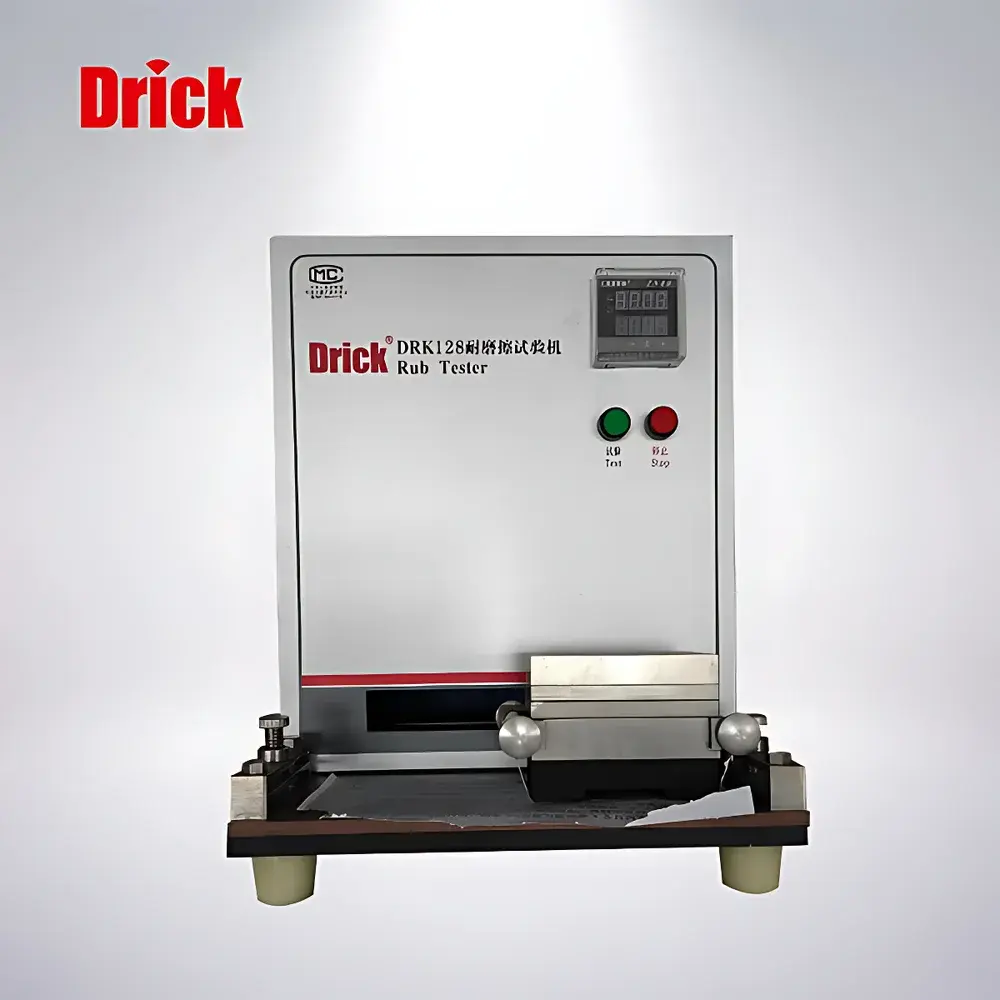
Drick DRK128 Print Rub Resistance Tester
| Brand | Drick |
|---|---|
| Origin | Shandong, China |
| Manufacturer Type | Direct Manufacturer |
| Model | DRK 128 |
| Friction Load | 20 ± 0.2 N |
| Friction Speed | 43 cycles per minute (cpm) |
| Friction Area | 155 mm (L) × 50 mm (B) |
| Adjustable Cycles | 1–9999 |
| Specimen Size | 230 mm (L) × 50 mm (B) |
| Power Supply | AC 220 V, 50 Hz |
| Dimensions | 260 mm × 245 mm × 340 mm |
| Net Weight | 17 kg |
| Compliance | GB/T 7706, ASTM D5264, JIS K5701, TAPPI T476 |
Overview
The Drick DRK128 Print Rub Resistance Tester is a precision-engineered tribological instrument designed specifically for evaluating the surface durability of printed materials and photosensitive plates under controlled mechanical stress. It operates on the principle of reciprocating linear abrasion—applying a defined normal load (20 ± 0.2 N) via a standardized friction head across a fixed specimen area (155 mm × 50 mm), at a consistent oscillation frequency of 43 cpm. This methodology replicates real-world handling, stacking, and transport conditions that induce ink rub-off, coating delamination, or emulsion wear—critical failure modes in commercial printing, packaging, and prepress plate manufacturing. Unlike generalized wear testers, the DRK128 is purpose-built to meet the geometric, kinematic, and metrological constraints outlined in GB/T 7706, ensuring traceable, inter-laboratory comparable results for quality assurance and process validation.
Key Features
- Calibrated friction load delivery system with ±0.2 N accuracy, maintaining constant normal force throughout test duration to ensure reproducible shear stress application.
- Embedded friction stage with rigid aluminum alloy construction and precision-machined guide rails, eliminating lateral drift and guaranteeing uniform contact pressure distribution over the full 155 mm travel path.
- Zero-noise operation achieved through synchronous stepper motor drive and low-backlash timing belt transmission—critical for vibration-sensitive environments such as metrology labs and cleanroom-adjacent QA facilities.
- Non-volatile cycle memory function retains programmed test parameters (including cycle count, load setting, and start/stop status) during unexpected power interruption, preserving data integrity and audit readiness.
- Digitally adjustable cycle range from 1 to 9999, supporting both rapid screening (e.g., 10–100 cycles for incoming inspection) and extended endurance testing (e.g., 5000+ cycles for PS plate qualification).
- Modular specimen holder accommodating standard 230 mm × 50 mm substrates—including offset prints, flexographic films, gravure laminates, and aluminum-based photopolymer plates—without clamping-induced edge deformation.
Sample Compatibility & Compliance
The DRK128 accepts flat, rigid, or semi-rigid sheet specimens up to 0.8 mm thickness, including coated paper, PET film, BOPP, aluminum PS plates, and UV-cured inkjet media. Its geometry and loading protocol are validated against internationally harmonized standards: GB/T 7706 (Chinese national standard for gravure ink rub resistance), ASTM D5264 (Standard Test Method for Rub Resistance of Ink Surfaces), JIS K5701 (Japanese Industrial Standard for printing ink durability), and TAPPI T476 (Rub Resistance of Printing Inks). The instrument’s mechanical design supports dry rub, wet rub (using standardized cotton swabs with controlled moisture content), and color transfer evaluation per ISO 105-X12 protocols. All test reports generated comply with GLP documentation requirements, including operator ID, environmental temperature/humidity logging (via optional external sensor integration), and timestamped cycle completion records.
Software & Data Management
The DRK128 operates via an embedded microcontroller interface with tactile keypad navigation and LED status display—designed for robustness in production-floor environments where touchscreen reliability is compromised by dust, solvents, or glove use. While standalone operation is fully functional, optional RS-232 or USB-to-serial connectivity enables integration into centralized LIMS or MES platforms. Exported data includes cycle count, elapsed time, pass/fail flag (based on user-defined visual assessment thresholds), and operator annotation fields. Audit trails adhere to FDA 21 CFR Part 11 principles when paired with compliant host software—supporting electronic signatures, change history, and locked report generation for regulated print certification workflows.
Applications
- Quantifying rub resistance of gravure, flexo, and offset inks during formulation development and supplier qualification.
- Evaluating wear life of photopolymer and diazo-based PS plates under simulated press-run conditions to predict plate longevity and optimize exposure/development parameters.
- Assessing coating adhesion on metallized films, barrier laminates, and pharmaceutical blister packaging where abrasion-induced pinhole formation compromises barrier integrity.
- Validating anti-scratch topcoats on digital print media subjected to automated sorting, bundling, and postal handling.
- Supporting root-cause analysis of customer complaints related to scuff marks, ink smearing, or image blurring in high-speed packaging lines.
- Enabling comparative benchmarking across ink systems, substrate treatments (e.g., corona vs. plasma), and curing technologies (UV, EB, thermal).
FAQ
What standards does the DRK128 directly support out-of-the-box?
The instrument’s mechanical configuration, load calibration, and motion profile are factory-verified to meet GB/T 7706, ASTM D5264, JIS K5701, and TAPPI T476 without hardware modification.
Can the DRK128 perform wet rub testing?
Yes—by inserting standardized dampened cotton swabs (per ASTM D5264 Annex A1) into the friction head assembly; no accessory kit is required.
Is temperature control available?
The base model operates at ambient laboratory conditions (15–25 °C); optional Peltier-cooled specimen stage modules are available for controlled-temperature rub testing down to 5 °C.
How is measurement traceability ensured?
Each unit ships with a NIST-traceable load calibration certificate (valid for 12 months), and friction speed is verified using optical tachometry prior to dispatch.
What maintenance is required?
Biannual lubrication of linear guides and annual verification of load cell linearity using certified deadweight standards—both procedures documented in the included GLP-compliant maintenance logbook.



