
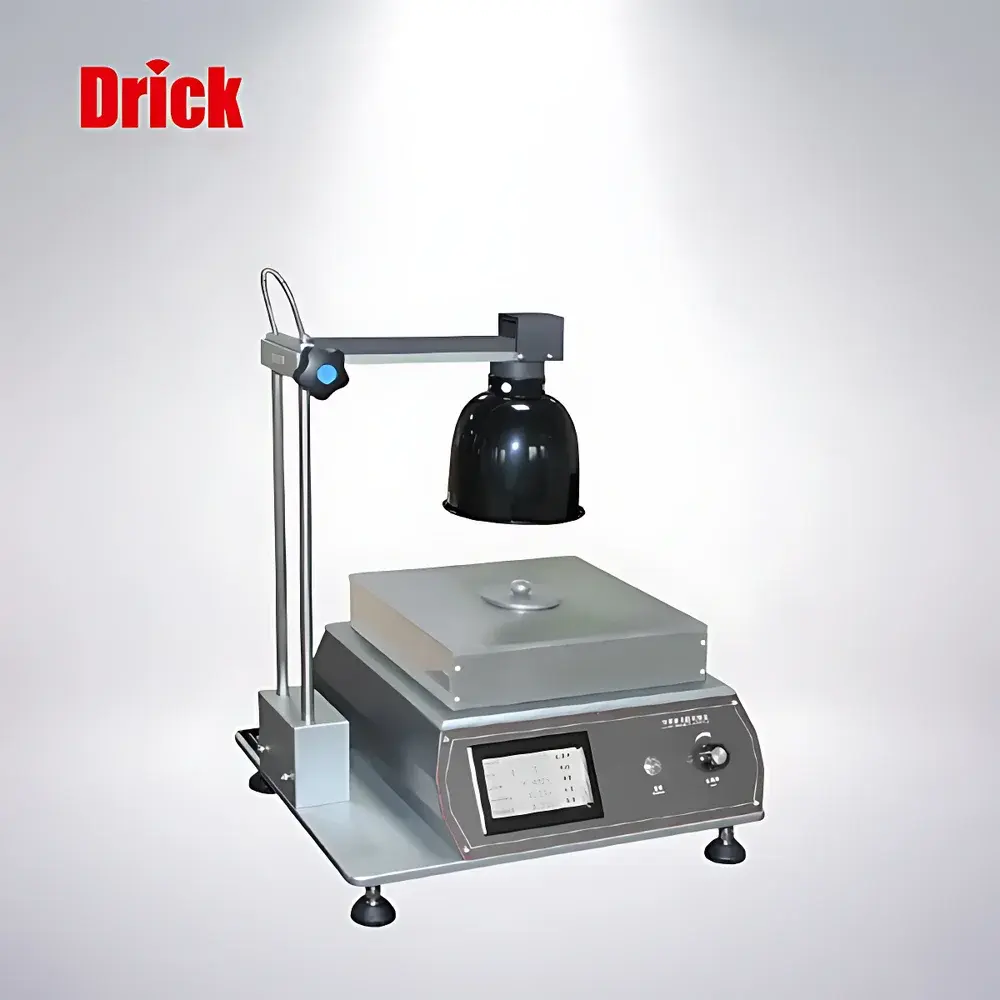
Drick DRK367 Diaper Foreign Contaminant Inspection System
| Brand | Drick |
|---|---|
| Origin | Shandong, China |
| Manufacturer Type | OEM/ODM Manufacturer |
| Regional Classification | Domestic (China) |
| Model | DRK367 |
| Price | USD 14,000 (FOB Qingdao) |
| Light Intensity Range | 0.01–8000 lx |
| Viewing Platform | Tempered Glass Surface (300 mm × 250 mm) |
| Power Supply | AC 220 V, 50 Hz, 80 W |
| Dimensions (L×W×H) | 420 × 370 × 600 mm |
| Weight | 25 kg |
| Control Interface | Color TFT Touchscreen (Bilingual: English/Chinese) |
| Core Controller | STMicroelectronics 32-bit ARM Cortex-M4 Microcontroller |
| Housing Finish | Electrostatic Powder Coating |
| Front Panel | Imported Anodized Aluminum Brushed Bezel with Metal Tactile Keypads |
| Compliance | GB/T 28004.1–2021 Annex C, GB/T 28004.2–2021 Annex C |
Overview
The Drick DRK367 Diaper Foreign Contaminant Inspection System is a purpose-built optical inspection instrument engineered for the qualitative and semi-quantitative detection of foreign particulate matter—such as metal shavings, plastic fragments, hair, fiber residues, or undispersed gel particles—embedded within absorbent hygiene products during manufacturing. It operates on the principle of transmitted visible-light imaging under controlled, adjustable illumination: when a diaper sample is placed flat on the tempered glass viewing platform and illuminated from below, internal contaminants with differing optical density or refractive index scatter or attenuate light relative to the surrounding matrix, rendering them visually discernible against the backlight. This non-destructive, real-time visual assessment method supports in-line quality gate checks, final product release verification, and root-cause analysis in production environments where compliance with national hygienic safety standards is mandatory.
Key Features
- Adjustable high-fidelity LED backlight source with continuous intensity control from 0.01 lx to 8000 lx—enabling optimization for varying diaper thicknesses, absorbency layers, and contaminant contrast levels.
- Full-color 7-inch TFT touchscreen interface with intuitive menu-driven navigation; supports bilingual (English/Chinese) operation for multinational manufacturing sites and QA teams.
- Dedicated 32-bit ARM-based mainboard using STMicroelectronics STM32 microcontroller architecture—ensuring deterministic real-time response, low-latency input handling, and firmware upgradability via USB.
- Modular data management: test records—including timestamp, operator ID (optional), light intensity setting, and pass/fail annotation—are stored locally; individual entries may be selectively deleted without clearing full memory.
- Industrial-grade mechanical design: electrostatically coated steel chassis, reinforced tempered glass viewing surface (300 mm × 250 mm), and corrosion-resistant anodized aluminum front panel with sealed metal tactile keypads for long-term reliability in humid or cleanroom-adjacent environments.
Sample Compatibility & Compliance
The DRK367 accommodates standard infant and adult diaper formats—including taped, pant-style, and booster-insert configurations—without requiring sample cutting or mounting fixtures. Its uniform backlight geometry ensures consistent illumination across the full 300 mm × 250 mm viewing area, minimizing edge falloff and enabling repeatable visual inspection per standardized protocols. The system conforms explicitly to the optical inspection methodology described in Annex C of GB/T 28004.1–2021 (“Disposable Baby Diapers and Pants”) and GB/T 28004.2–2021 (“Adult Incontinence Products”), which define requirements for foreign material detection sensitivity, lighting conditions, observer training, and pass/fail criteria. While not certified to ISO/IEC 17025, the instrument’s stable photometric output and traceable intensity calibration support integration into GLP-compliant quality systems where documented validation protocols are implemented by end users.
Software & Data Management
The embedded firmware provides local storage for up to 10,000 test records, each retaining metadata such as date/time stamp, selected illuminance level, operator identifier (if enabled), and manual pass/fail classification. Data export is supported via USB 2.0 port in CSV format for downstream analysis in Excel or LIMS platforms. Audit trail functionality includes immutable timestamps and sequential record numbering. No cloud connectivity or remote access capabilities are included—consistent with industrial hygiene instrumentation security best practices and alignment with FDA 21 CFR Part 11 principles for electronic records where local control and data sovereignty are prioritized.
Applications
- In-process quality assurance at converting lines producing diapers, training pants, and incontinence pads.
- Final product release testing prior to packaging and warehousing.
- Supplier qualification audits for nonwoven, SAP, and film component vendors.
- Root cause investigation following consumer complaints or field failures involving physical contamination.
- Internal method validation studies supporting ISO 13485 or GMP-aligned quality management systems.
FAQ
Does the DRK367 provide quantitative particle size measurement?
No. It is a visual inspection aid—not a particle analyzer. Detection relies on human observation under standardized lighting; it does not measure dimensions, count particles automatically, or generate size distribution histograms.
Can the system be integrated into a PLC-controlled production line?
Not natively. It operates as a standalone benchtop unit with no digital I/O, Ethernet, or Modbus interfaces. Integration requires external signal conditioning and relay-based pass/fail triggering via optional add-on modules (available upon request).
Is calibration traceable to NIST or other national metrology institutes?
The LED light source is factory calibrated against reference photometers; however, end-user periodic verification using a handheld lux meter compliant with ISO/CIE standards is recommended every six months or per internal SOP.
What maintenance is required?
Annual cleaning of the tempered glass surface with isopropyl alcohol and lint-free cloth; visual inspection of LED uniformity; and verification of touchscreen responsiveness. No consumables or scheduled replacement parts are specified.
Does the instrument meet UL or CE safety certification?
It complies with GB 4793.1–2019 (equivalent to IEC 61010–1:2010) for electrical safety in laboratory equipment. CE marking is not applied, as the device is intended for industrial use under Chinese regulatory frameworks and does not fall under EU Machinery Directive scope.





