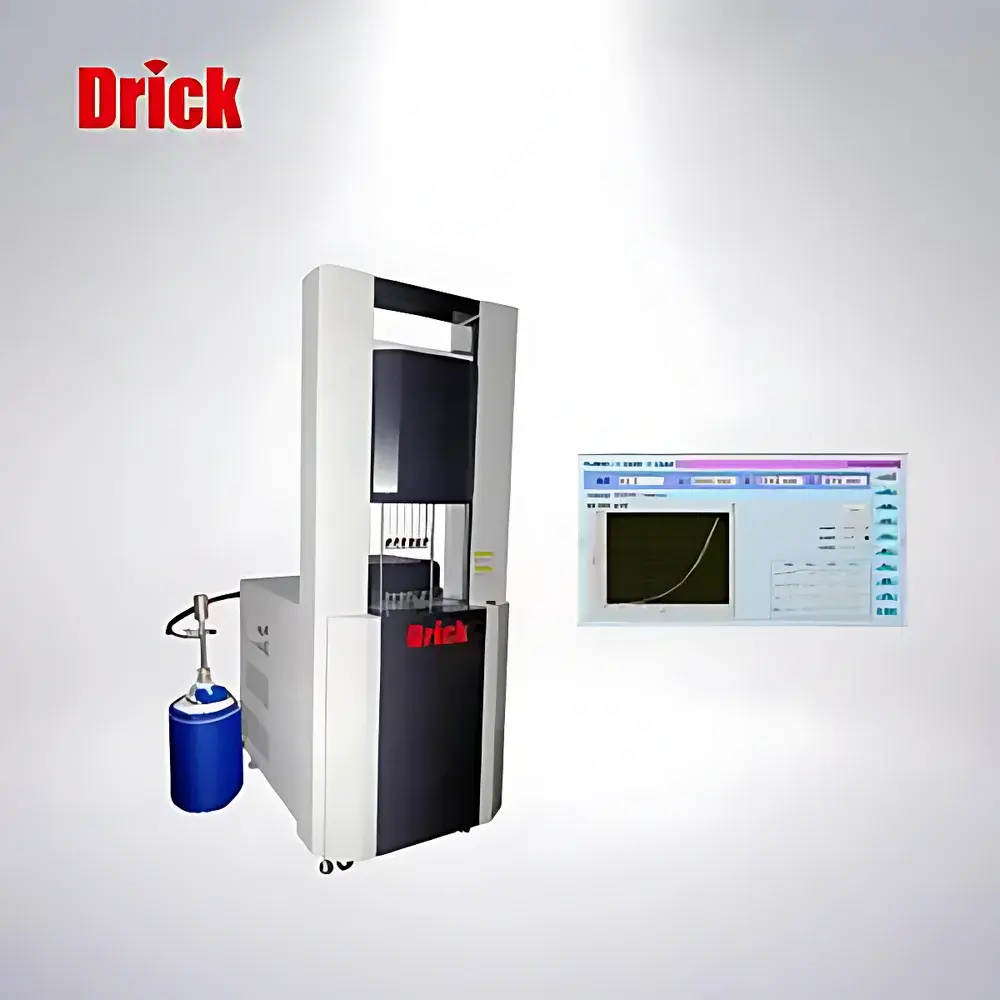
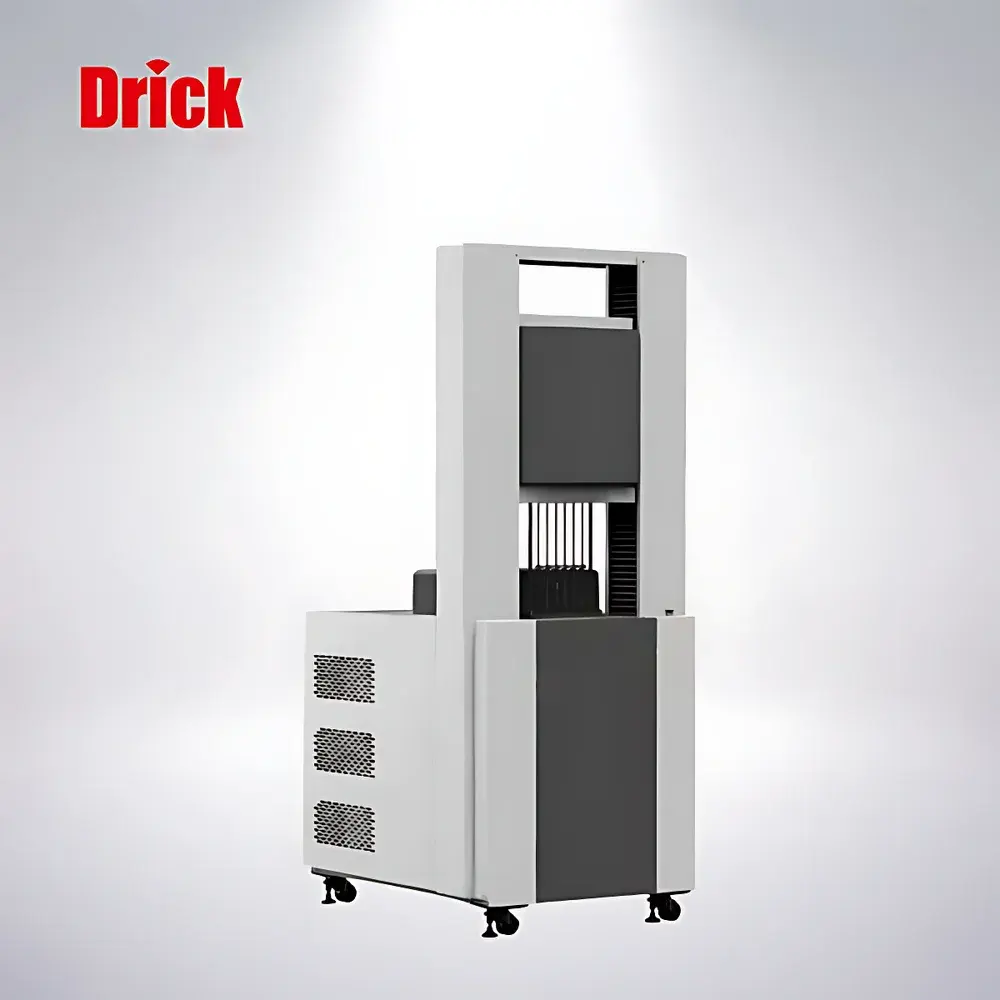
Drick DRK-PFI11TR Low-Temperature Tensile Retraction Tester for Rubber Seals (ISO 2921 Compliant)
| Key | Brand: Drick |
|---|---|
| Model | DRK-PFI11TR |
| Temperature Range | Ambient to –70.0 °C |
| Temperature Resolution | 0.1 °C |
| Heating Rate | 1 °C/min (±2 °C deviation over any 10-min interval) |
| Cooling Method | Two-stage hermetic compressor refrigeration (R404A/R23) |
| Heat Transfer Medium | Ethanol (60 L, user-supplied) |
| Test Stations | 3 independent |
| Displacement Sensing | LVDT + high-precision rotary magnetic scale |
| Displacement Resolution | 0.01 mm |
| Max Elongation | 175 mm |
| Initial Strain Control | Stepper motor + closed-loop displacement feedback |
| Release Mechanism | Pneumatically actuated automatic clamp release |
| Specimen Fixture | I-shaped standardized fixture per ISO 2921 |
| Power Supply | 3-phase AC 380 V, 50/60 Hz |
| Dimensions | 1220 × 1000 × 2200 mm |
Overview
The Drick DRK-PFI11TR Low-Temperature Tensile Retraction Tester is a precision-engineered instrument designed to determine the retraction temperature of vulcanized rubber and thermoplastic elastomers under controlled cryogenic conditions, in strict accordance with ISO 2921, GB/T 7758, and ASTM D3129. It operates on the principle of measuring the temperature at which a pre-stretched rubber specimen—after being held at a fixed low temperature—retracts to a defined residual elongation upon gradual warming. This critical parameter, known as the TR test (Tensile Retraction), quantifies the low-temperature flexibility and elastic recovery behavior of sealing compounds, O-rings, gaskets, and other dynamic elastomeric components used in automotive, aerospace, and industrial fluid systems. The system integrates mechanical refrigeration, programmable thermal ramping, high-fidelity displacement metrology, and synchronized electromechanical actuation to deliver repeatable, traceable, and standards-compliant results.
Key Features
- Two-stage hermetic compressor refrigeration system (Tecumseh/Tecumseh-derived architecture, compliant with EN 378), utilizing R404A (low-GWP secondary stage) and R23 (cryogenic primary stage) for stable operation down to –70.0 °C.
- PID-controlled thermal ramping with ±2 °C accuracy over any 10-minute interval, enabled by a dedicated high-stability temperature module and dual-point Pt100 sensor feedback in the ethanol bath.
- Three independent test stations allow parallel evaluation of replicate specimens or multi-material comparison within a single thermal cycle—enhancing throughput while maintaining inter-test consistency.
- LVDT-coupled rotary magnetic encoder system delivers 0.01 mm displacement resolution across the full 175 mm stroke range, with real-time digital compensation for thermal drift and mechanical hysteresis.
- Stepper motor–driven initial elongation control ensures precise, reproducible strain application (user-defined % elongation), followed by rapid motor retraction to establish true stress-free relaxation prior to cold immersion.
- Pneumatic specimen rack actuation enables friction-minimized vertical translation between ambient and cryogenic zones; low-contact sliding surfaces reduce parasitic thermal load and mechanical interference during retraction.
- Dual-fan forced convection system with adjustable airflow profile ensures ≤ ±0.5 °C spatial uniformity across the 60 L ethanol bath volume (measured per ISO/IEC 17025 calibration protocol).
- Integrated safety architecture includes high/low pressure cutouts, overcurrent protection, dual independent overtemperature limiters, and emergency stop with hardware interlock.
Sample Compatibility & Compliance
The DRK-PFI11TR accommodates standard I-shaped test pieces (ISO 2921 Type A, 25 mm gauge length, 6.0 ±0.1 mm width, 2.0 ±0.1 mm thickness) and supports optional custom fixtures for non-standard geometries. Specimens are mounted under nominal tension (10–20 kPa) via calibrated counterweight loading to ensure consistent contact without slippage. All thermal and mechanical protocols are fully documented for GLP/GMP environments. The system’s software logs include timestamped temperature/displacement traces, operator ID, calibration certificate references, and audit trail metadata—enabling compliance with FDA 21 CFR Part 11 requirements when configured with user authentication and electronic signature modules.
Software & Data Management
The embedded Windows-based control suite provides intuitive one-click test initiation, real-time dual-axis plotting (temperature vs. displacement), and automated TR10, TR30, TR50, and TR70 endpoint calculation per ISO 2921 Annex B. Raw data exports to CSV and XML formats support integration with LIMS platforms (e.g., LabWare, Thermo Fisher SampleManager). Calibration records—including temperature sensor NIST-traceable verification and LVDT linearity validation—are stored with version control and digital signatures. Firmware updates are delivered via secure HTTPS and validated using SHA-256 checksums.
Applications
- Quality assurance of nitrile (NBR), fluoroelastomer (FKM), silicone (VMQ), and hydrogenated nitrile (HNBR) seals in automotive powertrain and brake systems.
- R&D evaluation of low-temperature elasticity trade-offs in novel thermoplastic vulcanizates (TPVs) and dynamically vulcanized alloys (DVA).
- Validation of material batch consistency against OEM specifications (e.g., SAE J200, GMW16219, Ford WSS-M99P1111-A).
- Failure analysis of cold-weather seal extrusion, cracking, or permanent set in hydraulic and pneumatic actuators.
- Supporting accelerated aging studies where TR performance degradation correlates with network scission or plasticizer migration.
FAQ
What standards does the DRK-PFI11TR directly support?
ISO 2921, GB/T 7758, ASTM D3129, and DIN 53509-2.
Is ethanol the only compatible heat transfer medium?
Yes—only anhydrous ethanol (≥99.5% purity) is validated for use; methanol or glycol mixtures introduce viscosity-related thermal lag and corrosion risks.
Can the system operate unattended overnight?
Yes—fully autonomous thermal cycling, data logging, and endpoint detection are supported; built-in watchdog timers trigger safe shutdown on communication loss.
How often must the displacement sensors be recalibrated?
Annual calibration is recommended; however, daily zero-point verification and quarterly linearity checks using certified gauge blocks are required under ISO/IEC 17025 accreditation.
Does the instrument meet CE or UKCA marking requirements?
Yes—the electrical architecture complies with EN 61000-6-2 (immunity) and EN 61000-6-4 (emissions); mechanical safety conforms to EN ISO 12100.