
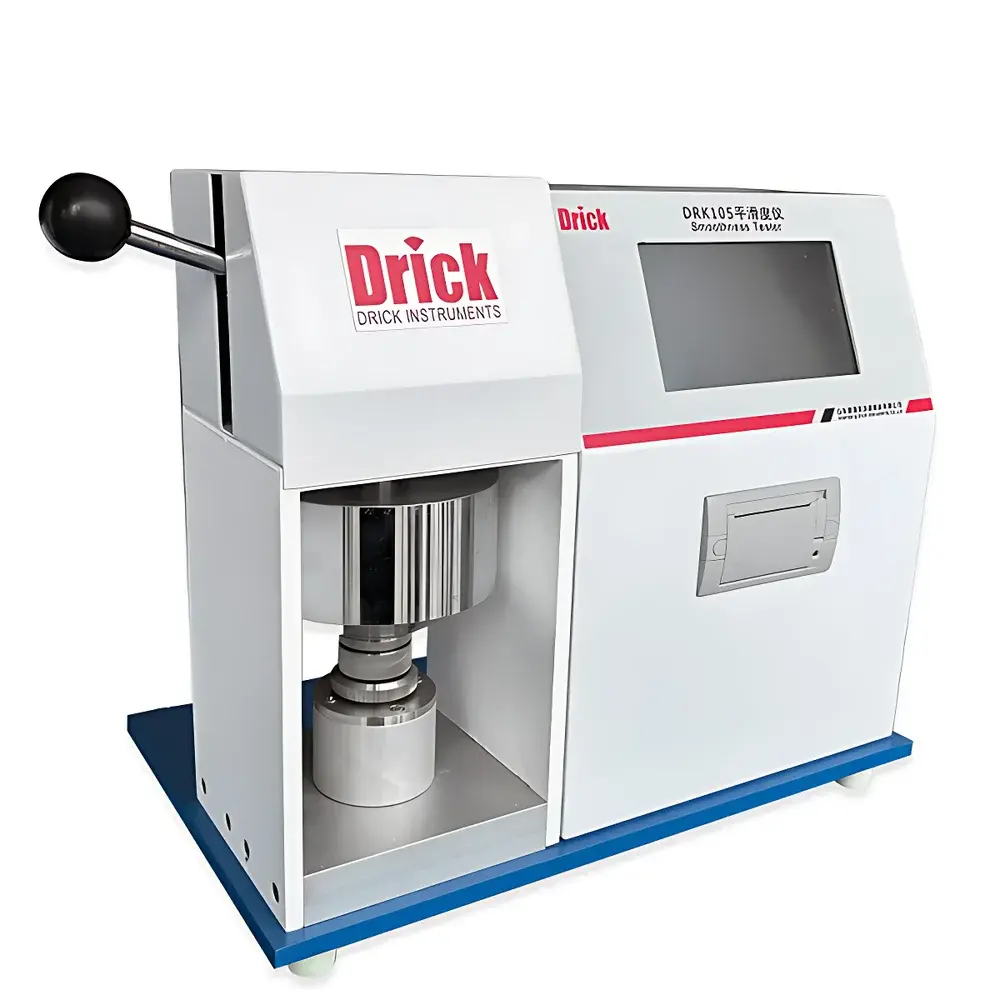
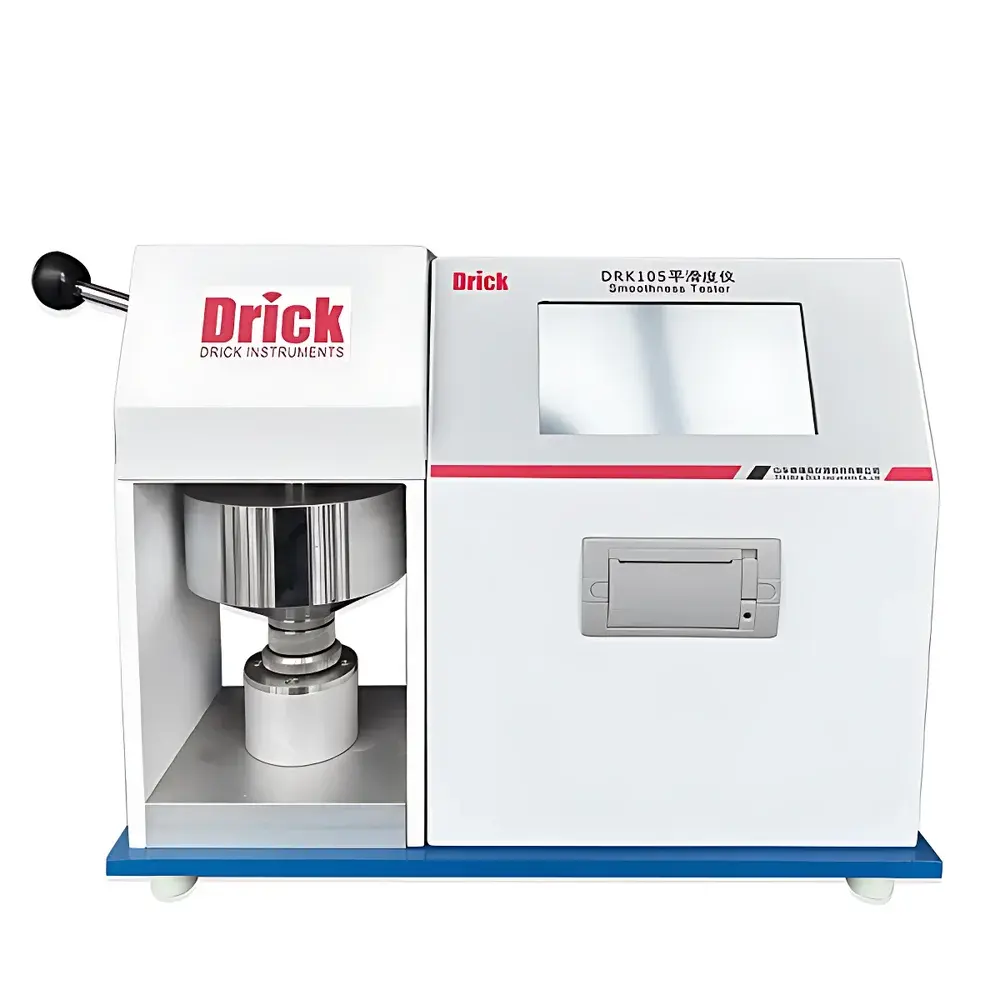
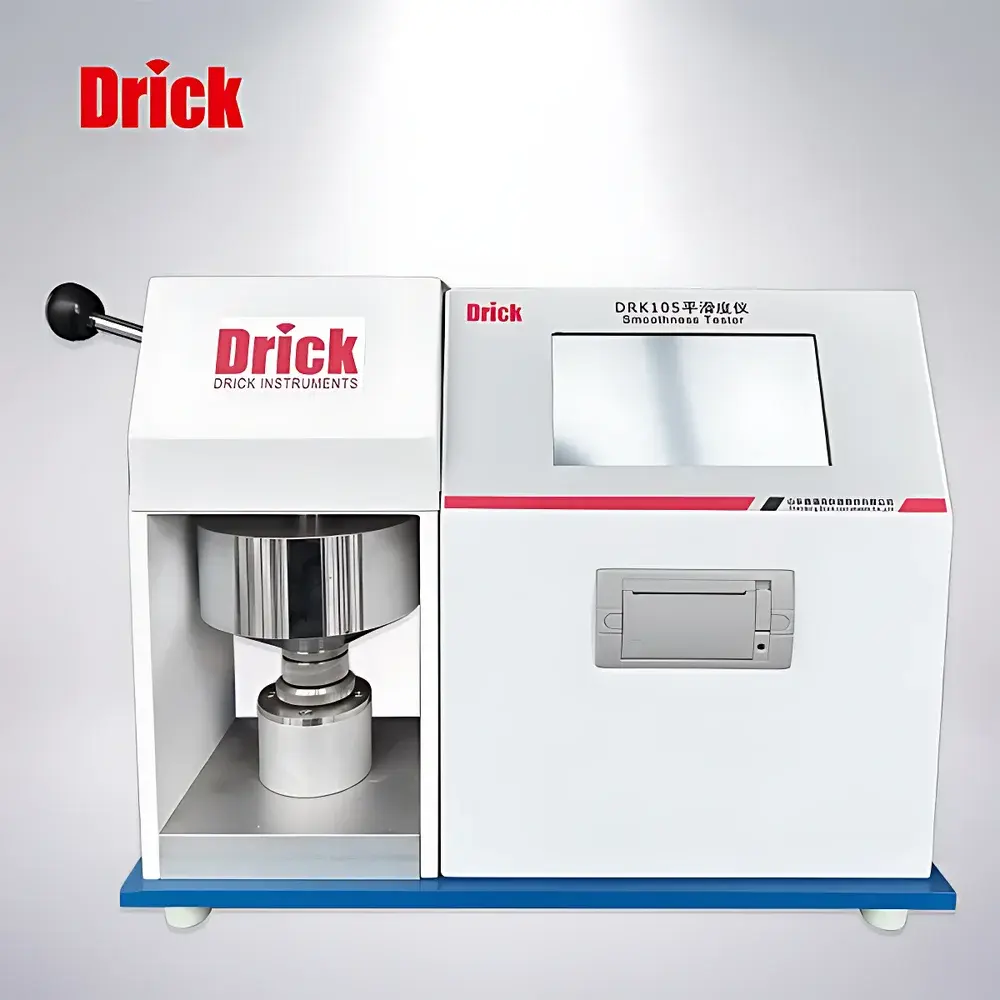
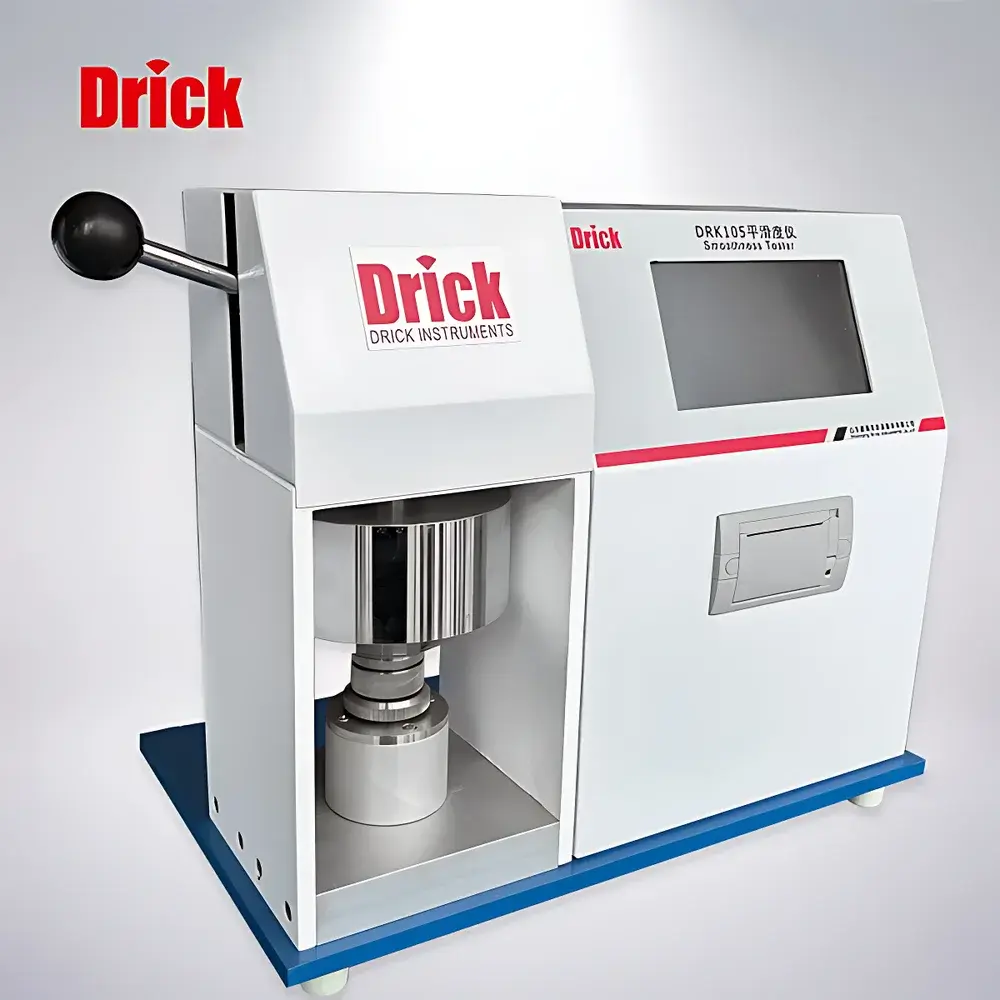
Drick DRK105 Intelligent Bekk Smoothness Tester for Paper and Paperboard
| Brand | Drick |
|---|---|
| Origin | Shandong, China |
| Manufacturer Type | Manufacturer |
| Country of Origin | China |
| Model | DRK105 |
| Pricing | Upon Request |
| Measurement Principle | Bekk Air-Leak Method (ISO 5627 / GB/T 456) |
| Vacuum System | Oil-Free Korean Vacuum Pump |
| Test Area | 10.00 ± 0.05 cm² |
| Timer Accuracy | ±1 s per 1000 s |
| Timing Range | 0–9999 s (3 ranges: 1–15 s, 15–300 s, 300–9999 s) |
| Vacuum Chamber Volumes | Large chamber: 380 ± 1 mL |
| Small chamber | 38 ± 1 mL |
| Vacuum Setpoints | Range I & II: 50.66–48.00 kPa |
| Range III | 50.66–29.33 kPa |
| Air Ingress Volume | 10.00 ± 0.20 mL (large chamber), 1.00 ± 0.05 mL (small chamber) |
| Applied Pressure | 100 kPa ± 2 kPa |
| Display | Touch-enabled color LCD with bilingual UI (English/Chinese) |
| Printer | Modular thermal or dot-matrix option |
| Operating Environment | 5–35 °C, ≤85% RH |
Overview
The Drick DRK105 Intelligent Bekk Smoothness Tester is a precision instrument engineered for the quantitative assessment of surface smoothness in paper and paperboard using the standardized Bekk air-leak method. It operates on the principle that the time required for a defined volume of air to leak through the interface between a flat glass anvil and a conditioned test specimen—under controlled vacuum and applied pressure—is inversely proportional to the material’s surface smoothness. This physical measurement correlates directly with printability, ink transfer efficiency, coating uniformity, and calendering performance—critical parameters in packaging, commercial printing, and premium label production. Designed in strict compliance with ISO 5627:2021 *Paper and board — Determination of smoothness — Bekk method* and GB/T 456–2002 *Determination of smoothness of paper and board (Bekk method)*, the DRK105 delivers traceable, repeatable results suitable for internal quality control, supplier qualification, and regulatory documentation under GLP-aligned laboratory practices.
Key Features
- Oil-free Korean vacuum pump ensures contamination-free operation, eliminating lubricant carryover risks and reducing maintenance intervals—essential for cleanroom-adjacent QC labs and ISO 9001-certified production environments.
- Dual-chamber vacuum system: Selectable large (380 ± 1 mL) or small (38 ± 1 mL) test chambers enable optimized measurement duration—small-chamber mode reduces typical test time by up to 90%, supporting high-throughput screening without compromising ISO-defined airflow dynamics.
- Precisely regulated vacuum setpoints across three ranges (I/II: 50.66–48.00 kPa; III: 50.66–29.33 kPa) accommodate diverse substrate classes—from lightweight coated offset papers to rigid folding boxboards—while maintaining compliance with Bekk method boundary conditions.
- High-fidelity sealing architecture incorporating imported vacuum-grade elastomeric gaskets and CNC-machined anvil surfaces achieves ≤0.05 mL/min leakage rate under 50 kPa vacuum, meeting national metrological verification requirements for pressure integrity.
- Intuitive 7-inch capacitive touch display with real-time graphical feedback supports dual-language (English/Chinese) navigation, step-by-step guided calibration, and on-screen statistical summary (mean, SD, CV%) per test batch.
- Modular printer integration—thermal or impact dot-matrix—enables direct hardcopy output of test records with timestamp, operator ID, environmental conditions, and full parameter audit trail, facilitating 21 CFR Part 11–compatible documentation where configured.
Sample Compatibility & Compliance
The DRK105 is validated exclusively for planar, low-permeability paper and paperboard specimens with thickness ≤0.5 mm and air resistance >100 s (Sheffield units). It is not suitable for corrugated medium, nonwovens, films, or highly porous boards (e.g., blotting paper, filter media), as uncontrolled bulk air permeation invalidates Bekk-derived smoothness values. All measurements require conditioning per ISO 187 (23 °C ± 1 °C, 50 % RH ± 2 % RH, ≥24 h). Instrument validation includes annual verification against NIST-traceable stopwatch standards and certified reference samples with assigned Bekk smoothness values (e.g., ISO 5627 Annex B reference materials). Full compliance documentation—including factory calibration certificates, uncertainty budgets, and installation qualification (IQ) templates—is provided with each unit.
Software & Data Management
While the DRK105 operates as a standalone instrument, its embedded firmware supports USB export of CSV-formatted datasets containing test ID, date/time stamp, chamber selection, vacuum range, measured time (s), ambient temperature/humidity, and operator code. When integrated into enterprise LIMS or QMS platforms via RS-232 or optional Ethernet module (DRK-EM1), it transmits raw timing data with metadata tags compatible with ASTM E1482 and ISO/IEC 17025 data integrity requirements. Audit trails record all parameter changes, calibration events, and user logins—retained for ≥12 months with tamper-evident timestamps. Firmware updates are delivered via signed .bin files with SHA-256 checksum verification to ensure cryptographic integrity.
Applications
- Quality assurance of coated freesheet and mechanical papers used in high-gloss magazine and catalog printing.
- Process monitoring during paper machine reel-up and calender stack optimization.
- Supplier evaluation for folding cartons, pharmaceutical blister lidding, and luxury packaging substrates.
- R&D validation of surface sizing formulations, pigment dispersion efficiency, and nano-coating adhesion.
- Conformance testing for ISO 12647-2 (process control for offset lithography) and TAPPI T 538 (smoothness specification for packaging grades).
FAQ
What standards does the DRK105 comply with?
It fully conforms to ISO 5627:2021 and GB/T 456–2002 for Bekk smoothness determination, with hardware and firmware validated against their procedural and metrological requirements.
Can the DRK105 test cardboard thicker than 0.5 mm?
No—substrates exceeding 0.5 mm thickness violate the Bekk method’s geometric assumptions and generate non-representative air-leak profiles; alternative methods (e.g., Parker Print-Surf) are recommended.
Is vacuum pump maintenance required?
The oil-free Korean pump requires no lubrication; routine inspection of intake filters and seal integrity every 6 months is sufficient under normal lab use.
How is measurement repeatability verified?
Users perform daily verification using certified reference specimens with known Bekk values (±2 s tolerance); intra-laboratory RSD must remain ≤3.5 % across 10 consecutive measurements.
Does the instrument support electronic signature capture?
Not natively—but when connected to validated third-party QMS software with 21 CFR Part 11 modules, digital signatures can be applied to exported reports prior to archival.
Related Products





