
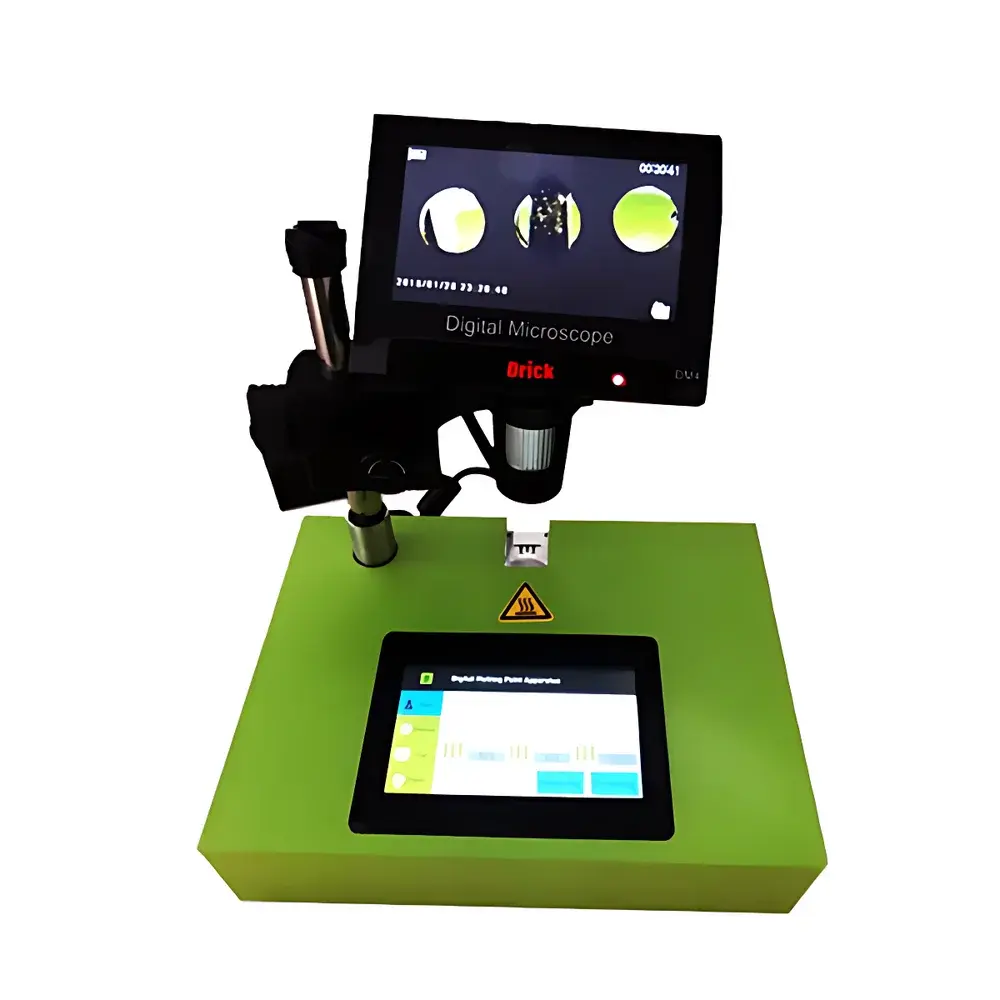
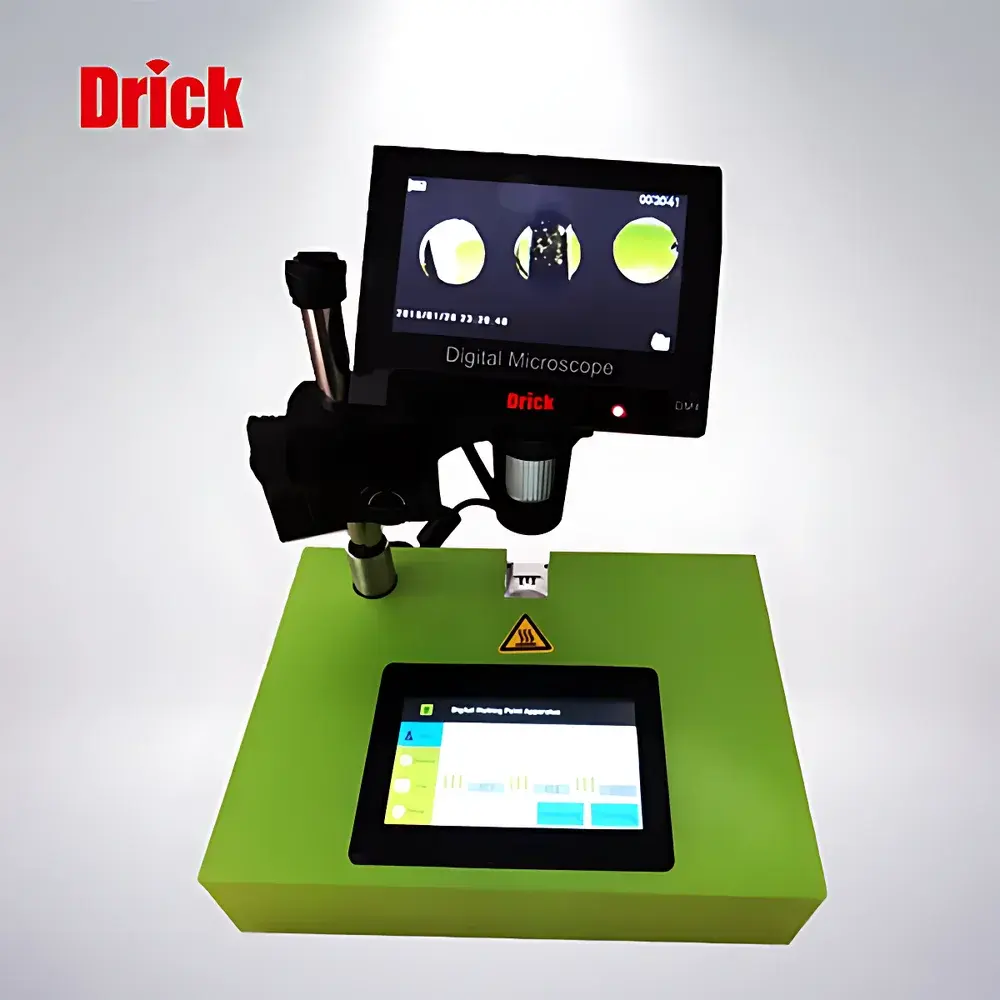
Drick DRK X-5 Microscopic Melting Point Apparatus
| Brand | Drick |
|---|---|
| Origin | Shandong, China |
| Manufacturer Type | Direct Manufacturer |
| Country of Origin | China |
| Model | DRK X-5 |
| Temperature Range | Ambient to 350 °C |
| Heating Rate | 0.1–10 °C/min (100-step continuously adjustable) |
| Temperature Repeatability | ±0.3 °C at 0.1 °C/min |
| Temperature Accuracy | ±0.4 °C (<250 °C) |
| Capillary Dimensions | OD 1.6 mm, ID 1.2 mm |
| Sample Capacity | 3 samples per run |
| Temperature Resolution | 0.1 °C |
| Control Method | PID-controlled closed-furnace heating |
| Cooling Method | Natural convection |
| Display | TFT high-definition color screen |
| Interface | RS232 serial port |
| Power Supply | 100–240 V AC, 50–60 Hz |
| Power Consumption | 100 W |
| Dimensions | 250 × 250 × 150 mm |
| Weight | 1.2 kg |
Overview
The Drick DRK X-5 Microscopic Melting Point Apparatus is a precision thermal analysis instrument engineered for accurate, reproducible determination of melting points in solid organic compounds. It operates on the capillary tube method—standardized in pharmacopoeial and industrial quality control protocols—and integrates real-time optical observation via a high-magnification microscope lens system. The apparatus employs a fully enclosed, PID-regulated heating furnace with programmable ramp rates, enabling precise thermal profiling from ambient temperature up to 350 °C. Unlike conventional analog melt point testers, the DRK X-5 combines thermometric accuracy with visual verification: users observe crystal lattice disintegration in situ through an optically aligned viewing path, ensuring unambiguous endpoint identification—critical for polymorph screening, purity assessment, and identity verification in regulated environments.
Key Features
- Triple-sample parallel testing: Simultaneous processing of three independently loaded capillaries improves throughput without compromising measurement integrity or cross-contamination risk.
- Continuous heating rate control: Adjustable ramp rates from 0.1 to 10 °C/min across 100 discrete steps allow method optimization for low-melting eutectics or high-stability crystalline APIs.
- High-resolution thermal sensing: 0.1 °C temperature resolution paired with verified accuracy (±0.4 °C below 250 °C; ±0.7 °C above) meets ASTM E324 and ISO 6179 requirements for routine QC applications.
- Optical-thermal correlation: Integrated microscope optics provide real-time visualization of solid-to-liquid phase transition, supporting manual endpoint confirmation and morphological documentation.
- Robust thermal architecture: Fully sealed furnace design minimizes ambient interference and ensures stable thermal gradients during slow-ramp analyses, contributing to ±0.3 °C repeatability at 0.1 °C/min.
- Regulatory-ready interface: RS232 serial output enables direct connection to LIMS or validated data acquisition systems, supporting audit trail generation under GLP/GMP frameworks.
Sample Compatibility & Compliance
The DRK X-5 accommodates standard thin-walled capillaries (OD 1.6 mm, ID 1.2 mm), compatible with USP & Ph. Eur. general chapter <281> and JP 17 methods. Its temperature range and resolution support testing of diverse organic solids—including pharmaceutical actives, excipients, fine chemicals, dyes, and food-grade additives. The instrument conforms to core principles outlined in ISO 11357-3 (Plastics — Differential Scanning Calorimetry — Part 3: Determination of melting temperature and enthalpy of fusion) and supports alignment with FDA 21 CFR Part 11 when paired with compliant software solutions. While not certified as Class I medical device hardware, its performance characteristics satisfy analytical validation criteria for Stage 1–2 method development per ICH Q2(R2).
Software & Data Management
Although the DRK X-5 operates as a standalone benchtop unit with embedded TFT color display, its RS232 interface allows integration into laboratory networks. Raw temperature/time data and user-defined method parameters (ramp rate, hold time, target temperature) can be exported for post-processing in Excel, MATLAB, or validated chromatography/data systems. When deployed in GxP environments, laboratories may configure external logging tools to capture timestamps, operator IDs, and instrument metadata—fulfilling traceability requirements for audit readiness. Firmware updates are performed via serial command protocol, with version history retained in non-volatile memory.
Applications
- Pharmaceutical quality control: Identity testing and purity estimation of active pharmaceutical ingredients (APIs) per USP <741>.
- Chemical synthesis validation: Confirmation of product crystallinity and batch-to-batch consistency in R&D labs.
- Food safety laboratories: Verification of melting behavior in fats, waxes, and emulsifiers subject to Codex Alimentarius standards.
- Academic research: Teaching fundamental thermal transitions and polymorphism in undergraduate and graduate physical chemistry curricula.
- Materials science: Preliminary screening of organic semiconductors, metal-organic frameworks (MOFs), and co-crystal stability.
FAQ
What capillary specifications are required for optimal performance?
Standard thin-wall glass capillaries with outer diameter 1.6 mm and inner diameter 1.2 mm are recommended. Use of non-standard dimensions may affect heat transfer uniformity and observed onset temperatures.
Can the DRK X-5 be used for decomposition point determination?
While primarily designed for sharp melting transitions, gradual discoloration or bubbling observed above 250 °C may indicate thermal degradation—but dedicated TGA instrumentation is required for quantitative decomposition analysis.
Is calibration traceable to national standards?
The unit supports user-performed calibration using NIST-traceable reference standards (e.g., pure indium, tin, or bismuth). Full calibration certificates require third-party metrology service; factory calibration is performed against certified thermistors prior to shipment.
Does the instrument meet electromagnetic compatibility (EMC) requirements for EU markets?
Yes—the DRK X-5 complies with EN 61326-1:2013 for laboratory equipment, including immunity to electrostatic discharge (IEC 61000-4-2) and radiated RF fields (IEC 61000-4-3), and has CE marking for intra-EU distribution.



