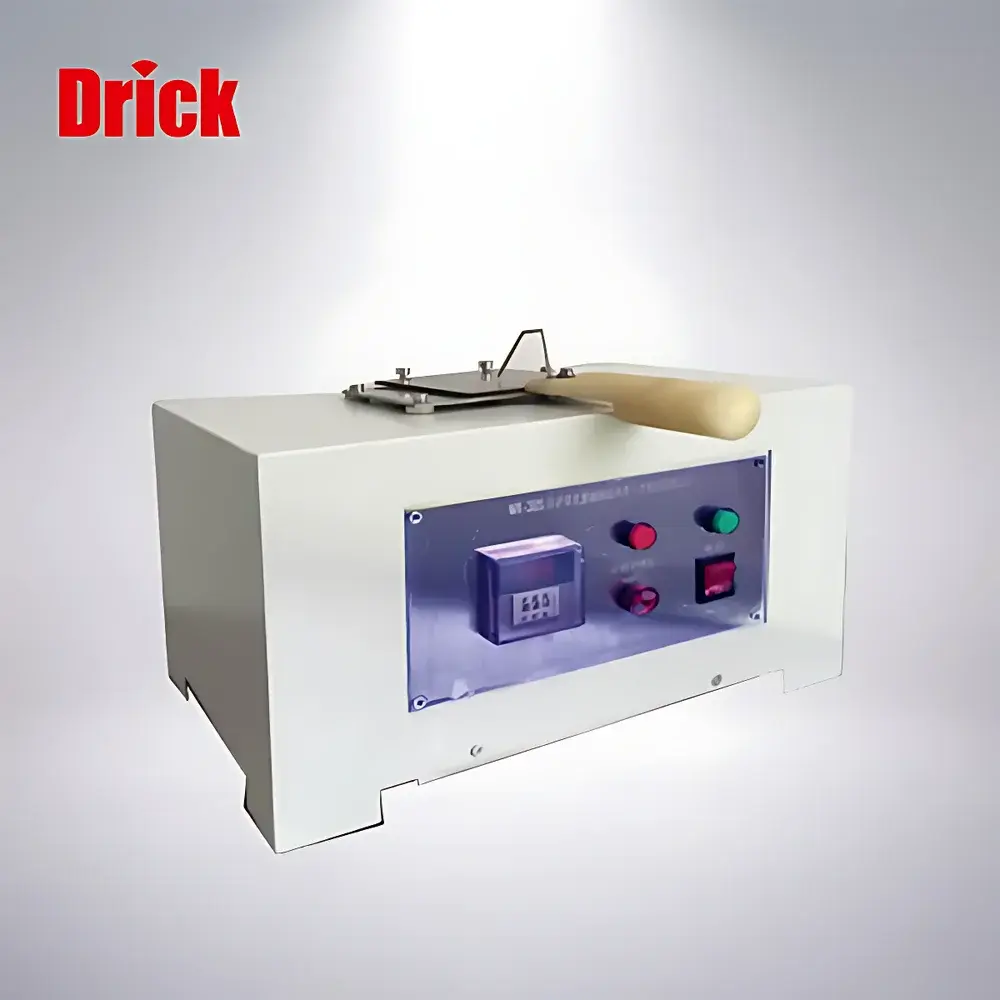
Drick DRK453 Chemical Protective Clothing Penetration Time Tester for Acid and Alkali Resistance
| Brand | Drick |
|---|---|
| Origin | Shandong, China |
| Manufacturer Type | Direct Manufacturer |
| Country of Origin | China |
| Model | DRK453 |
| Price | USD 7,000 (FOB Qingdao) |
| Test Principle | Electrical Conductivity Detection |
| Compliance Standard | GB 24540–2009 |
| Test Temperature Range | 17–30 °C |
| Relative Humidity | 65 ± 5 % RH |
| Sample Size | 100 mm × 100 mm |
| Test Liquid Volume | 0.1 mL (conductivity method) |
| Instrument Dimensions | 240 mm (L) × 180 mm (W) × 200 mm (H) |
Overview
The Drick DRK453 Chemical Protective Clothing Penetration Time Tester is a precision-engineered laboratory instrument designed to quantify the breakthrough resistance of textile-based chemical protective clothing against acidic and alkaline challenge agents. It operates on the principle of electrical conductivity detection—a standardized physical method defined in GB 24540–2009, “Protective Clothing – Acid and Alkali Resistant Garments.” When a conductive test solution (e.g., 0.1 M HCl or NaOH) is applied to the outer surface of a conditioned fabric specimen, the system continuously monitors electrical continuity between an upper electrode and a grounded lower plate. Upon liquid penetration through the fabric matrix—indicating failure of the barrier—the resulting closed circuit triggers an automatic timestamp, recording the exact elapsed time from initial contact to breakthrough. This measured parameter—penetration time—is a critical performance metric used in quality assurance, regulatory conformance, and material development workflows across occupational safety, PPE certification laboratories, and industrial hygiene testing facilities.
Key Features
- Automated, high-reproducibility penetration time measurement using dual-electrode conductivity sensing architecture
- Integrated digital timer with millisecond resolution and automatic event logging upon circuit closure
- Modular sample holder accommodating standardized 100 mm × 100 mm specimens under controlled environmental conditions (17–30 °C, 65 ± 5 % RH)
- Non-destructive, repeatable testing protocol compliant with GB 24540–2009 Annex B (Conductivity Method)
- Compact benchtop footprint (240 × 180 × 200 mm) optimized for ISO/IEC 17025-accredited laboratory environments
- Robust mechanical design with corrosion-resistant electrode surfaces and insulated sample chamber
Sample Compatibility & Compliance
The DRK453 supports evaluation of woven, nonwoven, laminated, and coated textile substrates used in Type 3, Type 4, and Type 6 chemical protective garments per EN 943-1:2015 and EN 13034:2005. It is validated for use with aqueous solutions of hydrochloric acid (pH ≤ 2), sodium hydroxide (pH ≥ 12), and other electrolyte-based challenge agents specified in national and international standards. While GB 24540–2009 is its primary reference, the methodology aligns with functional equivalents in ASTM F903–22 (“Standard Test Method for Resistance of Materials Used in Protective Clothing to Permeation by Liquids”) and ISO 6529:2013 (“Protective clothing — Protection against chemicals — Determination of resistance to permeation by liquids and gases”). The system does not perform permeation rate quantification (which requires analytical instrumentation such as GC or IC); rather, it delivers discrete, pass/fail–oriented breakthrough timing data essential for batch release and comparative material screening.
Software & Data Management
The DRK453 operates as a standalone hardware platform with embedded microcontroller logic—no external PC or proprietary software is required for basic operation. All test events are timestamped and stored in internal memory (non-volatile EEPROM) with traceable session identifiers. For laboratories operating under GLP or GMP frameworks, optional RS-232 or USB-C serial output enables integration with LIMS or custom data acquisition systems. Audit trail functionality—including operator ID input, test date/time stamp, ambient condition logging (via external hygrothermograph sync), and result export in CSV format—supports compliance with ISO/IEC 17025 clause 7.7 (Results Reporting) and FDA 21 CFR Part 11 when paired with validated third-party software. Calibration verification is performed using certified shunt resistors and documented in accordance with internal SOPs.
Applications
- Quality control of acid/alkali-resistant workwear during manufacturing and incoming inspection
- Comparative evaluation of barrier layer efficacy across polymer coatings, fluorocarbon laminates, and rubberized composites
- Supporting technical documentation for CE marking under EU PPE Regulation (EU) 2016/425
- Validation of cleaning and decontamination protocols by measuring residual barrier integrity post-exposure
- Academic research into textile degradation kinetics under corrosive chemical stress
- Regulatory submission testing for national PPE certification bodies in China and ASEAN markets
FAQ
Does the DRK453 comply with international standards beyond GB 24540–2009?
Yes—its test methodology is functionally equivalent to conductivity-based breakthrough detection in ASTM F903–22 and ISO 6529:2013. However, formal certification under those standards requires lab-specific validation per ISO/IEC 17025.
Can the system test non-aqueous solvents or organic chemicals?
No—the conductivity method is limited to ionizable aqueous solutions. For non-conductive challenge agents (e.g., toluene, acetone), alternative methods such as infrared spectroscopy or gas chromatography-based permeation testing are required.
Is calibration traceable to national metrology institutes?
Electrical calibration uses NIST-traceable shunt resistors; environmental monitoring requires user-supplied, accredited hygrothermographs per ISO 17025 requirements.
What maintenance is required for long-term reliability?
Biannual cleaning of electrodes with isopropyl alcohol and visual inspection of insulation integrity. No consumables or scheduled recalibration intervals are mandated under normal use.
Does Drick provide installation qualification (IQ) or operational qualification (OQ) documentation?
Yes—upon request, Drick supplies customizable IQ/OQ templates aligned with ISO/IEC 17025 and GMP Annex 15 requirements, including test scripts, acceptance criteria, and signature fields for QA sign-off.