
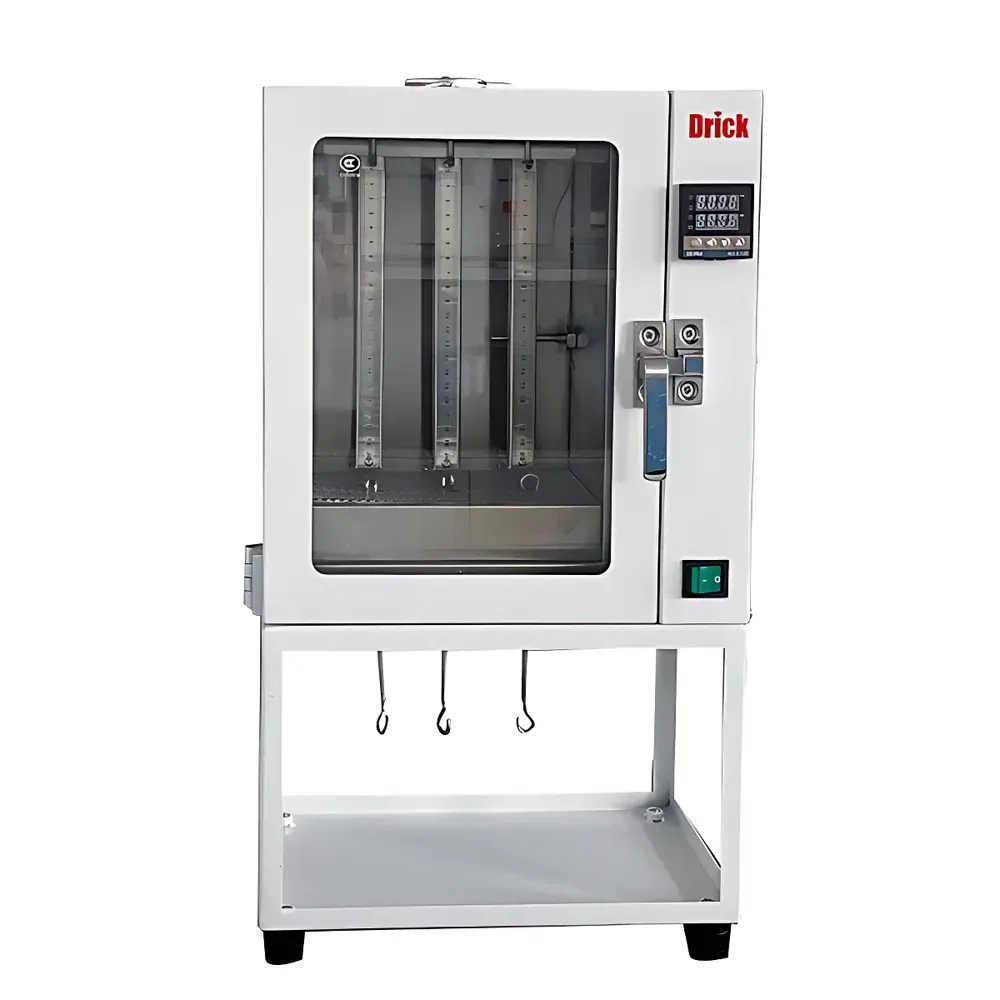
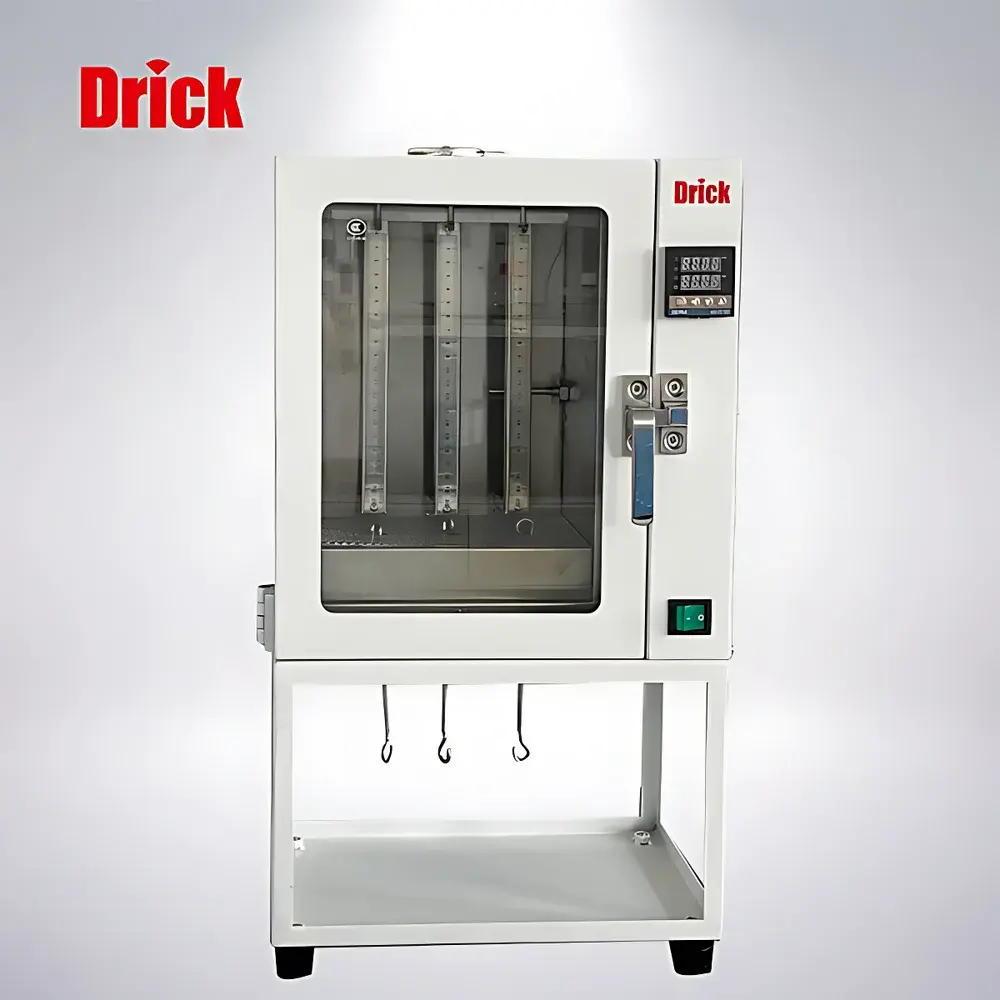
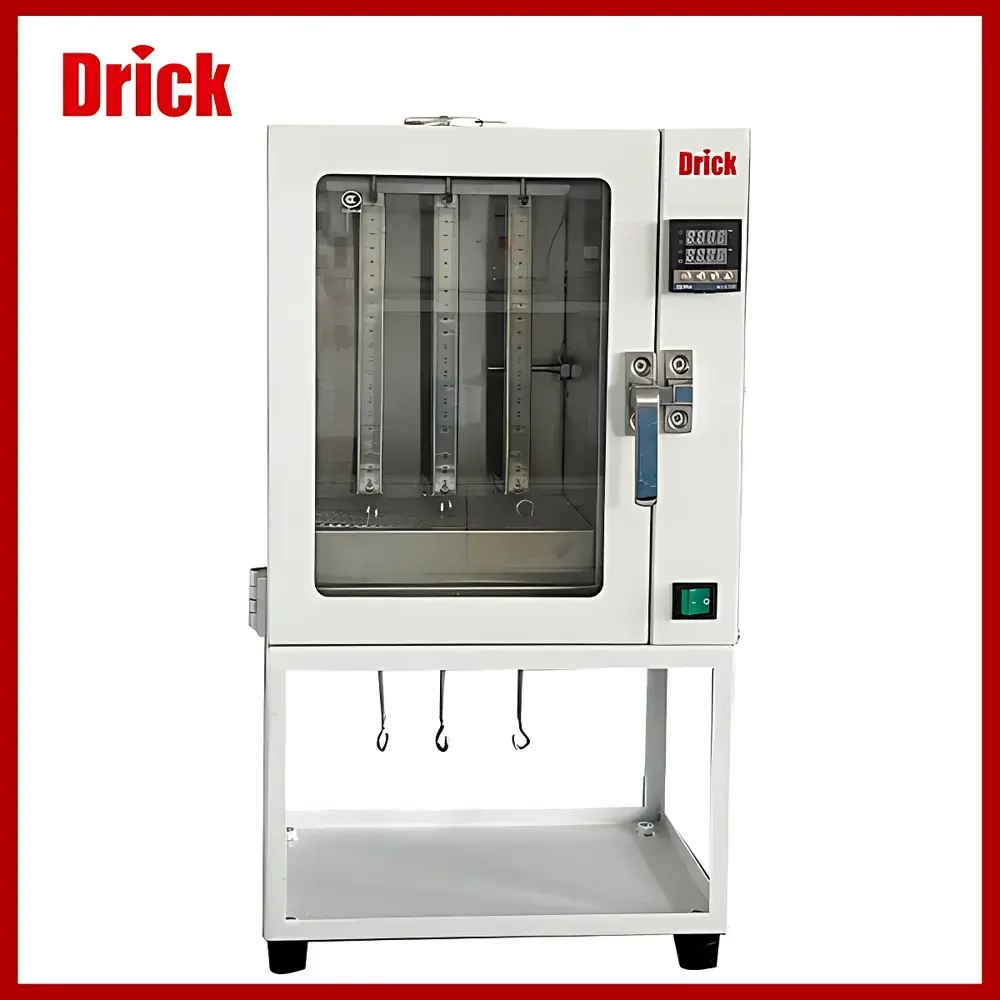
Drick DRK-L01 Cable Heat Extension Tester
| Brand | Drick |
|---|---|
| Origin | Shandong, China |
| Manufacturer Type | Direct Manufacturer |
| Country of Origin | China |
| Model | DRK-L01 |
| Heating Temperature Range | 200 ± 2 °C |
| Test Stations | 3 |
| Chamber Internal Dimensions (D×W×H) | 129 × 201 × 241 mm |
| Chamber Volume | 6.24 L |
| Heating Power | 400 W / 220 V |
| Chamber Liner Material | AISI 304 Stainless Steel |
| Overall Dimensions (L×W×H) | 335 × 225 × 581 mm |
| Compliance | GB/T 2951.12–2008, GB/T 2951.21–2008 |
Overview
The Drick DRK-L01 Cable Heat Extension Tester is a precision-engineered laboratory instrument designed to evaluate the thermal elongation and permanent set behavior of polymeric insulation and sheathing materials used in electric cables under controlled elevated temperature and mechanical load conditions. It operates on the principle of gravimetric tensile stress application combined with isothermal exposure—where standardized test specimens are vertically suspended between upper and lower fixtures, subjected to a defined dead-load mass, and then exposed to a precisely maintained high-temperature environment for a specified duration. The resulting dimensional change—measured as the increase in distance between two pre-marked reference points—is quantified to calculate percentage elongation and permanent deformation after cooling. This methodology directly reflects the material’s viscoelastic response under simultaneous thermal and mechanical stress, a critical performance indicator for cable integrity during service at elevated operating temperatures.
Key Features
- Triple-station testing configuration enables parallel evaluation of three specimens per cycle, improving throughput without compromising measurement consistency.
- Stainless steel (AISI 304) chamber liner ensures long-term corrosion resistance, thermal stability, and compliance with cleanliness requirements for repeated high-temperature operation.
- Precise temperature control system maintains 200 ± 2 °C across the entire working volume, validated per IEC 60584 and aligned with the tolerance limits specified in GB/T 2951.21–2008.
- Compact benchtop footprint (335 × 225 × 581 mm) optimizes laboratory space utilization while accommodating full-size cable specimens up to standard gauge lengths.
- Integrated mechanical load suspension design permits accurate application of standardized weights (e.g., 20 N per specimen, as required by GB/T 2951.12–2008) without lateral deviation or fixture slippage.
- Thermally insulated housing and optimized heating element layout minimize external surface temperature rise and ensure operator safety during extended test cycles.
Sample Compatibility & Compliance
The DRK-L01 accommodates flat and round cross-section cable specimens conforming to GB/T 2951.11–2008 preparation protocols—including precise marking at 20 mm intervals and conditioning at 23 ± 5 °C prior to testing. It fully satisfies the apparatus requirements outlined in Clause 8 of GB/T 2951.21–2008 (“Test method for heat extension”) and Clause 9 of GB/T 2951.12–2008 (“Elongation at break and tensile strength”). While primarily intended for domestic Chinese standards, its operational parameters—including temperature uniformity, load accuracy, and dimensional repeatability—are compatible with equivalent international methods such as IEC 60811-3-1 and ASTM D1238 (for extrudate-based validation). The unit supports traceable calibration via external PT100 probes and is suitable for use in GLP-compliant environments when paired with documented maintenance and verification records.
Software & Data Management
The DRK-L01 operates as a manually supervised, hardware-controlled test platform with no embedded digital interface or proprietary software. All test parameters—including start time, exposure duration, applied load, and post-test measurements—are recorded externally using laboratory notebooks or LIMS-integrated spreadsheets. Users are responsible for manual data entry of initial and final mark distances, ambient temperature/humidity, and specimen identification. For regulated environments, laboratories may implement audit-trail-enabled electronic records systems compliant with 21 CFR Part 11 to capture procedural adherence, operator ID, and timestamped observations. Calibration certificates for ancillary tools (e.g., digital calipers, certified weights) should be retained per ISO/IEC 17025 requirements.
Applications
This instrument is routinely deployed in cable manufacturing QC labs, third-party certification bodies (e.g., CNAS-accredited testing centers), and R&D departments evaluating cross-linked polyethylene (XLPE), ethylene propylene rubber (EPR), and thermoplastic elastomer (TPE) formulations. Typical use cases include incoming raw material qualification, batch release testing of finished cables, failure analysis of thermal deformation incidents, and comparative assessment of antioxidant package efficacy. Its results directly inform compliance decisions related to rated conductor temperature (e.g., 90 °C for XLPE-insulated power cables) and support technical documentation for CCC, CE, and RoHS declarations.
FAQ
What standards does the DRK-L01 explicitly support?
GB/T 2951.12–2008 and GB/T 2951.21–2008 are the primary referenced standards; compatibility with IEC 60811-3-1 and ASTM D1238 is achievable through procedural adaptation.
Is temperature uniformity verified across the chamber volume?
Yes—the 200 ± 2 °C specification applies to the entire usable test zone, verified using calibrated Class A PT100 sensors placed at geometric center and corner positions per GB/T 5170.5.
Can the unit be integrated into an automated testing workflow?
No native automation interface exists; however, external PLC-triggered start/stop signals and digital caliper data logging can be implemented via user-developed interfaces.
What maintenance is required for long-term accuracy?
Quarterly verification of weight calibration, annual inspection of heater elements and thermocouple integrity, and biannual cleaning of stainless steel interior surfaces with non-chlorinated solvents.
Does the DRK-L01 meet ISO/IEC 17025 traceability requirements?
The instrument itself does not provide traceability—but when used with certified reference materials, calibrated ancillary tools, and documented SOPs, it fully supports ISO/IEC 17025-compliant testing operations.
Related Products






