
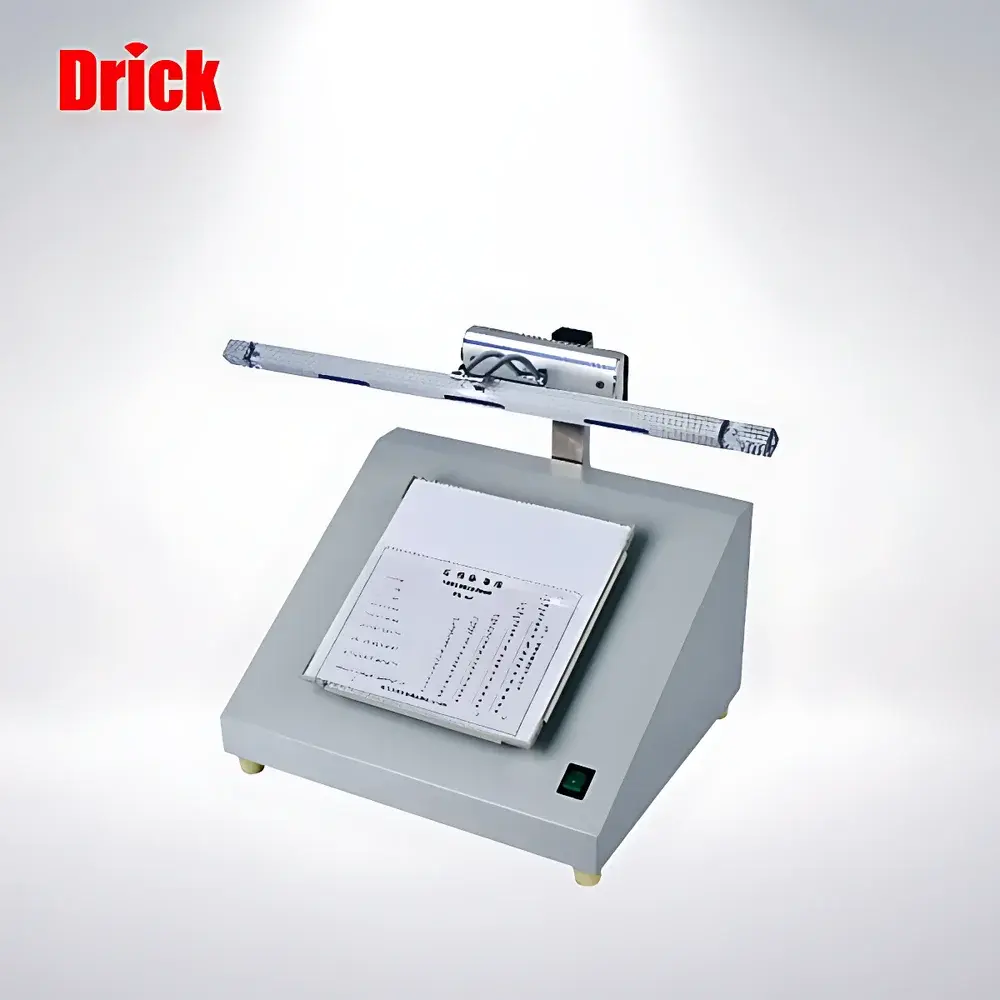
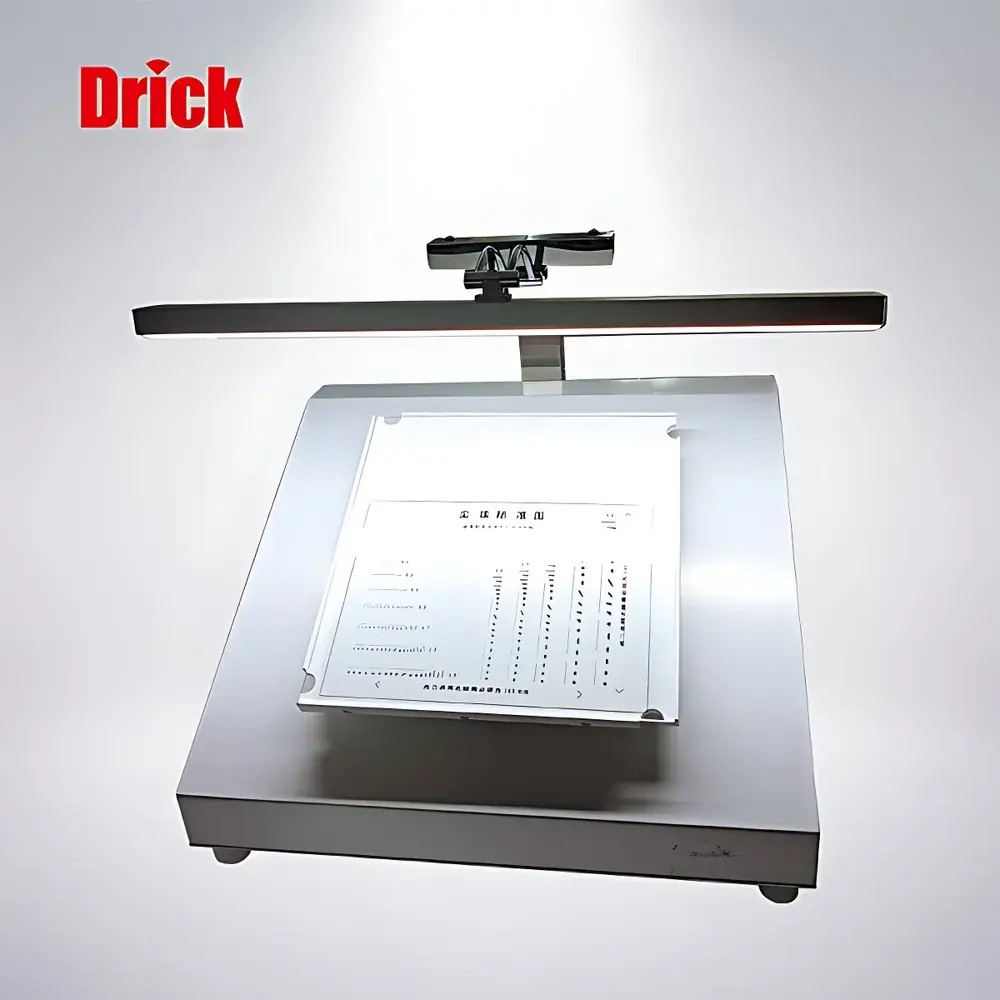
Drick DRK117 Dust Counting Instrument for Food Packaging Paper
| Brand | Drick |
|---|---|
| Origin | Shandong, China |
| Manufacturer Type | Manufacturer |
| Country of Origin | China |
| Model | DRK117 |
| Light Source | 16 W fluorescent lamp |
| Illumination Angle | 60° |
| Working Table Effective Area | 0.0625 m², 360° rotatable |
| Standard Dust Reference Chart Range | 0.05–5.0 mm² |
| Dimensions (L×W×H) | 750 × 350 × 500 mm |
| Power Supply | AC 220 V ± 5% |
| Weight | ~5 kg |
| Compliance Standard | GB/T 1541 |
Overview
The Drick DRK117 Dust Counting Instrument for Food Packaging Paper is a dedicated optical inspection system engineered for the quantitative assessment of visible particulate contaminants—commonly referred to as “dust spots”—on the surface of paper and paperboard used in food contact packaging applications. It operates on the principle of controlled oblique illumination combined with high-contrast visual detection, enabling standardized enumeration and sizing of foreign particles or fiber aggregates that appear as discrete opaque or translucent defects under defined lighting conditions. This instrument implements the methodology specified in GB/T 1541—China’s national standard for dust count determination in paper—and supports compliance verification required by food packaging regulatory frameworks, including QS (Quality Safety) certification protocols for food-grade paper products such as greaseproof paper, glassine, food wrapping paper, and food-grade paperboard.
Key Features
- Optimized optical configuration: A 16 W fluorescent lamp with integrated light-shielding hood ensures uniform, glare-free illumination at a fixed 60° incident angle—critical for consistent contrast enhancement of surface dust features.
- Rotatable precision worktable: The 0.0625 m² (250 mm × 250 mm) observation surface rotates fully 360°, allowing systematic scanning of large-area samples without repositioning and minimizing operator-induced variability.
- Standardized reference chart: Supplied with an officially calibrated dust size reference chart covering discrete increments from 0.05 mm² to 5.0 mm², facilitating objective classification and reporting per GB/T 1541 grading criteria.
- Rigid aluminum extrusion frame: Structural components are fabricated from anodized aluminum profiles, delivering dimensional stability, long-term rigidity, and resistance to environmental deformation during repeated use in QC laboratories.
- Compact benchtop footprint: With overall dimensions of 750 × 350 × 500 mm and a mass of approximately 5 kg, the DRK117 integrates seamlessly into constrained laboratory spaces while maintaining mechanical isolation from ambient vibration.
Sample Compatibility & Compliance
The DRK117 is validated for use with all paper and paperboard substrates intended for direct food contact, including but not limited to parchment paper, glassine, waxed paper, folding boxboard, and solid bleached sulfate (SBS) board. Its operational parameters align directly with the sampling, observation, and counting procedures outlined in GB/T 1541. While GB/T 1541 remains the primary referenced standard, the instrument’s design principles—including controlled illumination geometry, standardized viewing area, and traceable size calibration—support alignment with broader international expectations for visual defect assessment, such as those implied in ISO 9712 (non-destructive testing qualification) and ASTM D7251 (standard practice for evaluating paper cleanliness). For regulated environments operating under GLP or GMP, documentation of instrument verification (e.g., lamp output stability, table rotation repeatability, chart calibration traceability) is recommended to satisfy audit requirements.
Software & Data Management
The DRK117 is a manually operated, non-digital instrument; it does not incorporate embedded software, image capture, or automated data logging. All measurements are performed visually by trained personnel following the stepwise procedure in GB/T 1541. Users record dust counts and size classifications manually in laboratory notebooks or LIMS-integrated spreadsheets. To support data integrity in regulated settings, laboratories may implement complementary SOPs governing observer training, inter-operator reproducibility checks, periodic lamp intensity verification, and annual recalibration of the reference chart against NIST-traceable area standards. The absence of electronic data generation means the system inherently complies with FDA 21 CFR Part 11 requirements without necessitating electronic signature controls or audit trail functionality.
Applications
- Pre-shipment quality verification of food packaging paper supplied to bakeries, confectionery manufacturers, and frozen food processors.
- In-process monitoring during paper machine reel-off or converting operations to detect upstream contamination events (e.g., felt shedding, roll doctor blade wear).
- Supplier qualification testing where dust count thresholds are contractually specified—for example, ≤3 dust spots ≥0.5 mm² per 0.0625 m² for premium-grade greaseproof paper.
- Root cause analysis in customer complaint investigations involving visible specks or black spots reported on final packaged goods.
- Educational use in pulp & paper engineering curricula to demonstrate standardized visual assessment methodology and statistical sampling theory.
FAQ
Does the DRK117 comply with ISO or ASTM standards?
The DRK117 is designed and validated specifically for GB/T 1541. While no ISO or ASTM standard defines an identical test method, its illumination geometry and observation protocol exhibit functional equivalence to the visual inspection principles described in ISO 9712 Annex C and ASTM D7251 Section 6. Formal cross-referencing requires method validation per ISO/IEC 17025.
Can the instrument be used for non-food paper grades?
Yes—though optimized for food-contact materials, the DRK117 is technically applicable to any paper or paperboard where surface dust assessment is required, including printing papers, tissue base stock, and filtration media. Interpretation of results must follow the relevant product specification, not GB/T 1541, unless explicitly mandated.
Is lamp intensity monitoring required?
GB/T 1541 does not specify photometric verification, but best practice recommends quarterly verification of lamp output using a calibrated lux meter at the sample plane. A deviation exceeding ±10% from baseline warrants lamp replacement.
What maintenance is necessary?
Routine cleaning of the lamp diffuser, worktable surface, and reference chart with lint-free isopropyl alcohol wipes. Annual inspection of mechanical rotation smoothness and structural fastener tightness is advised. No scheduled calibration service is provided by the manufacturer; users must establish internal verification protocols.





