
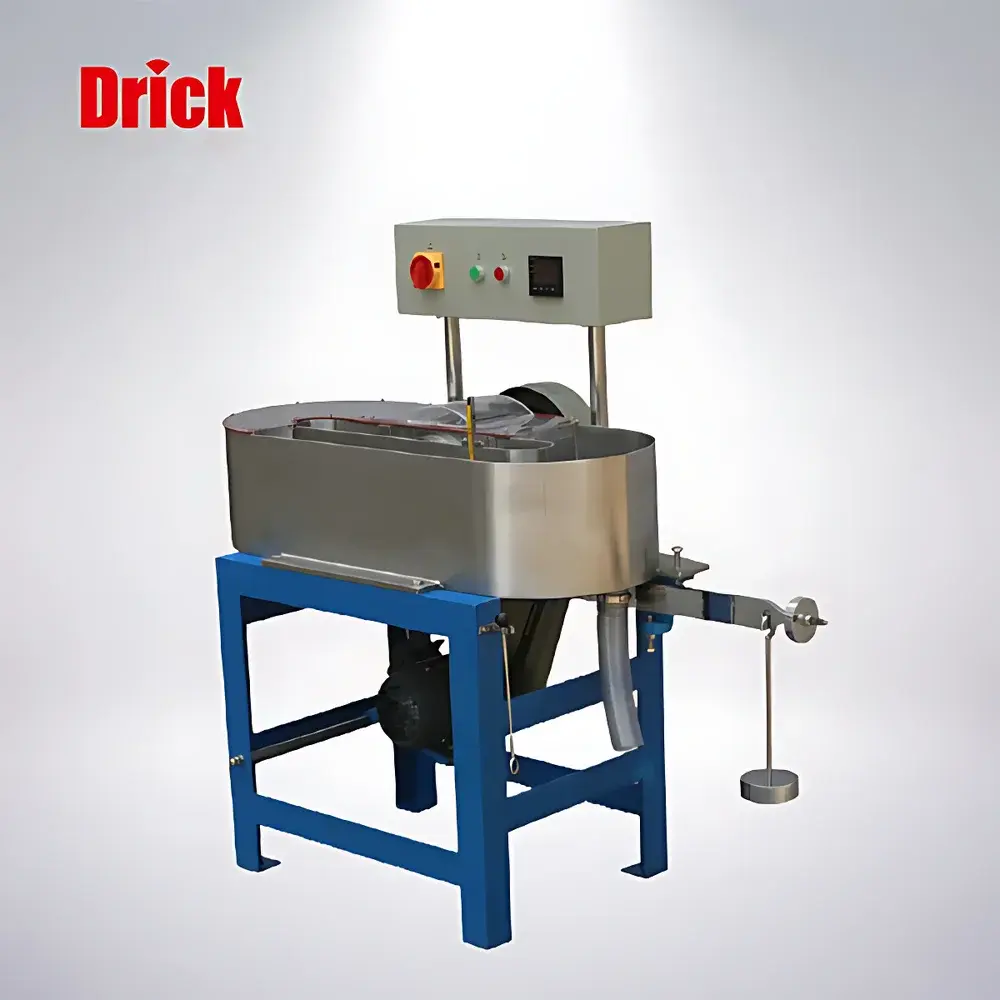
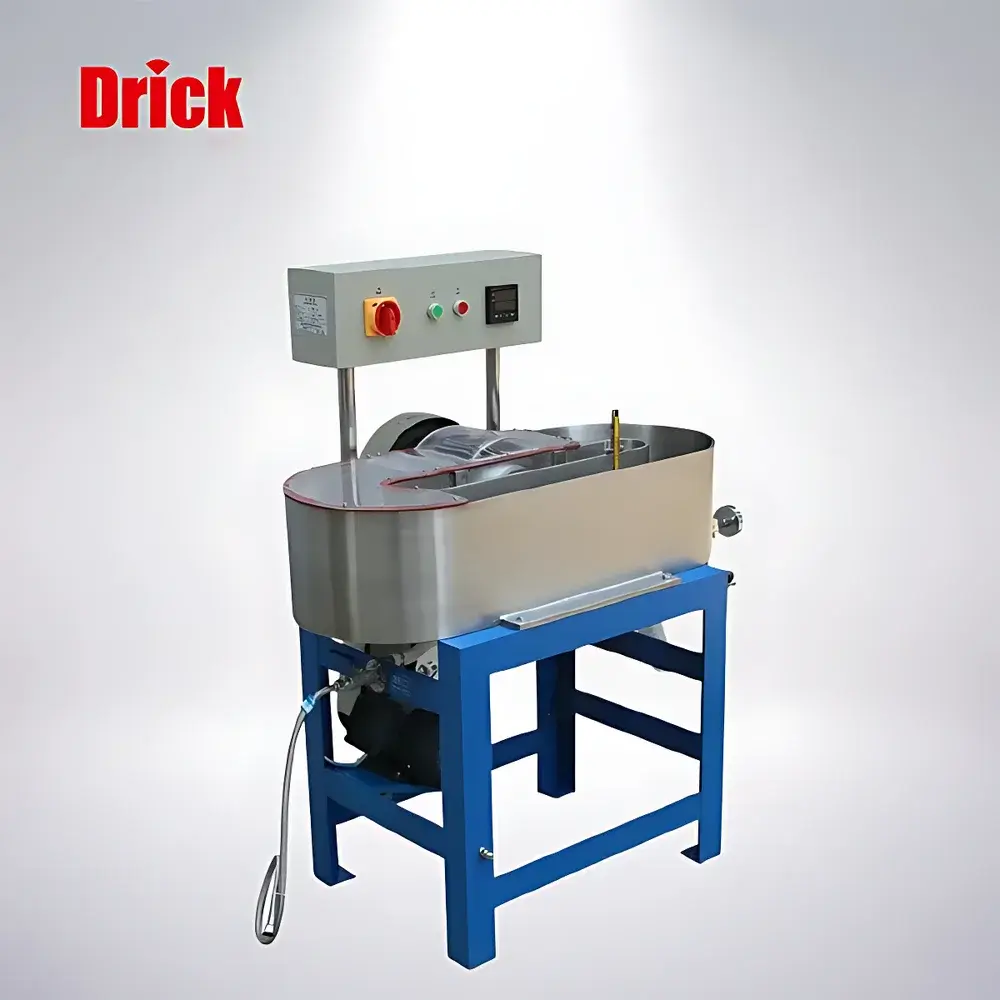
Drick DRK504A Valley Beater for Laboratory Pulping – ISO 5264-1 / TAPPI T200 Compliant
| Brand | Drick |
|---|---|
| Origin | Shandong, China |
| Manufacturer Type | Direct Manufacturer |
| Country of Origin | China |
| Model | DRK 504A |
| Capacity | 23 L |
| Dry Pulp Load | 200–700 g (cut into 25 mm × 25 mm pieces) |
| Flying Knife Roll | Ø194 mm × 155 mm |
| Rotational Speed | (500 ± 10) rpm |
| Motor Power | 750 W / 380 V |
| Overall Dimensions | 1240 mm × 650 mm × 1180 mm |
| Net Weight | 230 kg |
| Water Supply | Intermittent or continuous |
Overview
The Drick DRK504A Valley Beater is a precision-engineered laboratory-scale pulping instrument designed to replicate the classical Valley beater principle defined in ISO 5264-1 (Pulps — Laboratory beating — Part 1: Valley beater method), TAPPI T200 sp-07 (Standard Method for Laboratory Beating of Pulp Using the Valley Beater), and GB/T 7980–1987. It operates on the fundamental hydrodynamic shearing mechanism inherent to the Valley configuration: a rotating flying knife roll engages with a fixed bedknife under controlled mechanical loading, generating reproducible fiber refining action—including fibrillation, cell wall deformation, primary and secondary wall layer disruption, internal delamination, and fiber shortening. This enables systematic investigation of pulp refining behavior across diverse fiber sources (e.g., hardwood, softwood, non-wood plant fibers, synthetic polymers, carbon, and glass fibers), supporting R&D in papermaking science, process optimization, quality assurance, and academic curricula.
Key Features
- Compliance-certified design meeting ISO 5264-1, TAPPI T200, and GB/T 7980–1987 mechanical and dimensional specifications for Valley-type beaters.
- Robust cast-iron frame and precision-machined knife assembly ensuring long-term dimensional stability and repeatable shear geometry.
- Adjustable counterweight system enabling precise control of bedknife loading force—critical for simulating industrial refining intensities.
- Stable rotational drive delivering (500 ± 10) rpm at the flying knife roll, maintained within ±0.2 r/s tolerance per ISO requirements.
- 23-liter stainless-steel beater trough accommodating dry pulp loads from 200 g to 700 g—optimized for statistically representative sample volumes in lab-scale trials.
- Integrated timer with programmable duration control for automated endpoint termination, minimizing operator variability in time-dependent beating protocols.
- Flexible water supply interface compatible with both intermittent dosing and continuous flow configurations—supporting standardized dilution management per test method.
Sample Compatibility & Compliance
The DRK504A accommodates a broad spectrum of fibrous suspensions, including bleached/unbleached chemical pulps, mechanical pulps, recycled fiber fractions, nanocellulose precursors, aramid and polyester synthetic fibers, lignin-rich agricultural residues, and mineral-reinforced composites (e.g., glass or carbon fiber dispersions). Its mechanical configuration satisfies the geometric and operational constraints stipulated in ISO 5264-1 Annex A and TAPPI T200 Section 4. All critical dimensions—including flying knife roll diameter (Ø194 mm), length (155 mm), trough volume (23 L), and clearance tolerances—are validated against reference metrology standards. The unit supports GLP-aligned documentation workflows when paired with traceable calibration records and logbook entries for load, time, and sampling intervals.
Software & Data Management
While the DRK504A operates as a manually supervised mechanical system (no embedded microcontroller or digital HMI), its design facilitates integration into regulated laboratory environments. Operators may record parameters—including applied load, elapsed beating time, sampling timestamps, and corresponding freeness (Schopper-Riegler or Canadian Standard Freeness) results—in structured electronic lab notebooks (ELN) compliant with 21 CFR Part 11 requirements. Optional external data acquisition modules (e.g., torque sensors, temperature probes, or inline conductivity meters) can be interfaced via analog outputs for correlation studies. Full audit trails, user authentication, and version-controlled SOPs are recommended for GMP/QC applications involving pulp specification release or process validation.
Applications
- Refining kinetics analysis: Quantifying freeness decline, fiber length distribution shifts (via fiber analyzer), and drainage rate changes versus beating energy input.
- Comparative evaluation of pulp response to mechanical treatment across species, pulping methods (kraft, sulfite, organosolv), and recycling cycles.
- Development and verification of predictive models linking refining intensity to sheet strength properties (tensile index, burst factor, tear resistance).
- Quality control testing of incoming pulp lots against contractual freeness or Canadian Standard Freeness (CSF) targets.
- Teaching core concepts in fiber morphology, colloidal stability, hornification, and refining efficiency in undergraduate and graduate pulp & paper engineering programs.
- Supporting ASTM D646/D646M and ISO 5267-1 test preparations where standardized beating is prerequisite to handsheet formation.
FAQ
What international standards does the DRK504A explicitly comply with?
It conforms to ISO 5264-1, TAPPI T200 sp-07, and GB/T 7980–1987 for mechanical configuration, operating parameters, and procedural fidelity.
Can the DRK504A process non-wood or synthetic fibers?
Yes—its robust knife geometry and adjustable load system accommodate lignocellulosic non-woods (e.g., bamboo, bagasse), thermoplastic fibers, carbon, and glass fibers, provided slurry rheology remains within pumpable suspension limits.
Is electrical safety certification included?
The unit meets IEC 61000-6-2/6-4 immunity and emission requirements; CE marking is available upon request with full technical documentation package.
How is calibration verified?
Rotational speed is validated using traceable optical tachometry; load application is confirmed via calibrated dead-weight testing prior to commissioning and annually thereafter.
Does it support automated data export?
No native digital interface exists; however, external DAQ systems may capture analog signals (e.g., motor current, temperature) for synchronized logging in third-party platforms.





