
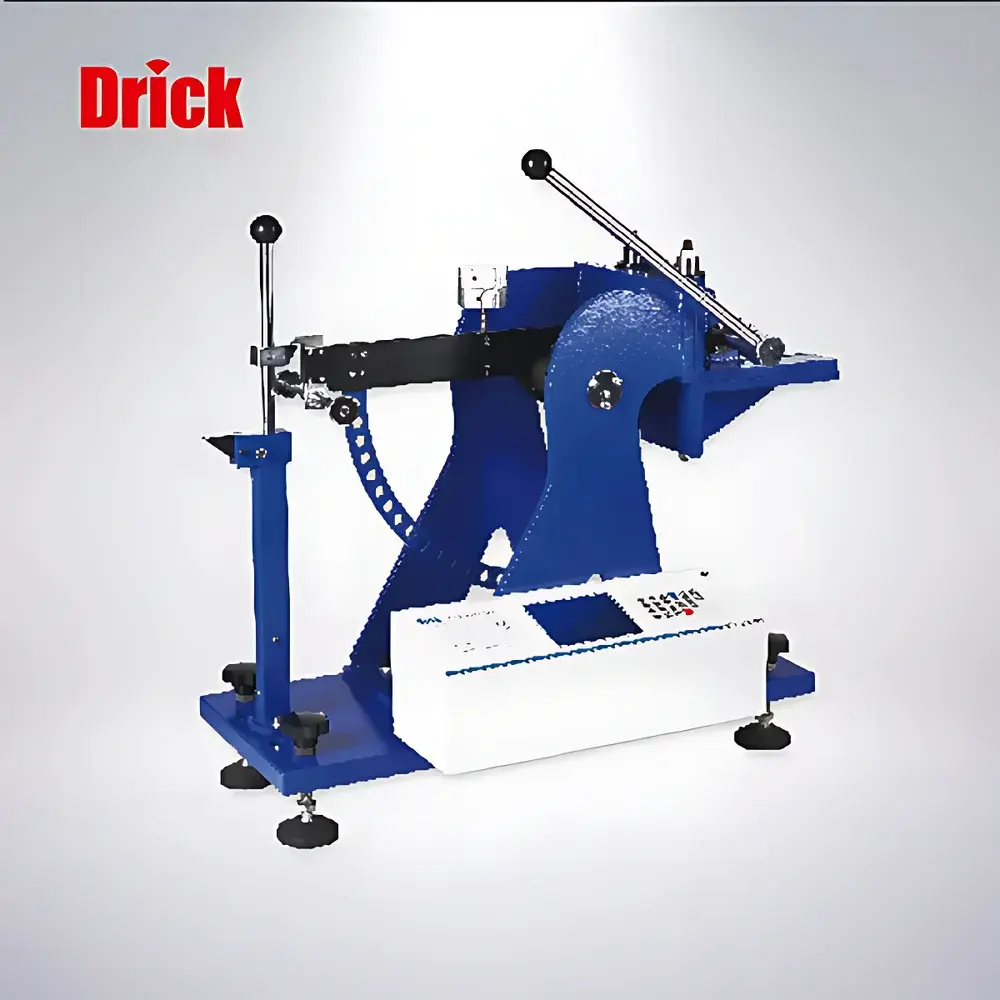
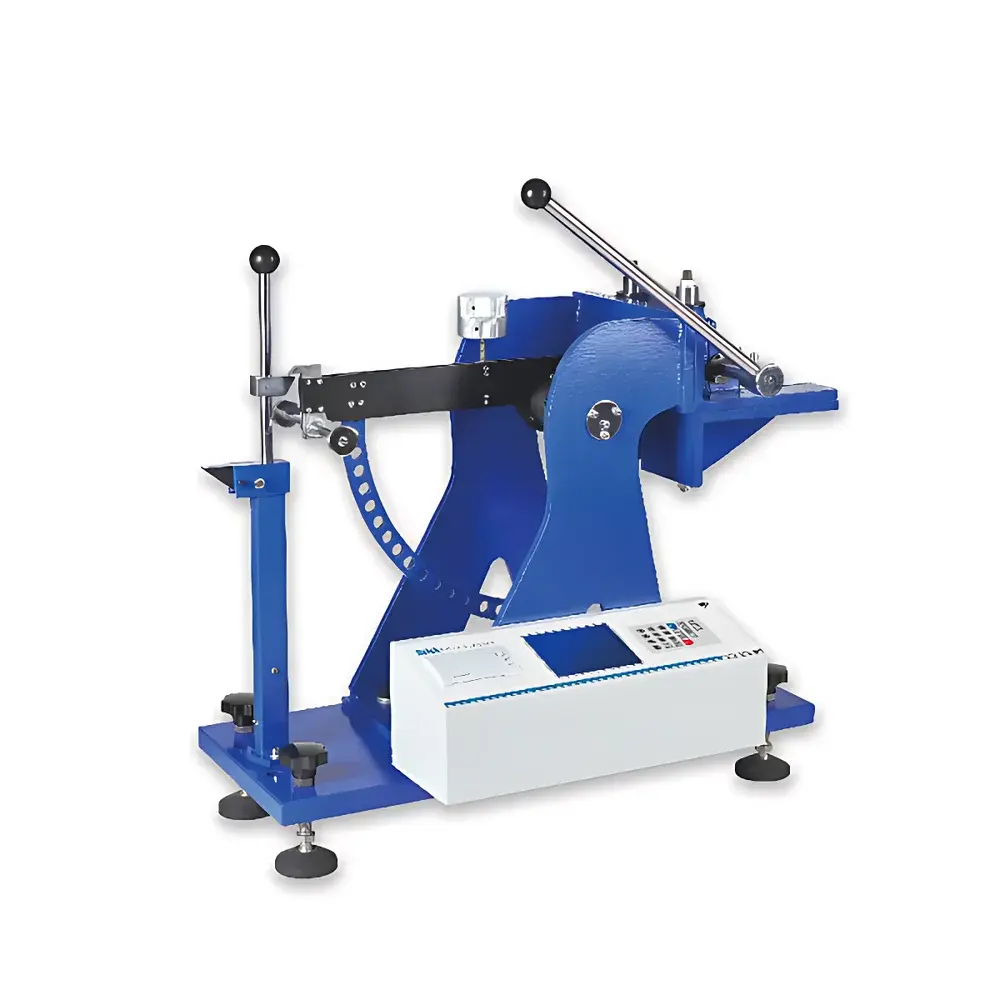
Drick DRK104 Puncture Strength Tester for Corrugated Board and Paperboard
| Brand | Drick |
|---|---|
| Origin | Shandong, China |
| Manufacturer Type | Direct Manufacturer |
| Country of Origin | China |
| Model | DRK104 |
| Measurement Range | 0–48 J (4 ranges: 0–6 J, 0–12 J, 0–24 J, 0–48 J) |
| Accuracy | ±0.05 J (A range), ±0.10 J (B), ±0.20 J (C), ±0.50 J (D) |
| Cone Geometry | Equilateral triangular pyramid |
| Friction Loss | ≤ 0.25 J |
| Swing Arm Frequency | >120 cycles/min |
| Dimensions (L×W×H) | 800 × 470 × 840 mm |
| Net Weight | 145 kg |
| Operating Environment | 5–35 °C, RH ≤ 85 % |
Overview
The Drick DRK104 Puncture Strength Tester is a precision mechanical instrument engineered for the quantitative determination of puncture resistance in corrugated fiberboard, solid fiberboard, containerboard, and other rigid paper-based packaging materials. It operates on the classical pendulum impact principle defined in ISO 3036 and GB/T 2679.7–2005: a standardized triangular pyramid (angle cone) mounted on a calibrated pendulum arm delivers controlled kinetic energy to the specimen. The energy absorbed during penetration—including initial piercing, localized deformation, tearing, and bending—directly corresponds to the puncture strength value, expressed in joules (J). Unlike tensile or compression tests, puncture strength reflects real-world handling hazards such as fork-lift prongs, stacking pressure points, or accidental impacts during distribution. The DRK104’s robust pendulum architecture ensures high reproducibility across repeated measurements, making it suitable for routine quality control in production environments and method validation in accredited laboratories.
Key Features
- Fully microprocessor-controlled operation with integrated LCD interface supporting Chinese-language menu navigation and real-time result display.
- Four-range selectable energy measurement (0–6 J, 0–12 J, 0–24 J, 0–48 J), each calibrated to meet specified accuracy tolerances per GB/T 2679.7–2005 Annex B.
- Automated specimen clamping mechanism with dual upper/lower pressure plates and spring-loaded actuation—ensuring consistent 100 kPa nominal clamping pressure across test area.
- Self-resetting release handle and fail-safe mechanical guard system compliant with EN ISO 12100:2019 risk reduction principles.
- Thermal line printer with non-impact operation, zero consumables (no ink or ribbon), and automatic print-on-completion functionality.
- Modular electromechanical design facilitating field serviceability; all critical components—including pendulum shaft bearings, cone mounting interface, and pointer calibration assembly—are accessible without disassembly of structural frame.
Sample Compatibility & Compliance
The DRK104 accommodates standard test specimens measuring 175 mm × 175 mm, compatible with all common grades of single- and multi-wall corrugated board (e.g., FEFCO-designated A, B, C, E, F flutes), solid bleached sulfate (SBS), chipboard, and laminated paperboard substrates. Specimen thickness up to 12 mm is supported without modification. Instrument compliance includes full alignment with ISO 3036:2017 (Paper and board — Determination of puncture resistance) and GB/T 2679.7–2005 (Chinese national standard equivalent). Data output meets GLP documentation requirements, including timestamped test records, operator ID fields (via optional USB keyboard), and traceable calibration certificate linkage. While not inherently 21 CFR Part 11 compliant, audit trails and data integrity can be maintained through external LIMS integration via RS232 serial output.
Software & Data Management
The embedded firmware supports statistical analysis of up to 99 test results per batch, calculating arithmetic mean, standard deviation, coefficient of variation (CV%), and min/max values. All results are stored in non-volatile memory with time/date stamping. Data export is enabled via built-in thermal printer or RS232 serial port for connection to laboratory PCs running custom CSV parsers or third-party QC software (e.g., Minitab, JMP, or internal SPC dashboards). No proprietary software installation is required; raw ASCII data streams contain unambiguous field delimiters (tab-separated) and conform to ASTM E1382-15 guidelines for instrument data formatting. Calibration verification routines are accessible via service mode, requiring authorized password entry and reference standard cone verification.
Applications
This tester serves as a core performance verification tool across packaging supply chains: corrugated box manufacturers use it to validate board grade specifications prior to die-cutting; e-commerce fulfillment centers deploy it for incoming material inspection against supplier COAs; regulatory testing labs apply it in conformity assessments for ISTA 3A/3E simulation protocols; and academic research groups utilize its repeatable energy-transfer profile for studying fiber network failure mechanics under dynamic loading. Its direct correlation with field damage incidence makes it indispensable for predictive modeling of palletized unit load integrity under mixed-mode transport stresses.
FAQ
What standards does the DRK104 comply with?
ISO 3036:2017 and GB/T 2679.7–2005 are fully implemented in both mechanical design and measurement algorithm.
Is calibration certification included with shipment?
Yes—a factory-issued calibration report traceable to CNAS-accredited reference standards is provided; annual recalibration is recommended per ISO/IEC 17025 requirements.
Can the instrument be used for non-standard specimen sizes?
Only 175 mm × 175 mm specimens are validated per standard; deviations require documented method equivalence justification and revalidation.
Does the DRK104 support automated data transfer to enterprise systems?
Via RS232 interface using Modbus RTU protocol or ASCII text streaming; no Ethernet or Wi-Fi connectivity is built-in.
What maintenance intervals are recommended?
Lubrication of pendulum pivot bearings every 6 months; visual inspection of cone geometry and friction sleeve wear before each shift; full mechanical verification annually.





