
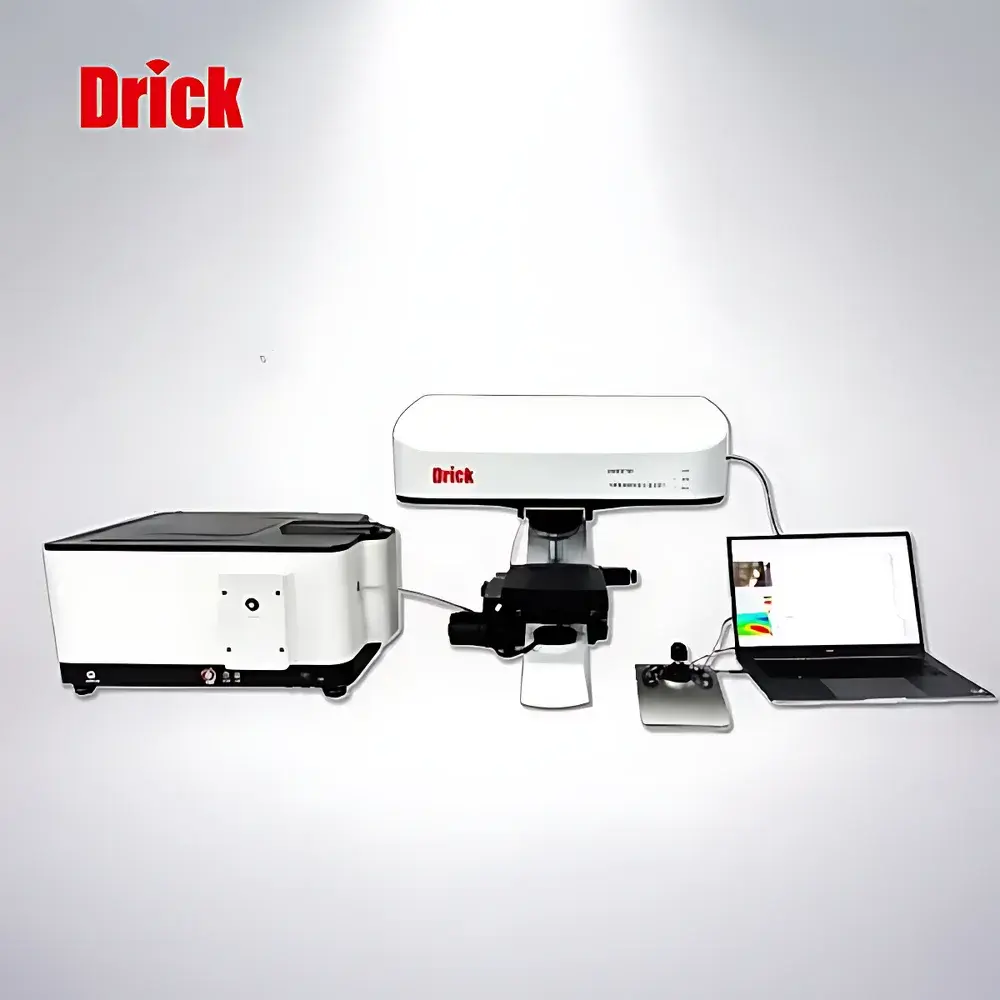
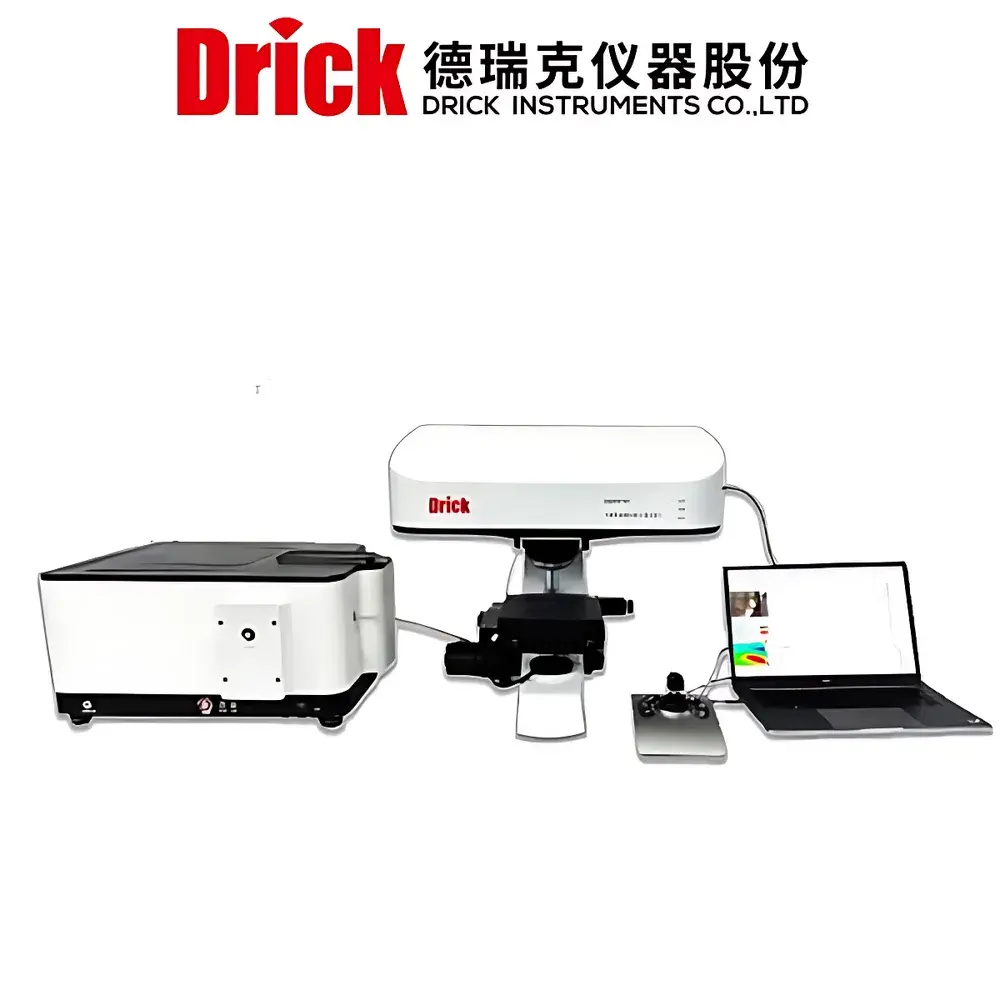
DRK8700 Split-Configuration True Confocal Automated Raman Microspectroscopy Imaging System
| Brand | Drick |
|---|---|
| Origin | Shandong, China |
| Manufacturer Type | OEM Manufacturer |
| Model | DRK8700 |
| Instrument Type | Confocal Micro-Raman Spectrometer |
| Excitation Wavelength | Standard 532 nm (optional 785 nm or 633 nm) |
| Spatial Resolution | Sub-micron (dependent on objective lens and laser wavelength) |
| Spectral Range | 100–3500 cm⁻¹ (typical) |
| Spectral Resolution | ≤ 2 cm⁻¹ (FWHM) |
| Detector | Back-illuminated CCD or EMCCD |
| Automation | Motorized XYZ stage, auto-focus, turret-mounted objectives, software-controlled laser attenuation and filter selection |
| Software Platform | Proprietary RamanSuite™ with spectral library matching, multivariate analysis (PCA, cluster mapping), and hyperspectral image reconstruction |
Overview
The DRK8700 Split-Configuration True Confocal Automated Raman Microspectroscopy Imaging System is engineered for high-fidelity chemical imaging and molecular fingerprinting at the microscale. Unlike conventional widefield or pseudo-confocal Raman systems, the DRK8700 implements a true confocal optical architecture—featuring a precisely aligned pinhole aperture in both excitation and detection pathways—to reject out-of-focus fluorescence and scattered light, thereby delivering unambiguous depth-resolved spectral data with enhanced signal-to-noise ratio and axial sectioning capability. Designed for integration into regulated laboratory environments, the system supports non-destructive, label-free identification of crystalline phases, polymorphs, stress/strain distribution, contaminant localization, and compositional heterogeneity across solid, thin-film, and embedded samples. Its modular split configuration separates the spectrometer unit from the microscope base, enabling flexible optical alignment, thermal stability management, and compatibility with inverted or custom optical tables—critical for long-duration mapping experiments or hybrid setups (e.g., combined with AFM or electrochemical cells).
Key Features
- True confocal design with adjustable pinhole diameter (25–100 µm) for optimized depth discrimination and lateral resolution trade-off
- Automated XYZ motorized stage (100 × 100 mm travel, 100 nm repeatability) with real-time autofocus and drift compensation algorithms
- Multi-laser excitation support (standard 532 nm; optional 785 nm for reduced fluorescence in organics/biologicals; 633 nm for resonance enhancement in specific dyes)
- Turret-mounted objective lens changer (up to 6 positions) with calibrated magnification (20×, 50×, 100×) and correction collar for coverslip thickness compensation
- High-throughput spectral acquisition: <1 sec per spectrum (1024 × 128 pixel CCD, 16-bit dynamic range); full 2D hyperspectral cube acquisition in <30 min for 100 × 100 µm area at 0.5 µm step size
- Rugged aluminum-alloy optical bench with passive vibration damping and temperature-stabilized detector housing (±0.1 °C control)
Sample Compatibility & Compliance
The DRK8700 accommodates standard microscope slides, silicon wafers, metallographic cross-sections, polymer films, pharmaceutical tablets, textile fibers, and encapsulated biological tissues (e.g., FFPE sections). Sample height tolerance extends up to 30 mm, supporting irregular or thick specimens without reconfiguration. All optical components comply with ISO 10110 surface quality standards; spectral calibration traceability is maintained via NIST-traceable silicon (520.7 cm⁻¹) and cyclohexane (2849 cm⁻¹) reference standards. The system meets essential requirements for GLP-compliant laboratories—including electronic signature support, audit trail logging (per FDA 21 CFR Part 11), and instrument qualification documentation (IQ/OQ/PQ templates available upon request). It supports ASTM E1840 (Standard Guide for Raman Shift Standards) and ISO/IEC 17025:2017 clause 5.9 (method validation for spectroscopic analysis).
Software & Data Management
RamanSuite™ v4.x provides a unified interface for acquisition, processing, visualization, and reporting. Core modules include: (1) Real-time spectral preview with live background subtraction and cosmic ray removal; (2) Hyperspectral map generation with intensity, peak position, FWHM, and ratio overlays; (3) Multivariate analysis suite (PCA, hierarchical clustering, MCR-ALS) for unsupervised component decomposition; (4) Quantitative modeling tools (PLS regression) validated against reference standards; (5) Export formats compliant with ASTM E1347 (ASCII-based spectral data exchange) and HDF5 for large-scale dataset interoperability. All raw and processed data are stored in a timestamped, immutable project structure with SHA-256 hash integrity verification. User roles and permissions are configurable to enforce data governance policies.
Applications
- Pharmaceutical: Polymorph screening in active pharmaceutical ingredients (APIs), counterfeit drug detection, coating uniformity analysis of controlled-release tablets
- Materials Science: Graphene layer counting, carbon nanotube chirality assignment, residual stress mapping in thin-film solar cells and semiconductor heterostructures
- Forensics: Trace evidence analysis (paint chips, fibers, explosives residues) with sub-10 µm spatial resolution
- Environmental: Microplastic identification and polymer typing in water filtration membranes and sediment cores
- Life Sciences: Label-free histopathology of unstained tissue sections; lipid/protein distribution mapping in single cells
- Quality Control: In-line verification of ink composition in printed electronics; defect chemistry analysis in lithium-ion battery cathodes
FAQ
Is the DRK8700 compatible with third-party microscopes?
Yes—the split configuration allows direct coupling to Olympus BX series, Nikon Eclipse Ci, or Zeiss Axio Imager platforms via C-mount or tube lens adapters.
Does the system support time-resolved Raman measurements?
Not natively; however, external TTL-triggered pulsed lasers (e.g., picosecond Nd:YAG) can be synchronized via the digital I/O port for pump-probe configurations.
What spectral calibration frequency is recommended for routine operation?
Daily verification using silicon reference is advised; full recalibration (grating alignment + detector pixel mapping) is required every 6 months or after mechanical shock.
Can RamanSuite™ generate reports compliant with ISO 17025 accreditation?
Yes—templates include metadata fields for analyst ID, instrument ID, environmental conditions, uncertainty estimation (k=2), and revision history, all exportable as PDF/A-2b.
Is remote maintenance supported?
Yes—secure TLS-encrypted remote desktop access is available for firmware updates and diagnostic troubleshooting under signed service agreement.





