
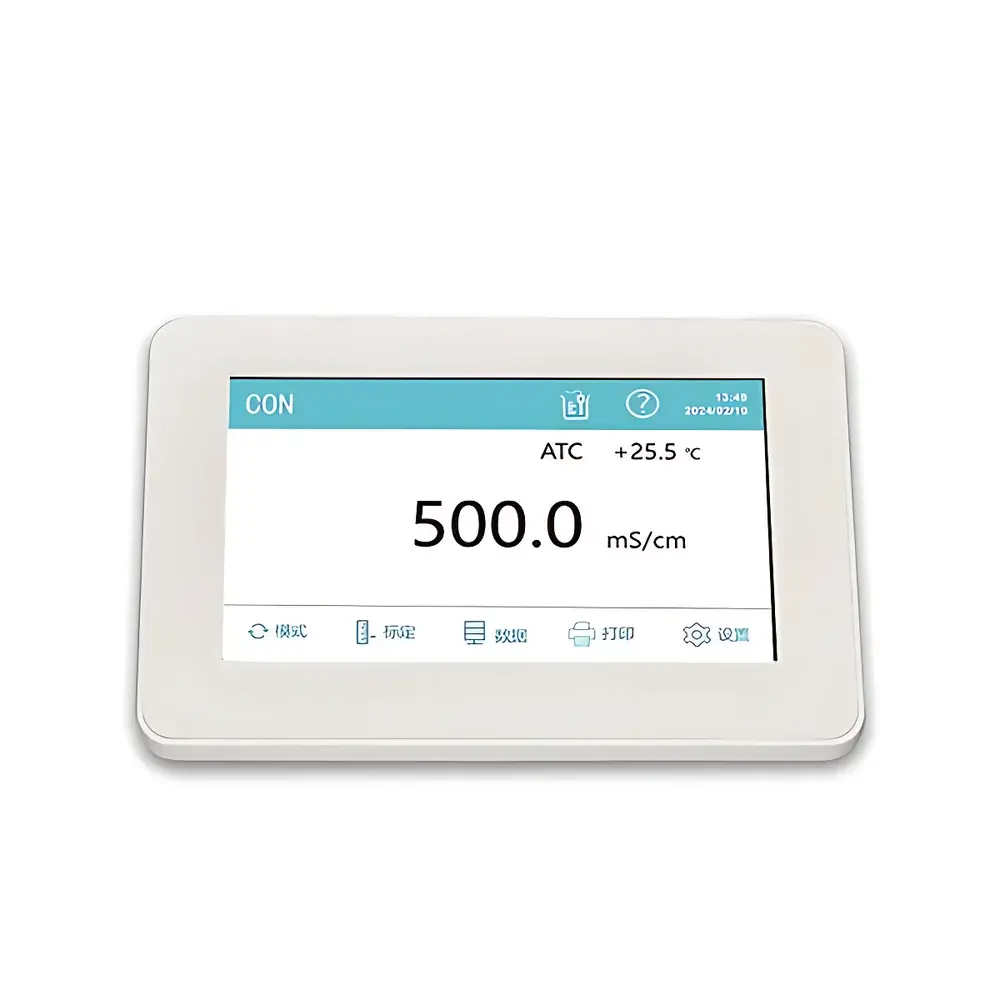
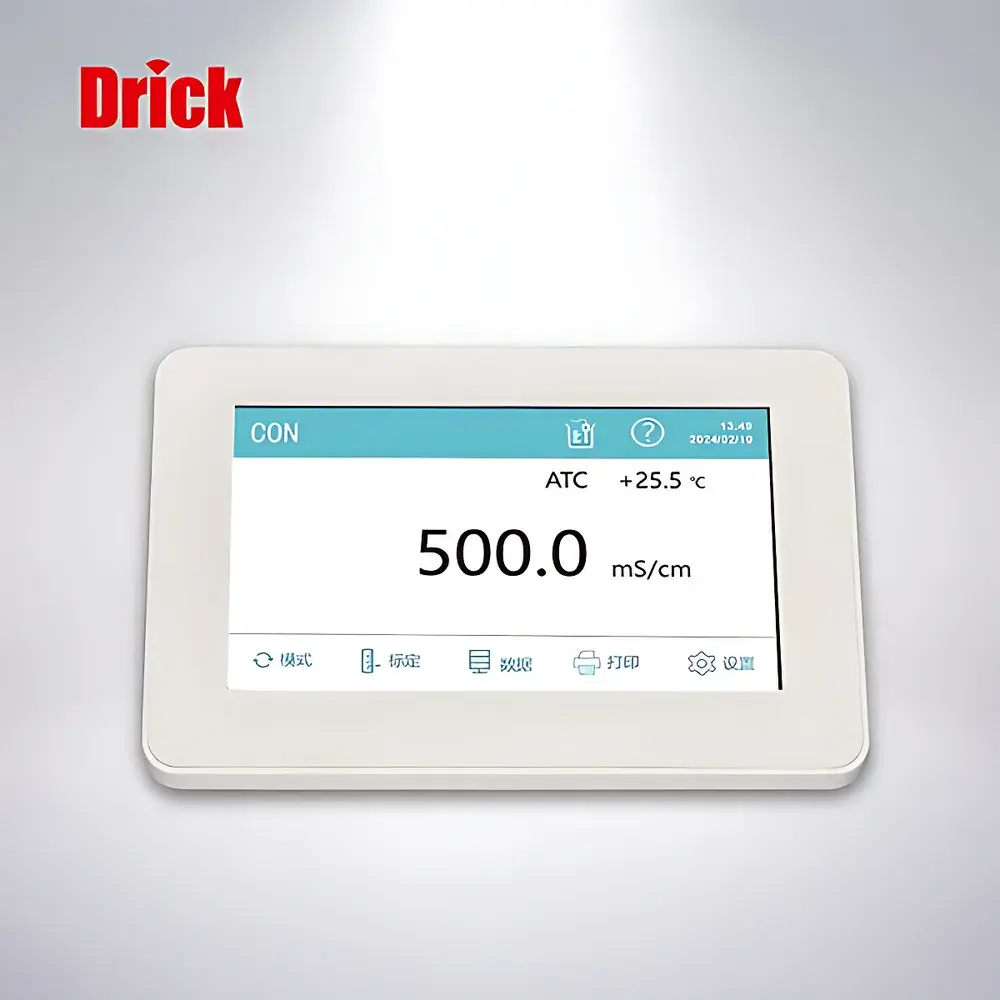
Drick DRK-DDS-421 Benchtop Conductivity Meter
| Brand | Drick |
|---|---|
| Model | DRK-DDS-421 |
| Type | Benchtop Conductivity Meter |
| Measurement Modes | Conductivity, Resistivity, TDS, Salinity, Temperature |
| Conductivity Range | 0.05 µS/cm to 500.0 mS/cm |
| Resistivity Range | 5.00 Ω·cm to 20.00 MΩ·cm |
| TDS Range | 0.000 mg/L to 100 g/L |
| Salinity Range | 0.00–8.00 % |
| Temperature Range | −5.0 to 110.0 °C |
| Accuracy | ±0.5 % FS (Conductivity/Resistivity/TDS), ±0.1 % (Salinity), ±0.2 °C (Temperature) |
| Electrode Interface | BNC + RCA |
| Display | 7-inch color TFT touchscreen |
| Data Storage | 1500 measurement records |
| Calibration | 1–3 point conductivity cell constant calibration, 1-point TDS conversion factor calibration |
| Temperature Compensation | Automatic/manual (−5.0 to 110.0 °C) |
| Compliance | GLP-compliant data logging and reporting |
| Connectivity | USB + RS232 |
| Power | DC 12 V, 10 W |
| Dimensions | 200 × 130 × 60 mm |
| Weight | 1.0 kg |
Overview
The Drick DRK-DDS-421 Benchtop Conductivity Meter is a precision electrochemical instrument engineered for reliable, multi-parameter measurement of aqueous electrolyte solutions in quality control, environmental monitoring, pharmaceutical manufacturing, and academic research laboratories. Based on the fundamental principle of conductometric analysis—measuring the electrical conductance of a solution between two electrodes—the DRK-DDS-421 quantifies ion mobility under controlled conditions to derive conductivity (σ), resistivity (ρ), total dissolved solids (TDS), salinity, and temperature. Its dual-electrode architecture supports interchangeable sensor configurations—including platinum black (DJS-1N), low-conductivity titanium alloy (DJS-0.01), and high-range stainless steel (DJS-10)—enabling trace-level ultrapure water analysis as well as concentrated brine characterization. The instrument operates within a validated temperature range of −5.0 to 110.0 °C, with integrated automatic temperature compensation (ATC) aligned to standard reference curves (e.g., NaCl or KCl-based linear/nonlinear models), ensuring metrological consistency across diverse sample matrices.
Key Features
- Multi-parameter measurement engine supporting simultaneous display and logging of conductivity, resistivity, TDS, salinity, and temperature
- Configurable electrode constant calibration (1–3 points) using certified standard solutions (146.5 µS/cm, 1408.3 µS/cm, 12.852 mS/cm, 111.31 mS/cm) and independent TDS conversion factor adjustment
- Three-tier user access control (Administrator, User, Guest) with password protection and role-specific permissions for audit trail integrity
- GLP-compliant data management system featuring time-stamped records, operator ID tagging, and full traceability of calibration events and measurement history
- 7-inch high-resolution color TFT touchscreen with Metro-style UI, intuitive icon-driven navigation, and embedded contextual help (accessed via “?” icon)
- Automatic frequency and range selection to optimize signal-to-noise ratio across six decades of conductivity (0.05 µS/cm to 500.0 mS/cm)
- Integrated thermal compensation algorithms supporting both automatic (via built-in Pt1000 sensor or external probe) and manual input modes
- Direct printing capability via USB or RS232 interfaces; all reports include calibration verification status, date/time stamps, and instrument identification per FDA 21 CFR Part 11 alignment principles
Sample Compatibility & Compliance
The DRK-DDS-421 accommodates a broad spectrum of liquid samples—from deionized water and buffer solutions to industrial process streams and seawater analogs—through its modular electrode interface (BNC for conductivity cells, RCA for temperature probes). Compatible electrode options include DJS-1N (platinum black, optimal for medium-to-high conductivity), DJS-0.01 (titanium alloy, suited for ultrapure water resistivity >10 MΩ·cm), and DJS-10 (stainless steel, rated for aggressive saline environments). All measurements adhere to internationally recognized standards including ASTM D1125 (Standard Test Methods for Electrical Conductivity and Resistivity of Water), ISO 7888 (Water quality — Determination of electrical conductivity), and USP (Water Conductivity). The instrument’s firmware enforces GLP requirements through immutable audit logs, electronic signatures (where enabled via network integration), and secure data export protocols.
Software & Data Management
Data handling is governed by an embedded real-time operating system supporting up to 1500 measurement entries with full metadata: timestamp (YYYY-MM-DD HH:MM:SS), operator ID, electrode ID, calibration status, temperature reading, and raw/compensated values. Export formats include CSV and PDF via USB mass storage or serial transmission. All printed reports comply with GLP documentation criteria, listing instrument serial number, calibration due dates, standard solution lot numbers, and uncertainty estimates derived from full-scale error specifications (±0.5 % FS). Optional PC software enables advanced trend analysis, statistical process control (SPC) charting, and integration into LIMS environments via standardized ASCII command sets.
Applications
- Pharmaceutical water systems validation (PW, WFI, purified water per EP/USP monographs)
- Environmental testing of surface water, groundwater, and wastewater effluents
- Food & beverage QC for brine concentration, syrup conductivity, and cleaning-in-place (CIP) rinse verification
- Chemical manufacturing process monitoring of acid/base titration endpoints and electrolyte bath stability
- Academic electrochemistry labs for teaching conductivity–concentration relationships and Kohlrausch’s law validation
- Power plant boiler feedwater purity assurance and corrosion inhibitor dosing control
FAQ
What electrode types are supported, and how do I select the appropriate one for my application?
The DRK-DDS-421 accepts DJS-series electrodes with cell constants ranging from 0.01 cm⁻¹ (DJS-0.01) to 10.0 cm⁻¹ (DJS-10). Selection depends on expected conductivity: use 0.01 cm⁻¹ for ultrapure water (>10 MΩ·cm), 1.0 cm⁻¹ for general lab use (100 µS/cm–10 mS/cm), and 10.0 cm⁻¹ for high-salinity samples (>100 mS/cm).
Does the instrument support compliance with FDA 21 CFR Part 11?
While the standalone DRK-DDS-421 does not include electronic signature modules, its GLP-compliant audit trail, time-stamped calibration logs, and immutable data export meet foundational requirements for Part 11 readiness when deployed within validated networked environments.
Can I perform temperature-compensated measurements outside the built-in sensor’s range?
Yes—manual temperature entry is supported from −5.0 to 110.0 °C, allowing compensation even when using external calibrated thermometers or RTDs beyond the internal Pt1000’s operational envelope.
How is calibration verification documented and retained?
Each calibration event generates a timestamped report containing standard solution IDs, measured values, deviation calculations, and pass/fail status against ±0.5 % FS tolerance—stored locally and printable on demand.
Is the touchscreen interface operable with gloves or in humid laboratory conditions?
The projected capacitive touchscreen supports gloved operation and maintains responsiveness at relative humidity levels up to 80 %, consistent with ISO 14644-1 Class 8 cleanroom ambient specifications.





