
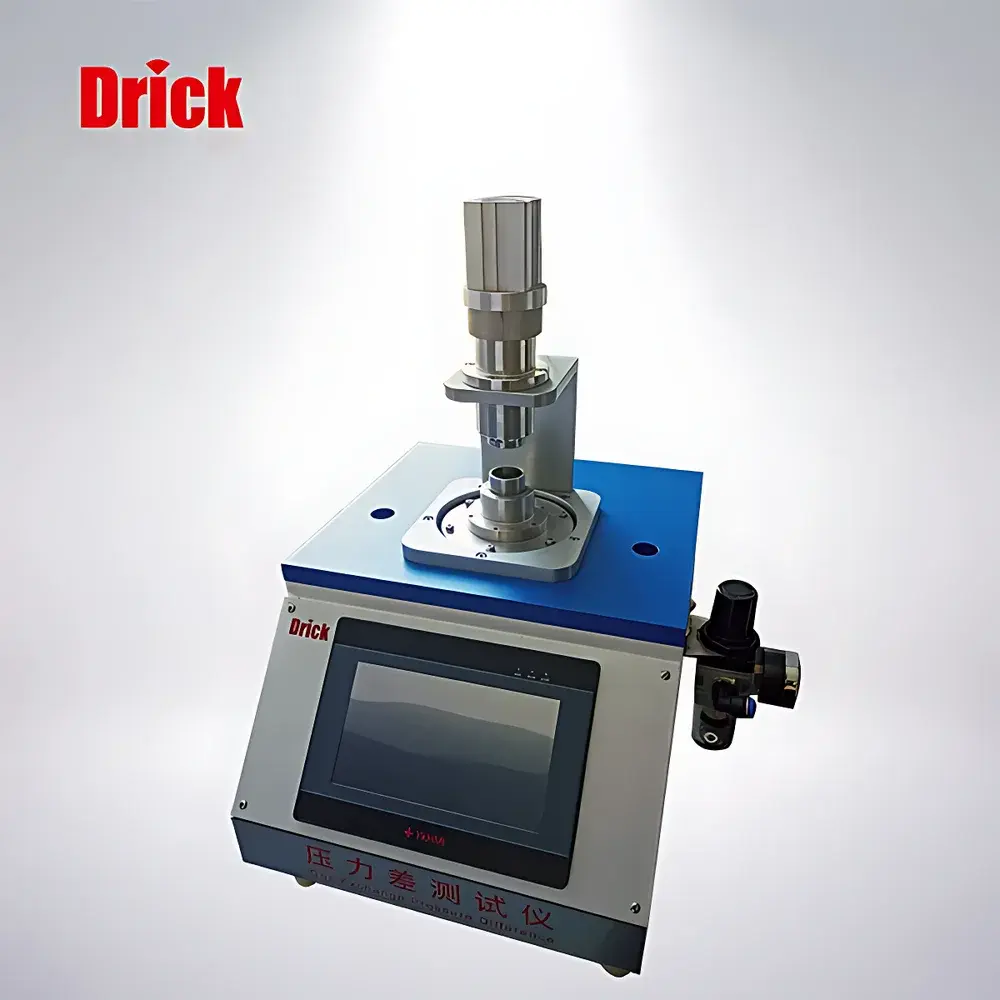
Drick DRK206 Respirator and Surgical Mask Pressure Differential Tester
| Brand | Drick |
|---|---|
| Origin | Shandong, China |
| Manufacturer Type | OEM/ODM Manufacturer |
| Country of Origin | China |
| Model | DRK206 |
| Air Flow Rate | 8 L/min |
| Test Area Diameter | Ø25 mm |
| Pressure Differential Range | 0–500 Pa |
| Power Supply | AC 220 V, 50 Hz |
| Compliance Standards | YY 0469–2011, YY 0969–2013, EN 14683:2014 |
Overview
The Drick DRK206 Respirator and Surgical Mask Pressure Differential Tester is a precision-engineered instrument designed to quantify the pressure differential across respiratory protective devices under standardized airflow conditions. It operates on the principle of controlled air suction through a defined test area (Ø25 mm), enabling direct measurement of resistance to airflow — a critical parameter for assessing breathability and user comfort in medical face masks and respirators. This instrument conforms to internationally recognized regulatory frameworks governing personal protective equipment (PPE), including YY 0469–2011 (Chinese standard for surgical masks), YY 0969–2013 (for disposable medical masks), and EN 14683:2014 (European standard specifying requirements and test methods for medical face masks). Its design prioritizes metrological stability, mechanical repeatability, and operational independence from ambient laboratory airflow constraints — achieved via an integrated vacuum-driven air source.
Key Features
- Vacuum-powered airflow system ensures consistent 8 L/min volumetric flow rate without reliance on external compressed air or dedicated ventilation infrastructure.
- High-accuracy differential pressure transducer (0–500 Pa range) with digital display provides real-time, drift-compensated readings traceable to national metrology standards.
- Custom-engineered clamping mechanism employs face-seal geometry to eliminate edge leakage and ensure uniform compression of specimens — critical for reproducible results across diverse textile-based mask materials.
- Compact benchtop footprint and self-contained power supply (AC 220 V, 50 Hz) support deployment in QC labs, R&D facilities, and regulatory testing centers with minimal installation overhead.
- Robust mechanical architecture minimizes sensitivity to vibration and thermal drift during extended test sequences, supporting high-throughput batch validation.
Sample Compatibility & Compliance
The DRK206 accommodates flat, non-rigid specimens up to 3 mm thickness, including multi-layer melt-blown polypropylene composites, spunbond nonwovens, and hybrid filtration media used in surgical masks, procedure masks, and basic respirators (e.g., KN95-equivalent designs). Its Ø25 mm test aperture aligns precisely with the active sampling zone specified in YY 0469–2011 Clause 5.5 and EN 14683:2014 Annex A. All mechanical interfaces are constructed from corrosion-resistant stainless steel and anodized aluminum to maintain dimensional integrity over repeated sterilization cycles and long-term use. The instrument supports audit-ready documentation workflows compatible with GLP-compliant laboratories; raw pressure differential values are directly recordable into LIMS or ELN systems via manual entry or optional RS232 interface (available upon request).
Software & Data Management
While the base DRK206 operates as a stand-alone analog-digital hybrid instrument with front-panel digital display, it is fully compatible with external data acquisition protocols. Users may integrate the device into validated QA/QC software environments via its analog voltage output (0–5 V DC proportional to pressure differential) or optional serial communication module. This enables automated logging, statistical process control (SPC) charting, and electronic signature-capable reporting aligned with FDA 21 CFR Part 11 requirements when deployed within validated computerized systems. Calibration certificates include NIST-traceable uncertainty budgets and are issued per ISO/IEC 17025–accredited procedures by authorized third-party metrology providers.
Applications
- Verification of breathability performance for surgical masks prior to CE marking or NMPA registration.
- Comparative evaluation of filtration media alternatives during PPE material development.
- In-process quality control of mask production lines to monitor consistency of layer bonding and pleat integrity.
- Regulatory submission testing for compliance with EN 14683 Class I/IIa/IIb classification thresholds (ΔP ≤ 40 Pa for Type I, ≤ 60 Pa for Type II/IR).
- Research into humidity- and temperature-dependent airflow resistance behavior of electrostatically charged filter layers.
FAQ
What standards does the DRK206 explicitly support?
It is configured and validated for YY 0469–2011, YY 0969–2013, and EN 14683:2014 — with hardware geometry and airflow calibration traceable to each standard’s test method clauses.
Is the 8 L/min airflow rate adjustable?
No — the vacuum source is fixed at 8 L/min to comply with mandatory test conditions in all referenced standards; no user adjustment is permitted or required.
Can the DRK206 test respirators with exhalation valves?
Yes, provided the valve remains closed during testing; the instrument measures static pressure differential across the mask body only, not dynamic valve function.
Does the system include calibration documentation?
Yes — each unit ships with a factory calibration certificate indicating as-found/as-left values, measurement uncertainty, and traceability to national standards.
What maintenance is required for long-term accuracy?
Annual recalibration of the pressure transducer and verification of clamp force uniformity are recommended; no consumables or routine servicing beyond cleaning of the sample chamber is necessary.





