
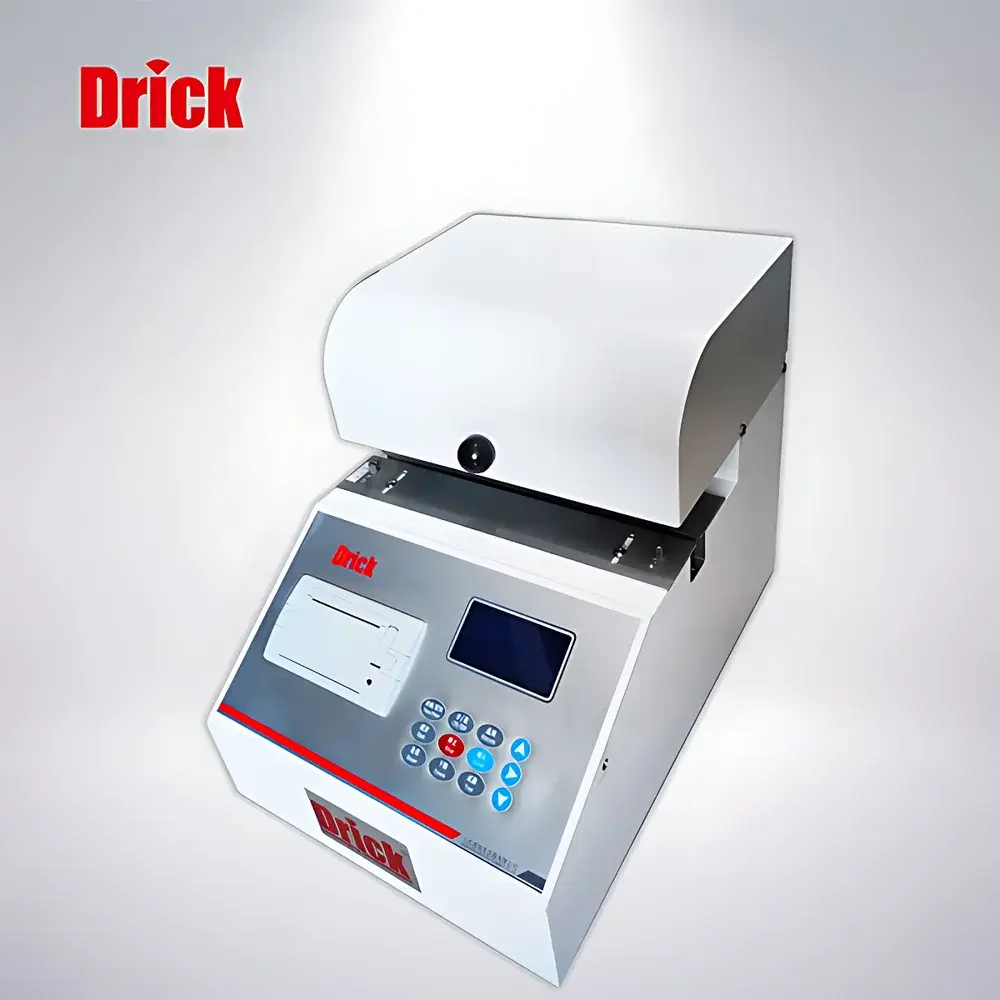
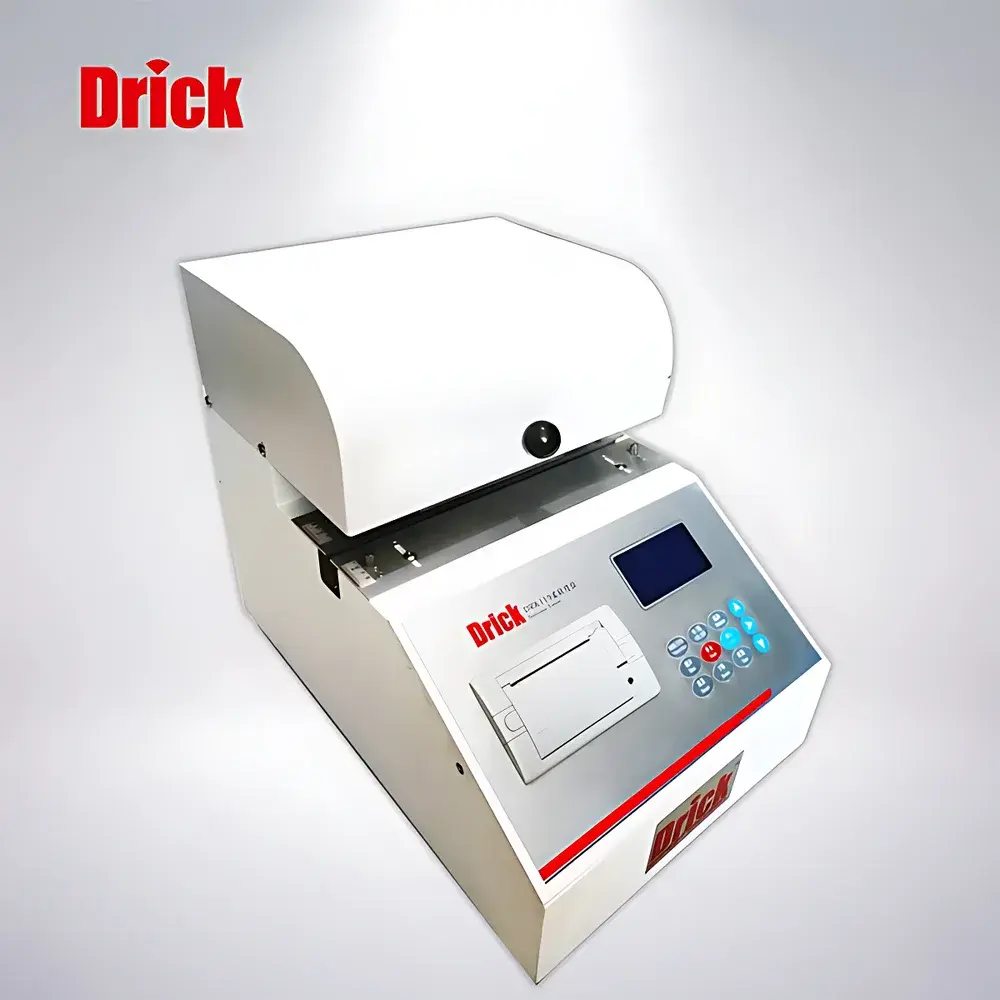
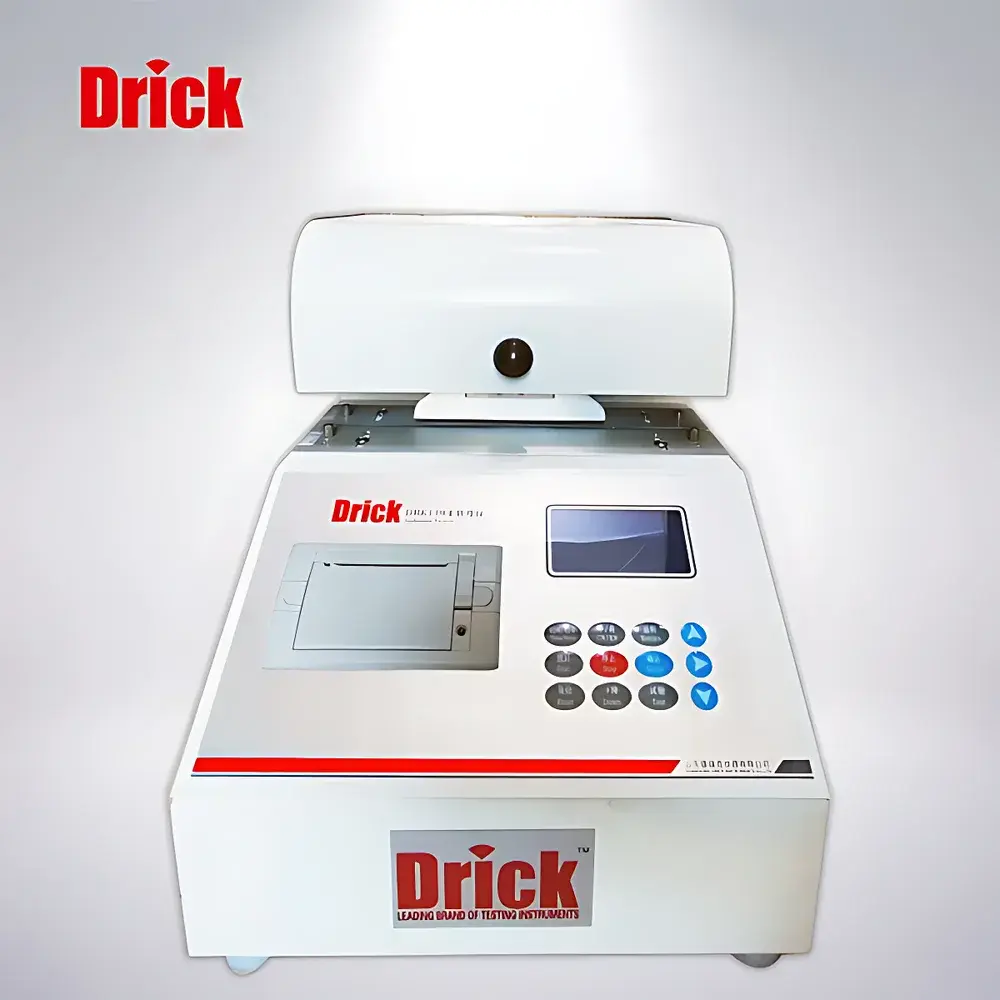
Drick DRK119 Button-Operated Tissue Softness Tester
| Brand | Drick |
|---|---|
| Origin | Shandong, China |
| Manufacturer Type | Manufacturer |
| Country of Origin | China |
| Model | DRK 119 |
| Force Range | 0–1000 mN |
| Resolution | 0.01 mN |
| Accuracy | ±1% (±1 mN below 20% of full scale) |
| Repeatability | <3% (±1 mN below 20% of full scale) |
| Probe Travel | 12 ± 0.5 mm |
| Probe Penetration Depth | 8–8.5 mm |
| Slit Width Options | 5 mm, 6.35 mm, 10 mm, 20 mm (tolerance ±0.05 mm) |
| Slit Parallelism Error | ≤0.05 mm |
| Probe Centering Error | ≤0.05 mm |
| Power Supply | AC 220 V ±5% |
| Dimensions (L×W×H) | 240 × 300 × 280 mm |
| Weight | ~24 kg |
| Interface | RS-232 serial output |
| Display | Dual-language LCD (English/Chinese) |
| Data Output | Built-in thermal printer |
| Statistical Functions | Mean, SD, Max/Min |
Overview
The Drick DRK119 Button-Operated Tissue Softness Tester is a precision-engineered instrument designed to quantitatively evaluate the perceived softness of flexible sheet materials—primarily tissue paper, sanitary products, nonwovens, and thin films—by simulating manual finger compression under standardized mechanical conditions. It operates on the principle of controlled probe displacement against a constrained sample strip mounted across a calibrated slit, measuring the resistive force (in millinewtons) required to deflect the material to a defined depth. This method aligns with established tactile evaluation paradigms used in quality control laboratories where subjective hand-feel assessment must be replaced by objective, repeatable metrics. The instrument implements a constant-speed, motor-driven probe actuation system coupled with high-fidelity load cell sensing, enabling compliance with internationally recognized test protocols for softness characterization in hygiene and packaging applications.
Key Features
- High-accuracy load cell with ±1% full-scale accuracy—exceeding the ±3% tolerance specified in GB/T 8942 and TAPPI T 498 cm-85.
- Stepper-motor-driven probe mechanism ensuring precise, vibration-free travel and consistent penetration depth (8–8.5 mm) across repeated cycles.
- Dual-language (English/Chinese) graphical LCD interface with intuitive button-based navigation—no touchscreen or external PC required for basic operation.
- Onboard statistical engine calculating mean, standard deviation, maximum, and minimum values from up to 10 sequential measurements per test session.
- Four selectable slit widths (5 mm, 6.35 mm, 10 mm, 20 mm), each manufactured to tight geometric tolerances (±0.05 mm parallelism and centering), supporting method flexibility per material stiffness and industry practice.
- Integrated thermal printer for immediate hard-copy output of raw data, summary statistics, and timestamped test records.
- RS-232 serial interface for bidirectional communication with external PCs or LIMS systems—enabling automated data logging and traceability.
Sample Compatibility & Compliance
The DRK119 accommodates a broad spectrum of thin, flexible substrates including facial tissues, toilet paper, baby wipes, medical gauze, spunbond/meltblown nonwovens, cigarette paper, synthetic leather laminates, and polymer films (e.g., LDPE, PET). Its mechanical configuration satisfies the physical requirements of multiple national and international standards: GB/T 8942 “Determination of Softness of Paper”, TAPPI T 498 cm-85 “Softness of Tissue”, and IST 90-3 (1995) “Handle-O-Meter Stiffness Test for Nonwovens”. While not certified to ISO/IEC 17025, the instrument’s metrological performance—traceable via factory calibration certificates—and deterministic mechanical design support GLP-aligned testing environments. Users are advised to perform periodic verification using NIST-traceable force standards and documented procedural checks prior to critical QC release decisions.
Software & Data Management
The DRK119 operates autonomously without proprietary software; all functions—including parameter setup, test execution, real-time display, statistical analysis, and printout generation—are embedded within its firmware. Data integrity is maintained through non-volatile memory storage of individual test results (up to 100 entries), each tagged with date/time stamp and operator ID field. The RS-232 interface supports ASCII-formatted data export at 9600 baud, compatible with generic terminal emulators or custom Python/Excel scripts for batch processing. For regulated environments requiring audit trails, users may integrate the device into validated laboratory information management systems (LIMS) via serial-to-USB adapters and FDA 21 CFR Part 11–compliant middleware—though native electronic signature or user-role management is not implemented onboard.
Applications
This tester serves as a primary physical property evaluation tool in R&D labs developing new tissue formulations, production QA/QC lines verifying batch consistency, and supplier qualification programs assessing incoming nonwoven rolls. Typical use cases include: comparative softness benchmarking of virgin vs. recycled fiber blends; correlation studies between softness metrics and sensory panel scores; validation of creping or embossing process parameters; stability monitoring of lotion-impregnated wipes during shelf-life testing; and specification conformance checking for contract manufacturing of private-label hygiene products. Its reproducible mechanical stimulus makes it especially valuable when correlating lab-scale measurements with consumer perception data in market research settings.
FAQ
What standards does the DRK119 comply with?
It is engineered to meet the mechanical and procedural requirements of GB/T 8942, TAPPI T 498 cm-85, and IST 90-3 (1995). Full compliance depends on correct sample preparation, calibration status, and operator adherence to standard test methods.
Can the DRK119 measure materials thicker than standard tissue?
Yes—within limits. The 12 mm total probe travel and adjustable slit widths allow testing of materials up to ~2 mm thickness, provided they remain compliant under localized indentation and do not obstruct probe retraction.
Is calibration certificate included with shipment?
Each unit ships with a factory calibration report referencing traceable force standards. Annual recalibration using certified weights or dead-load testers is recommended for continued metrological confidence.
Does the instrument support GLP or GMP documentation requirements?
While the DRK119 itself lacks built-in electronic signatures or audit trail logging, its deterministic behavior, printed output, and RS-232 data export enable integration into externally validated GLP/GMP workflows when paired with appropriate SOPs and record-keeping practices.
How is probe alignment verified?
Probe centering error (≤0.05 mm) and slit parallelism (≤0.05 mm) are verified during final assembly using optical alignment fixtures and certified gauge blocks. Users should inspect mechanical integrity periodically and replace worn probe tips per maintenance schedule.






