
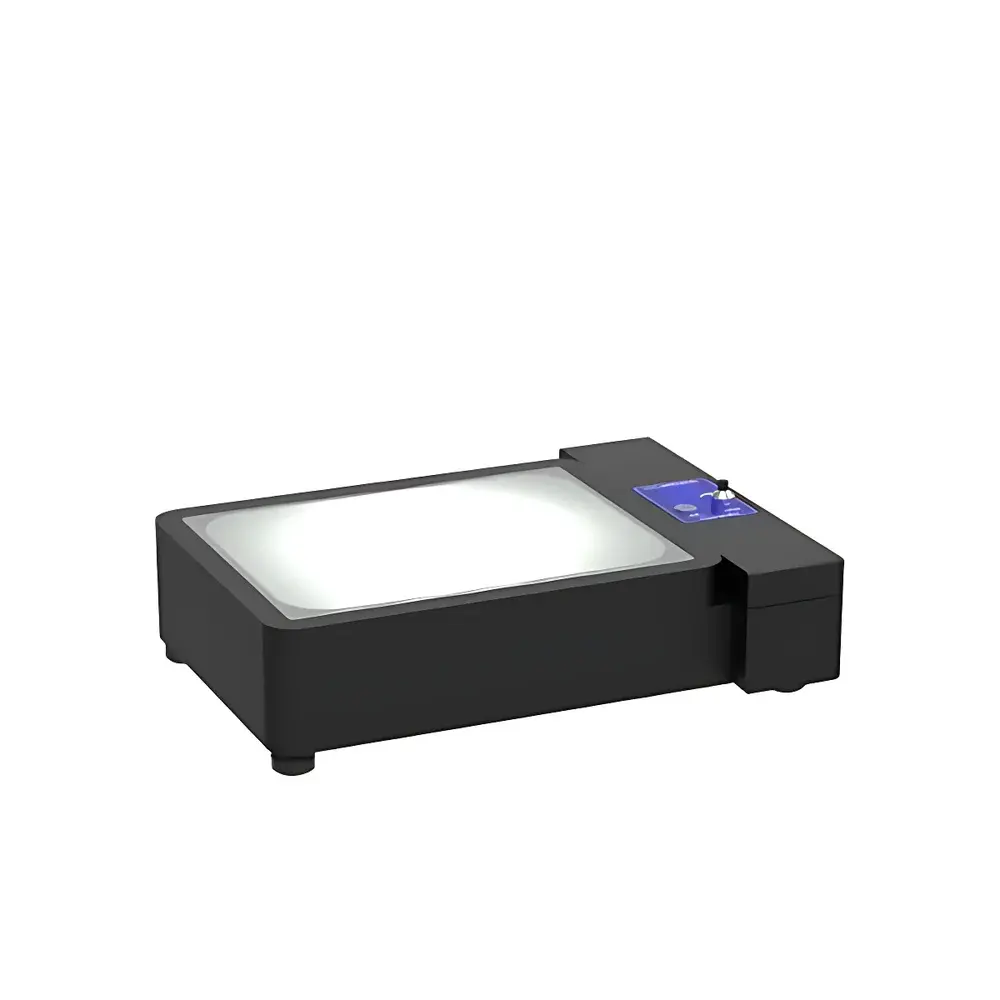
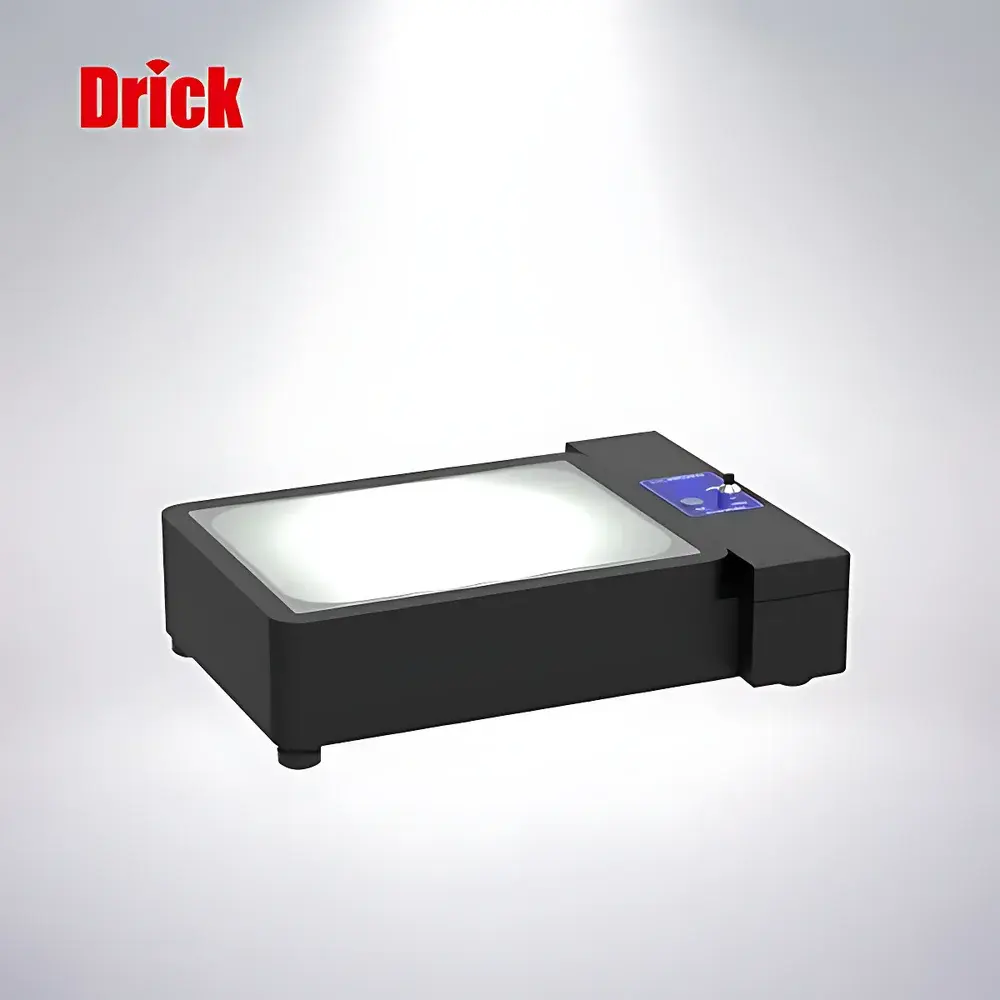
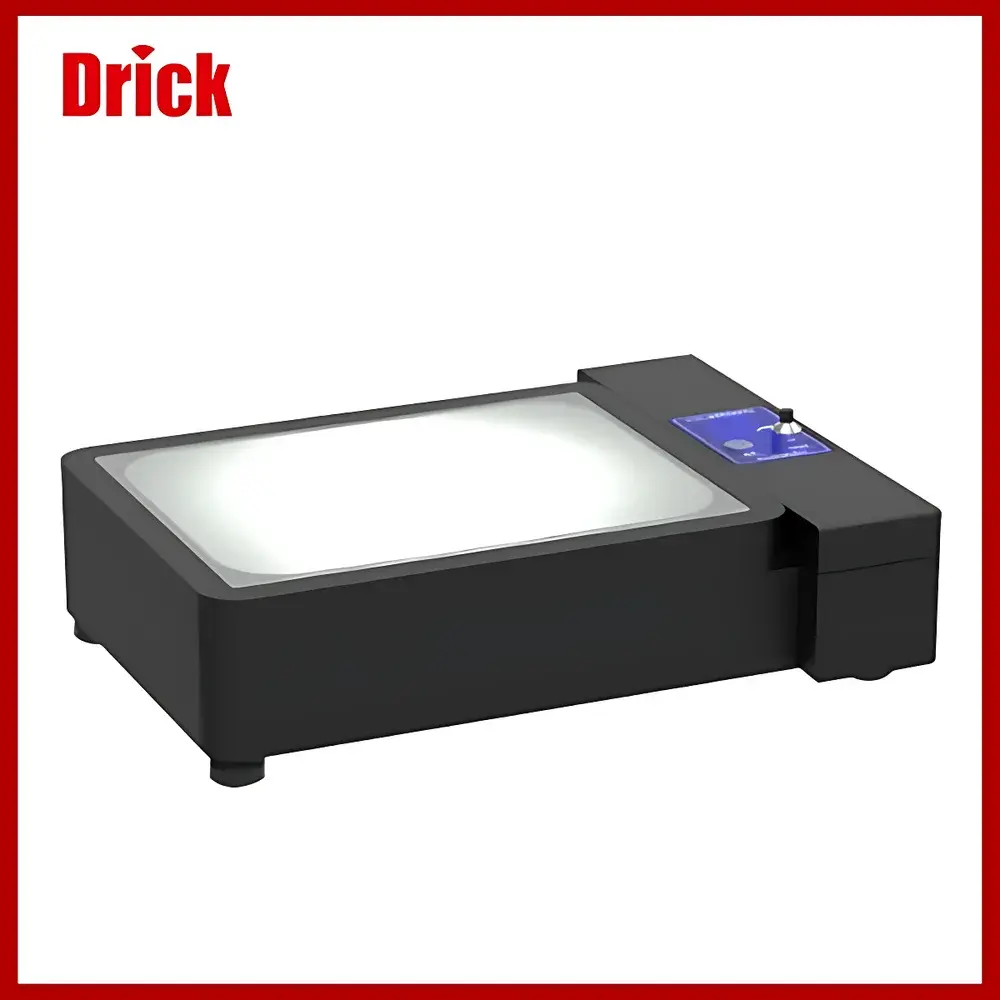
DRK367A Drick LED-Adjustable Light Source Impurity Inspection System for Diapers and Panty Liners
| Brand | Drick |
|---|---|
| Model | DRK367A |
| Origin | Shandong, China |
| Manufacturer Type | OEM/ODM Manufacturer |
| Country of Origin | China |
| Price | USD 7,000 (FOB Qingdao) |
Overview
The DRK367A is a dedicated optical inspection system engineered for the qualitative and semi-quantitative detection of foreign particulate contaminants in absorbent hygiene products—including disposable diapers, training pants (pull-ups), and sanitary liners. It operates on the principle of high-contrast transmittance illumination, utilizing a precisely adjustable monochromatic or white-light LED source to enhance visual differentiation between substrate fibers and non-fibrous impurities (e.g., metal fragments, plastic shavings, hair, insect parts, or undispersed polymer granules). Unlike automated vision systems requiring algorithmic training, the DRK367A supports manual operator-assisted screening under standardized lighting conditions—making it suitable for QC labs performing routine lot-release testing per internal specifications or industry guidelines such as EDANA Recommended Practice RP 10.0 (Absorbent Hygiene Products – Quality Assurance) and ISO 15223-1:2021 (Symbols for use in medical device labeling).
Key Features
- Continuously adjustable LED light source with intensity control (0–100% brightness) and selectable color temperature (4500 K–6500 K), enabling optimization for varying basis weights and dye loads across diaper core layers;
- Uniform illumination field (≥90% homogeneity over 300 × 300 mm active area) achieved via diffuser optics and collimated beam geometry;
- Ergonomic vertical viewing station with tilting sample stage (±15°) and anti-glare acrylic shield for operator comfort during extended visual inspection;
- Integrated digital timer and pass/fail logging interface compatible with basic LIMS integration via USB export (CSV format);
- Modular design compliant with ISO/IEC 17025:2017 clause 6.4 (Equipment) — all optical components are traceably calibrated against NIST-traceable luminance standards;
- No moving parts or consumables; maintenance limited to periodic LED output verification using a calibrated photometer.
Sample Compatibility & Compliance
The DRK367A accommodates flat, unrolled specimens up to 400 mm wide and 600 mm long—sufficient for full-width cross-sections of premium-tier diapers and panty liners. Samples are placed directly on the illuminated glass platen without fixation or vacuum hold-down, minimizing mechanical distortion of SAP (superabsorbent polymer) gels or fluff pulp layers. The system meets functional requirements outlined in ASTM D737-18 (Air Permeability of Textile Fabrics) for light transmission assessment and aligns with EDANA’s guidance on contaminant detection methodology for nonwovens used in hygiene applications. While not certified for regulatory submission per se, its operational parameters support GLP-compliant documentation when paired with controlled environmental monitoring (temperature: 23 ± 2°C; RH: 50 ± 5%) and documented operator qualification records.
Software & Data Management
The DRK367A operates via embedded firmware with no external PC dependency. Inspection results are recorded manually by the operator using a touchscreen interface supporting batch ID entry, inspector ID, date/time stamp, and discrete “Pass” / “Fail” / “Retest” flags. All entries are stored internally (10,000-record capacity) and exportable via USB 2.0 to CSV files containing columns: Batch_No, Inspector_ID, Date_Time, Sample_Location, Observed_Impurity_Type (free-text), and Final_Disposition. Audit trail functionality includes immutable timestamps and write-once memory architecture—supporting FDA 21 CFR Part 11 readiness when deployed within validated laboratory environments with role-based access controls implemented at the facility level.
Applications
- Routine incoming inspection of nonwoven topsheets, acquisition distribution layers (ADL), and backsheet films prior to converting;
- Final product release testing for particulate contamination in finished diapers and pull-ups, aligned with brand-specific AQL Level II sampling plans;
- Root cause analysis during production line investigations—e.g., correlating impurity morphology with specific slitting, embossing, or SAP-dusting process steps;
- Supplier qualification audits where visual defect mapping (e.g., location frequency, size distribution estimation) informs corrective action requests;
- Training tool for new QA personnel to develop consistent visual recognition thresholds for Class I–III contaminants per internal defect classification matrices.
FAQ
Is the DRK367A compliant with ISO 13485 or FDA QSR requirements?
The instrument itself is not a medical device and does not require ISO 13485 certification. However, its design, calibration protocol, and data handling features enable use within ISO 13485-certified manufacturing environments when incorporated into a documented inspection procedure.
Can the system detect sub-100 µm particles?
Visual detection limits depend on operator acuity, contrast, and particle refractive index. Under optimal conditions (6500 K light, 5× magnifier optional), experienced inspectors reliably identify particles ≥150 µm; particles below 100 µm generally require microscopy confirmation.
Does Drick provide installation qualification (IQ) or operational qualification (OQ) documentation?
Yes—Drick supplies a standard IQ/OQ protocol package upon request, including test scripts, acceptance criteria, and blank execution forms compliant with Annex 15 of the EU GMP Guidelines.
What is the expected service life of the LED light source?
Rated lifetime is 50,000 hours at 70% lumen maintenance (L70), equivalent to >10 years of typical lab usage (8 hrs/day, 250 days/year).
Is third-party calibration available?
Yes—Drick partners with ISO/IEC 17025-accredited calibration laboratories in Germany and Singapore for annual luminance and uniformity verification, with full traceability to PTB and NPL standards.






