
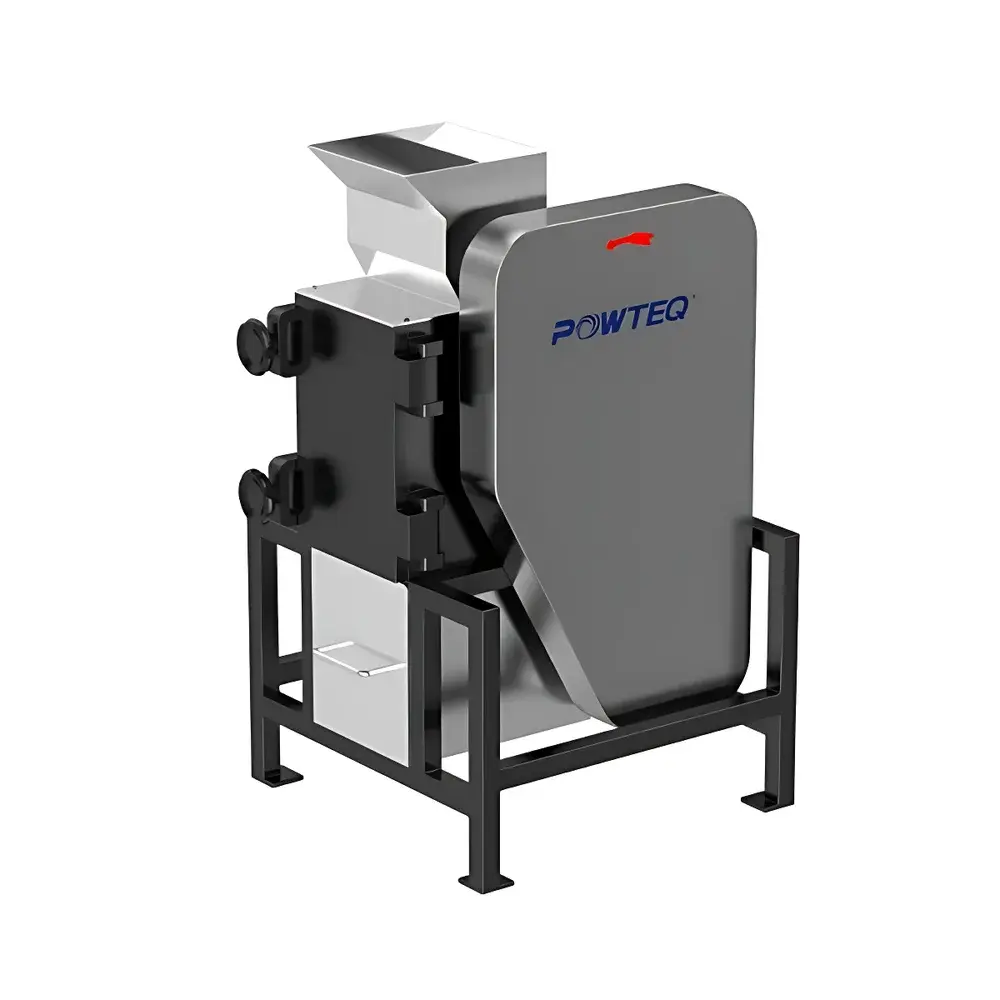
Grinderman JC8 Jaw Crusher
| Brand | Grinderman |
|---|---|
| Origin | Beijing, China |
| Manufacturer Type | Direct Manufacturer |
| Country of Origin | China |
| Model | JC8 |
| Instrument Type | Jaw Crusher |
| Sample Suitability | Hard and Brittle Materials |
| Feed Size | < 220 × 90 mm |
| Discharge Size | 0.01–0.5 mm |
| Throughput Capacity | 400 kg/h |
| Jaw Width | 90 mm |
| Adjustable Jaw Gap | 0–30 mm (continuously variable) |
| Motor | 3-phase AC, 380 V / 50 Hz |
| Rated Power | 5.5 kW |
| Speed | 270 rpm |
| Hopper Capacity | 10 L (standard) |
| Compliance | Designed for GLP-compliant sample preparation workflows |
Overview
The Grinderman JC8 Jaw Crusher is an industrial-grade, high-throughput laboratory crusher engineered for reproducible primary size reduction of hard, brittle, and medium-hard materials. Based on the classical toggle-jaw principle—where a motor-driven eccentric shaft induces reciprocating motion in the movable jaw against a fixed jaw—the JC8 achieves controlled compressive fracture via regulated gap adjustment and consistent mechanical force transmission. Unlike impact or rotor-based grinders, the JC8 operates through pure mechanical compression, minimizing heat generation, particle amorphization, and cross-contamination—critical for geochemical assays, metallurgical assay prep, and regulatory-compliant raw material qualification. Its robust cast-iron frame, modular housing architecture, and continuous-duty motor make it suitable for extended batch processing in QC labs, central analytical facilities, and R&D environments where throughput, repeatability, and material integrity are non-negotiable.
Key Features
- Continuous-duty 5.5 kW three-phase motor enabling stable 270 rpm operation under load, supporting uninterrupted crushing at rated capacity of 400 kg/h.
- Continuously adjustable jaw gap (0–30 mm) with calibrated scale indicator for precise control over discharge particle size distribution—essential for downstream sieving, XRF fusion, or ICP-OES digestion protocols.
- Modular frame and quick-release front access door compliant with ISO 13857 ergonomic safety standards—enabling full visual inspection and tool-free cleaning of the crushing chamber.
- Interchangeable jaw plates and wear liners available in five certified materials: Mn steel (general purpose), stainless steel (low leaching), tungsten carbide (ultra-high wear resistance), Ni-Hard 4 (abrasion-intensive ores), and heavy-metal-free grinding steel (pharmaceutical and environmental trace analysis).
- Integrated dust extraction port (Ø50 mm) compatible with standard lab vacuum systems, reducing airborne particulate exposure and meeting OSHA PEL and EU Directive 2004/37/EC requirements.
- Quick-detachable feed hopper with splash guard and manual pusher assembly—designed for safe handling of irregularly shaped feedstock up to 220 × 90 mm dimensions.
Sample Compatibility & Compliance
The JC8 is validated for use with geologically and industrially representative hard-brittle matrices, including but not limited to: ferroalloys (e.g., FeV, FeNb, WC), igneous rocks (granite, basalt), refractory ceramics (sintered alumina, electro-ceramics), construction aggregates (bauxite, quartzite, cement clinker), and energy materials (coal, coke, slag). All jaw plate variants are certified per ISO 8502-3 for extractable metal content and tested for leachate neutrality in aqueous suspension (pH 5–8, 24 h, ASTM D5232). The instrument supports audit-ready documentation: built-in zero-point calibration verification, jaw wear tracking log (via engraved scale), and mechanical interlock validation for safety gate operation—all aligning with GLP Annex 11 and FDA 21 CFR Part 11 data integrity expectations when paired with optional digital logging modules.
Software & Data Management
While the JC8 operates as a standalone electromechanical unit, its design integrates seamlessly into digitally governed lab ecosystems. Optional RS-485/Modbus RTU interface enables connection to LIMS or MES platforms for run-time logging (start/stop timestamps, motor current draw, cumulative runtime). Jaw gap settings can be recorded manually or captured via external barcode-scanned parameter tags. All mechanical adjustments—including jaw replacement events and calibration verifications—are documented using standardized SOP templates aligned with ISO/IEC 17025 clause 7.6 (equipment management) and ASTM E2500-13 (verification of equipment performance).
Applications
- Preparation of homogenized sub-samples for X-ray fluorescence (XRF) fused bead analysis in mining QA/QC labs.
- Size reduction of refractory ceramics prior to laser ablation ICP-MS depth profiling.
- Primary comminution of coal and coke samples per ASTM D2974 and ISO 19557 for proximate and ultimate analysis.
- Crushing of construction materials (e.g., recycled concrete aggregate) for particle shape and gradation testing (ASTM C136, EN 933-1).
- Safe, low-contamination fragmentation of battery cathode scrap (LiCoO₂, NMC) for hydrometallurgical recovery studies.
FAQ
What is the maximum feed size the JC8 can accept?
The JC8 accepts feed particles up to 220 mm × 90 mm in cross-section—optimized for irregular geological specimens and industrial bulk samples.
Is the discharge particle size distribution narrow or broad?
Discharge PSD is inherently polydisperse due to compressive fracture mechanics; however, continuous jaw gap control and optional downstream vibratory screening (e.g., Retsch AS 200) enable tight D90 targeting within 0.01–0.5 mm range.
Can the JC8 be used for food or pharmaceutical applications?
Yes—when equipped with stainless steel or heavy-metal-free jaw plates and operated under validated cleaning procedures (SOP-GRN-JC8-CIP), it complies with USP and EP 2.9.12 for solid dosage comminution.
Does the unit include overload protection?
Yes—integrated thermal motor protection and mechanical shear-pin safeguard prevent damage during jamming events; the dust extraction port also functions as a pressure-relief vent.
How often should jaw plates be replaced?
Replacement frequency depends on abrasivity: tungsten carbide jaws last >1,200 hours on quartz-rich feed; Mn steel requires inspection every 200–300 operating hours, guided by the integrated wear-scale indicator.



