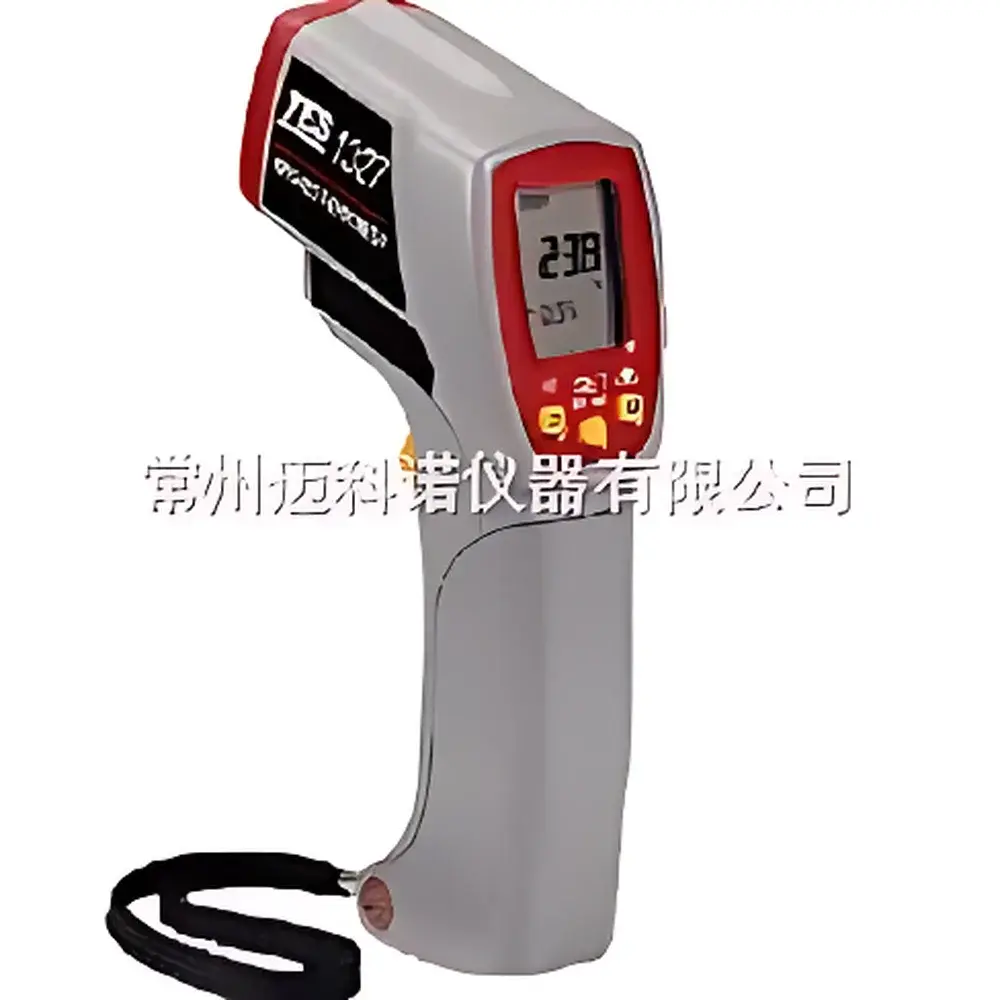
TES-1327 Infrared Thermometer by MKN
| Brand | MKN |
|---|---|
| Model | TES-1327 |
| Measurement Range | -35 °C to +500 °C |
| Resolution | 0.1 °C / 0.2 °F |
| Accuracy | ±2% of reading or ±2 °C (whichever is greater) |
| Spectral Response | 6–14 µm |
| Distance-to-Spot Ratio | 12:1 |
| Emissivity Adjustment | 0.17–1.00 |
| Laser Targeting | Class II, <1 mW |
| Display | Backlit LCD |
| Data Logging Capacity | 50 readings |
| Auto Power-Off | ~15 s |
| Battery | 9 V (IEC 6F22 / 006P) |
| Operating Environment | 0–50 °C, ≤80% RH |
| Storage | -10–60 °C, ≤70% RH |
| Dimensions | 172 × 118 × 46 mm |
| Weight | 220 g |
Overview
The TES-1327 Infrared Thermometer is a non-contact, handheld optical temperature measurement instrument engineered for industrial maintenance, HVAC diagnostics, electrical inspection, and laboratory spot-check applications. It operates on the principle of passive infrared radiation detection: thermal energy emitted from a target surface in the 6–14 µm mid-infrared spectral band is focused via an optical lens onto a silicon photodiode sensor. The device converts the detected radiant flux into a proportional electrical signal, which—after compensation for ambient temperature and user-defined emissivity—is translated into a calibrated temperature reading. Its fixed 12:1 distance-to-spot ratio enables reliable measurements at moderate working distances (e.g., 1.2 m for a 100 mm target), while the integrated Class II laser pointer (≤1 mW) provides precise visual targeting without interfering with radiometric performance. Designed for field robustness and operational simplicity, the TES-1327 delivers traceable, repeatable surface temperature data without requiring physical contact or thermal equilibrium.
Key Features
- High-resolution digital display with adjustable backlight for low-light environments
- User-selectable emissivity (0.17–1.00) to accommodate diverse material surfaces—from oxidized steel (ε ≈ 0.8) to polished aluminum (ε ≈ 0.05)
- Real-time max/min temperature tracking with automatic hold function
- On-device data logging capacity of 50 measurement records, accessible directly via LCD navigation
- Programmable high/low temperature alarms with audible buzzer feedback
- Automatic power-off after ~15 seconds of inactivity to conserve battery life
- Compact ergonomic housing (172 × 118 × 46 mm) with balanced weight distribution (220 g) for extended one-handed use
- Single 9 V alkaline battery operation supporting up to 100 hours of continuous measurement (laser and backlight disabled)
Sample Compatibility & Compliance
The TES-1327 is suitable for measuring the surface temperature of solid, non-transmissive materials including metals, ceramics, plastics, painted surfaces, and building envelopes. It is not intended for transparent media (e.g., glass, quartz), highly reflective bare metals without surface oxidation, or moving targets exceeding 1 m/s. While not certified to ISO/IEC 17025 calibration standards out-of-box, the instrument supports periodic verification using NIST-traceable blackbody sources. Its optical design complies with IEC 62471 (photobiological safety) for Class II laser products and meets CE marking requirements for electromagnetic compatibility (EMC Directive 2014/30/EU) and low-voltage safety (LVD Directive 2014/35/EU). Emissivity adjustment capability facilitates alignment with ASTM E1933-19 and ISO 18434-1 guidelines for condition monitoring of rotating equipment and electrical connections.
Software & Data Management
The TES-1327 performs standalone data acquisition without external software dependency. All 50 logged readings—including timestamped max/min values and associated emissivity settings—are stored in non-volatile memory and retrievable via intuitive button navigation on the LCD interface. No proprietary drivers, USB connectivity, or cloud synchronization are provided. For integration into broader asset management workflows, users may manually transcribe logged data into CSV-compatible spreadsheets or CMMS platforms. The absence of wireless transmission or firmware-upgradable architecture ensures deterministic behavior and long-term operational consistency—critical in regulated environments where change control documentation is required per ISO 9001 or GxP-aligned quality systems.
Applications
- Preventive maintenance: Monitoring bearing housings, motor windings, transformer bushings, and switchgear contacts for abnormal thermal patterns
- HVAC commissioning: Verifying duct surface temperatures, coil performance, and insulation integrity
- Food service safety: Spot-checking holding/storage surface temperatures in compliance with FDA Food Code §3-501.15
- Building diagnostics: Identifying thermal bridging, air leakage, and moisture-related anomalies in façades and roofing assemblies
- Educational laboratories: Demonstrating Stefan-Boltzmann law, emissivity dependence, and infrared thermography fundamentals
- Automotive service: Assessing exhaust manifold, brake rotor, and catalytic converter operating temperatures
FAQ
What is the spectral response range of the TES-1327, and why is it significant?
The detector responds to infrared radiation between 6 and 14 µm—a band optimized for near-ambient to mid-range industrial temperatures and minimally affected by atmospheric water vapor absorption.
Can this thermometer measure through glass or plastic covers?
No. Standard silicate glass and most polymers are opaque in this spectral band and will report the cover’s surface temperature—not the underlying object.
How does emissivity adjustment improve measurement accuracy?
Emissivity correction compensates for the fact that real-world surfaces emit less radiation than a perfect blackbody; incorrect ε-setting introduces systematic bias, especially on metallic or low-emissivity surfaces.
Is the laser pointer used for measurement or only for aiming?
The laser serves exclusively as a visual aiming aid; it contributes no energy to the measurement and is independent of the IR detection path.
Does the device support calibration certificate issuance?
The unit ships without factory calibration documentation; however, its linearity and drift characteristics permit third-party calibration against accredited blackbody sources per ISO/IEC 17025.