
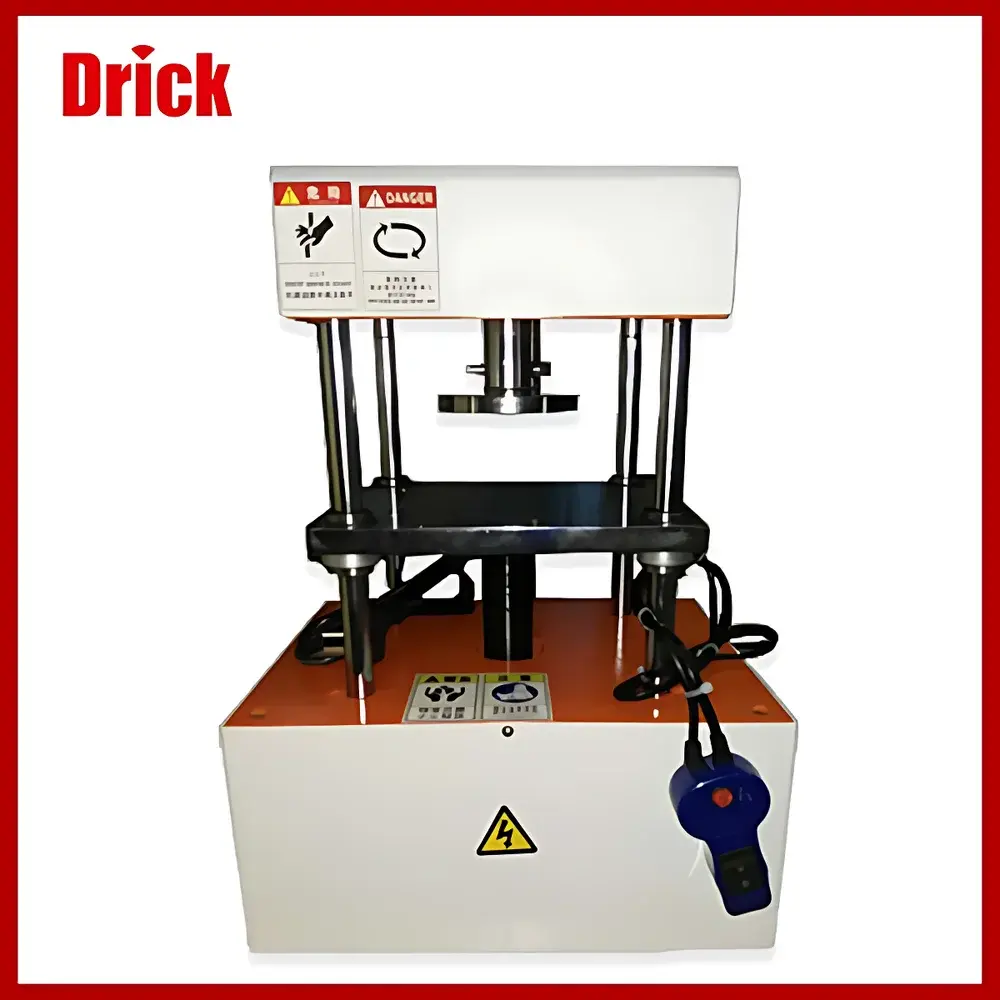
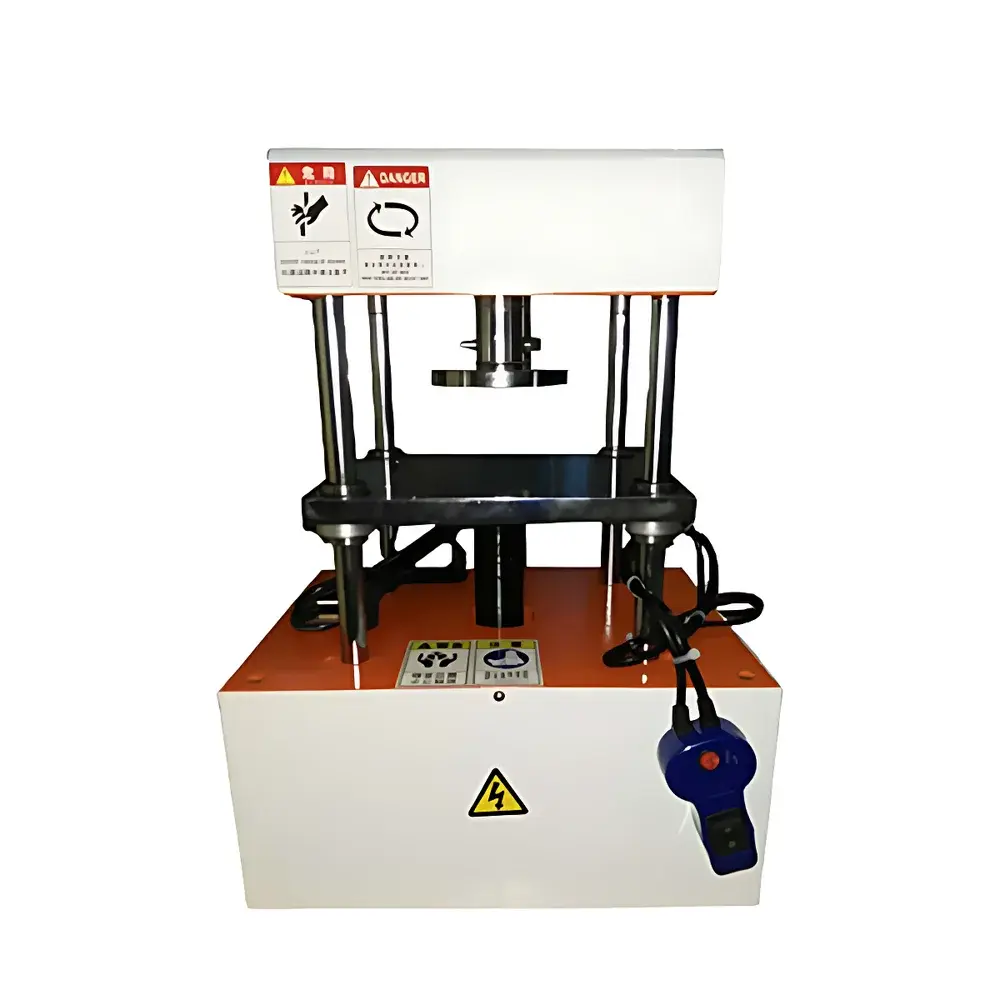
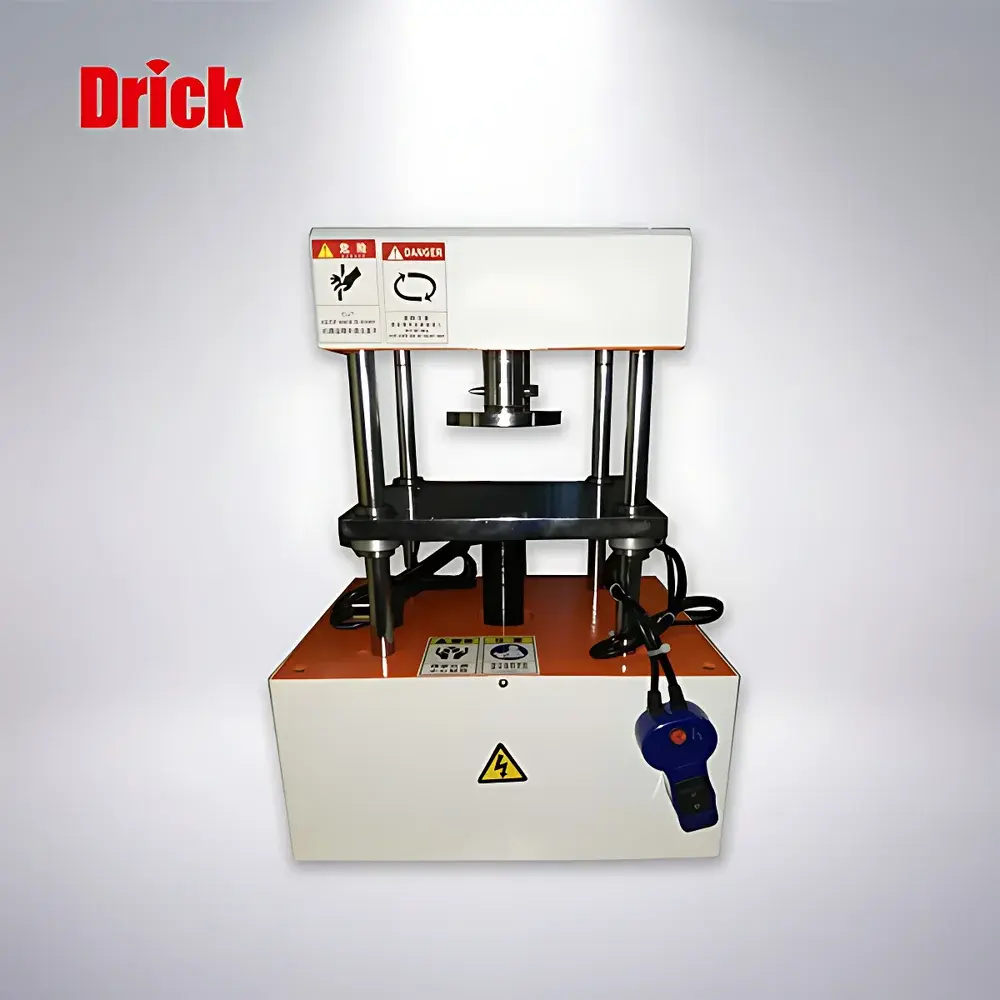
Drick DCP Electric Hydraulic Die-Cutting Press
| Brand | Drick |
|---|---|
| Origin | Shandong, China |
| Manufacturer Type | Direct Manufacturer |
| Country of Origin | China |
| Model | DCP |
| Dimensions (L×W×H) | 350 mm × 220 mm × 450 mm |
| Weight | 65 kg |
| Power Supply | AC 220 V, 50 Hz |
| Stroke Adjustment Range | 20–100 mm |
| Worktable Size | 180 mm × 250 mm |
| Compliance | Designed to support specimen preparation per GB/T 528–1992 (equivalent to ISO 37:2017 for tensile testing of vulcanized and thermoplastic rubbers) |
Overview
The Drick DCP Electric Hydraulic Die-Cutting Press is a precision-engineered sample preparation instrument specifically designed for standardized specimen fabrication in rubber and plastic laboratories. It operates on a controlled electric-hydraulic actuation principle, delivering consistent, repeatable force transmission during die-cutting operations—critical for achieving dimensional accuracy and edge integrity required by international mechanical testing standards. Unlike manual or pneumatic alternatives, the DCP integrates an electromechanical hydraulic system that enables fine-tuned stroke adjustment (20–100 mm), ensuring optimal penetration depth across variable material thicknesses without over-compression or blade deflection. Its primary function is to produce standardized test specimens—particularly Types 1, 2, 3, and 4 dumbbell-shaped specimens as specified in GB/T 528–1992 (aligned with ISO 37:2017)—for tensile property evaluation in quality control, R&D, and certification workflows.
Key Features
- Electric-hydraulic dual-mode actuation ensures stable pressure output and eliminates operator-induced variability inherent in manual presses.
- Digitally controllable stroke range (20–100 mm) allows precise adaptation to specimen thickness and material hardness—essential for elastomers, thermoplastics, composites, and polymer sheets.
- Reinforced steel frame and hardened worktable (180 mm × 250 mm) provide structural rigidity and long-term parallelism retention between cutting surface and platen—minimizing angular deviation during shearing.
- Ergonomic push-button interface (UP/DOWN controls) enables single-hand operation with immediate visual feedback; no external air supply or complex calibration required.
- Integrated safety design includes mechanical limit stops and automatic pressure relief at end-of-stroke, preventing over-travel and protecting both tooling and operator.
- Compact footprint (350 mm × 220 mm × 450 mm) and moderate mass (65 kg) facilitate benchtop deployment in ISO/IEC 17025-accredited labs without floor anchoring.
Sample Compatibility & Compliance
The DCP press accommodates a broad spectrum of polymeric materials—including natural rubber (NR), styrene-butadiene rubber (SBR), ethylene propylene diene monomer (EPDM), thermoplastic elastomers (TPE), PVC, polyethylene (PE), and polypropylene (PP)—provided specimen blanks are pre-conditioned per ASTM D618 or ISO 291. Standard die sets (Type 1–4 per GB/T 528–1992) are fully compatible and may be interchanged without recalibration. The system supports traceability under GLP and GMP environments when paired with documented maintenance logs and calibrated force verification (e.g., using NIST-traceable load cells). While not intrinsically certified to ISO/IEC 17025, its mechanical consistency enables full compliance with method validation requirements outlined in ISO 17025:2017 Clause 7.2.2 for equipment used in accredited testing.
Software & Data Management
The DCP operates as a standalone electromechanical device with no embedded firmware or digital data logging capability. All operational parameters—including stroke position, cycle count, and activation timestamp—are manually recorded per laboratory SOPs. For integration into LIMS or ELN ecosystems, users may employ external USB-connected industrial timers or PLC-based cycle counters (e.g., Omron K3HB or Siemens LOGO!) to generate CSV-compatible audit trails. Optional third-party calibration certificates (traceable to CNAS-accredited providers) can be generated upon request to satisfy FDA 21 CFR Part 11 requirements for electronic records in regulated manufacturing settings.
Applications
- Preparation of tensile test specimens for rubber compound development and batch release testing.
- Quality assurance sampling in tire cord, conveyor belt, and sealing gasket production lines.
- Academic research involving stress–strain characterization of novel elastomeric nanocomposites.
- Third-party testing laboratories performing conformity assessments per GB/T, ISO, ASTM, or DIN standards.
- Cross-material comparison studies requiring identical geometry and edge finish across heterogeneous polymer families.
FAQ
What standards does the DCP support for specimen geometry?
It is engineered to produce specimens compliant with GB/T 528–1992 (Types 1–4), which mirrors ISO 37:2017 and aligns with ASTM D412 requirements for die-cut dimensions and tolerances.
Can the DCP accommodate custom die geometries beyond standard dumbbell shapes?
Yes—any die with mounting compatibility (flat base, ≤180 mm × 250 mm footprint, and ≤100 mm total height) can be installed; however, user responsibility includes verifying parallelism and validating cut quality per ISO 27207 for non-standard configurations.
Is routine calibration required?
No formal calibration interval is mandated; however, periodic verification of stroke repeatability (±0.2 mm) and worktable flatness (≤0.05 mm/m) is recommended per ISO/IEC 17025 Clause 6.4.10 and documented in lab maintenance records.
What maintenance practices ensure long-term blade life?
After each use, clean cutting edges with lint-free cloth and apply rust-inhibiting oil (e.g., MIL-C-16173 Class 3); avoid contact between blade face and metal worktable surface—always use compliant polyethylene or neoprene backing pads.
Does the unit comply with CE or UL safety directives?
The DCP meets general electrical safety principles per IEC 61000-6-2 (immunity) and IEC 61000-6-4 (emissions); however, it is supplied without CE marking or UL listing—users must conduct local regulatory assessment prior to installation in EU or North American facilities.






