
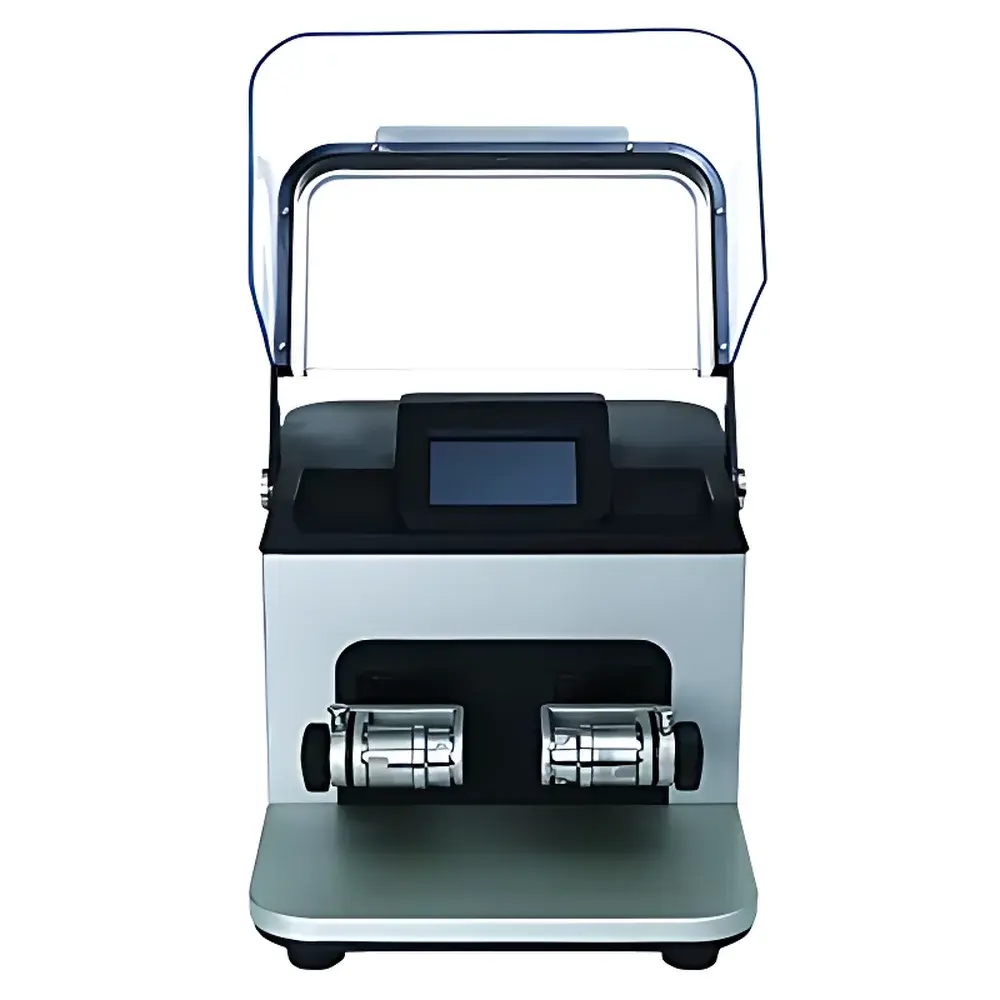
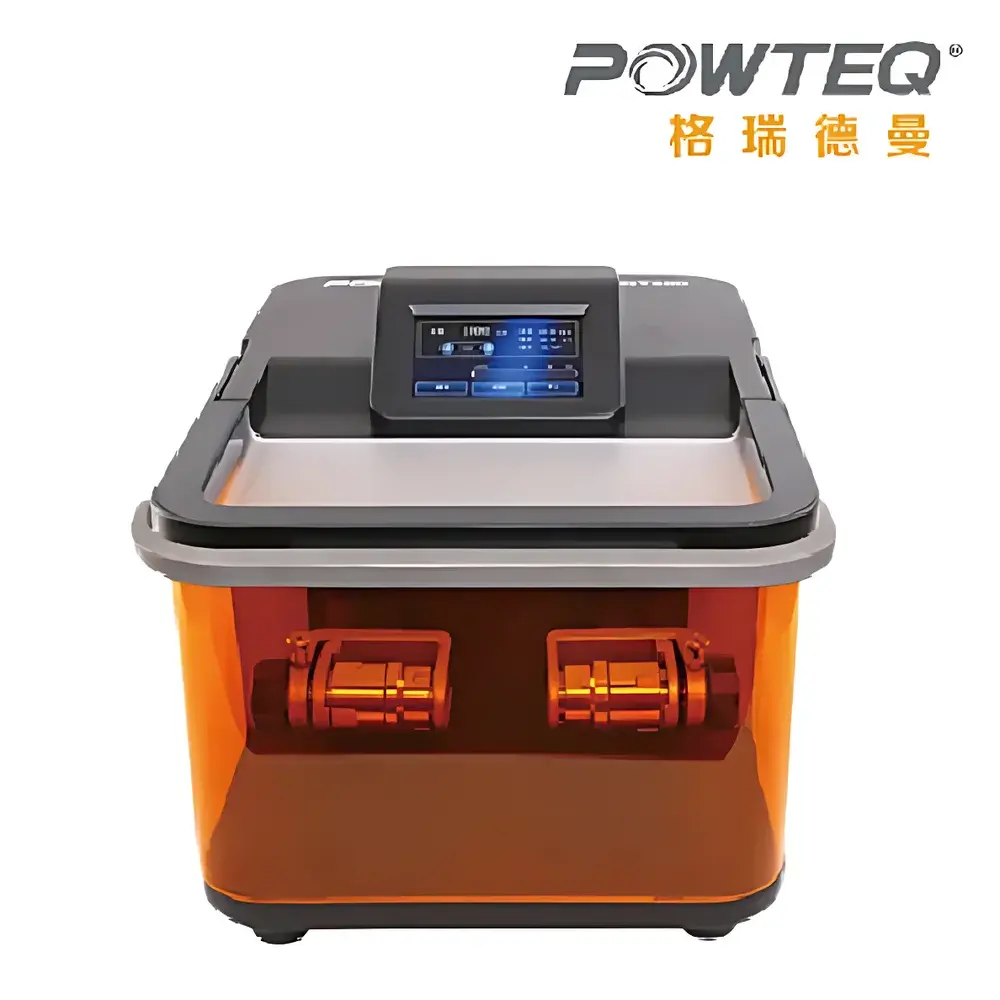
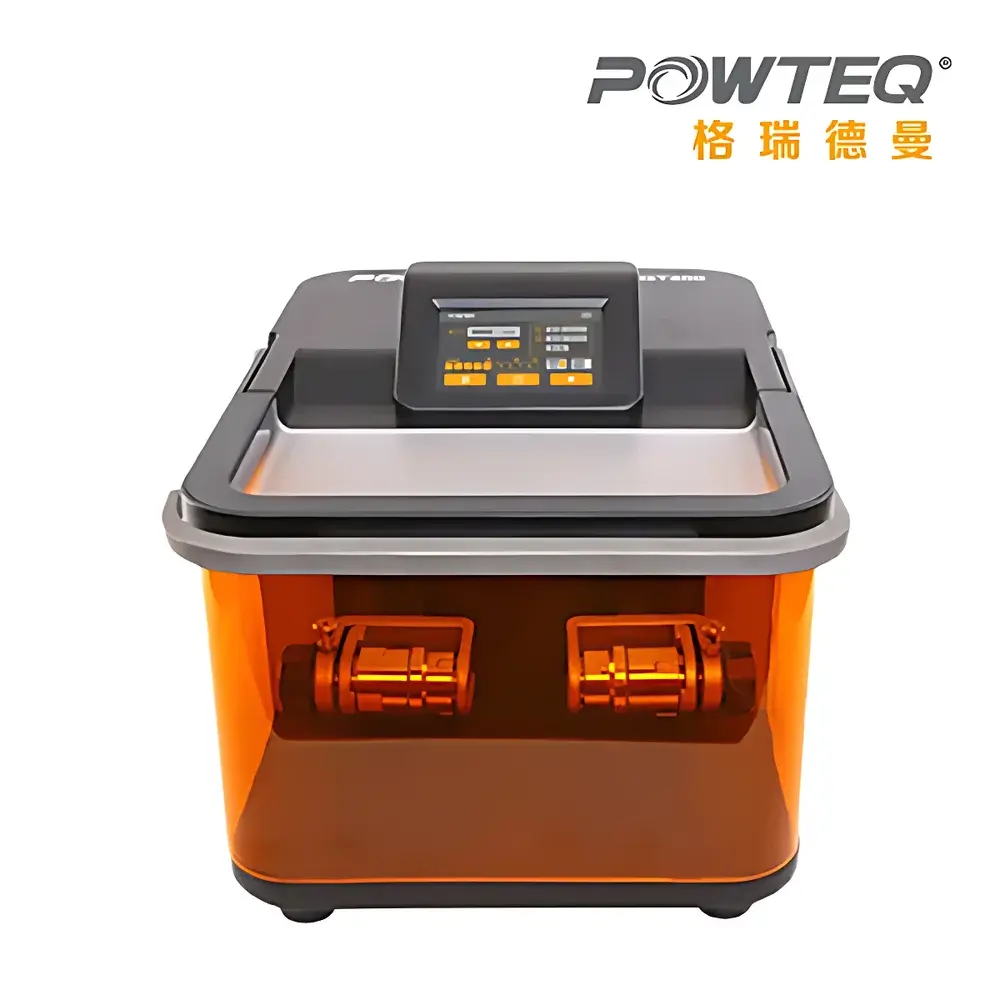
Grindemann GT300 High-Frequency Vibratory Ball Mill
| Brand | Grindemann |
|---|---|
| Model | GT300 |
| Origin | Beijing, China |
| Manufacturer | Grindemann Instrument Co., Ltd. |
| Instrument Type | Vibratory Ball Mill |
| Sample Types | Soft, elastic, fibrous, biological, and moderately hard materials |
| Max. Feed Size | 10 mm |
| Final Particle Size | ~5 µm |
| Batch Capacity | 0.2–20 mL per container |
| Vibration Frequency | 200–1800 rpm (digitally adjustable & displayed) |
| Motor Power | 200 W |
| Dimensions (W×D×H) | 370 × 330 × 470 mm |
| Net Weight | 33 kg |
| Safety Certification | CE-compliant |
| Grinding Vessel Options | 0.2 mL, 1.2 mL, 1.5 mL, 2.0 mL, 5.0 mL, 50 mL tubes |
| Electrical Supply | 200–240 V, 50–60 Hz |
Overview
The Grindemann GT300 High-Frequency Vibratory Ball Mill is an engineered solution for rapid, reproducible, and scalable sample homogenization in life science, pharmaceutical, environmental, and materials research laboratories. It operates on the principle of high-energy radial oscillation—where grinding vessels undergo controlled arc-shaped horizontal motion at programmable frequencies (200–1800 rpm), inducing intense collisions between grinding media (e.g., stainless steel, zirconia, or glass beads) and sample material. This mechanical energy transfer enables efficient cell lysis, tissue pulverization, and particle size reduction without significant thermal buildup—particularly critical for nucleic acid integrity, protein stability, and thermolabile compound preservation. Unlike planetary ball mills or rotor-stator homogenizers, the GT300’s vibration-driven architecture delivers uniform energy distribution across multiple samples simultaneously, making it especially suitable for pre-analytical workflows requiring high throughput and minimal operator intervention.
Key Features
- High-throughput capability: Supports parallel processing of up to 192 samples (96×2) using dual-position 96-well deep-well plates or matched tube adapters.
- Digital parameter control: Precise, repeatable setting of vibration frequency and duration via intuitive front-panel interface; real-time rpm display ensures process traceability.
- Multi-material compatibility: Interchangeable grinding vessels and media—including PTFE-lined tubes for low-adsorption applications, zirconia for ultra-fine grinding, and stainless steel for robust biological matrices.
- Integrated safety architecture: Electromechanical interlock system halts motor operation immediately upon lid opening; transparent polycarbonate viewing window allows visual monitoring without compromising containment.
- Thermally managed operation: Optimized motor cooling and short-cycle protocols (30 s – 2 min typical) minimize heat accumulation—validated for RNA integrity (RIN > 8.5) in plant and mammalian tissue lysates.
- CE-certified design: Compliant with EN 61000-6-2 (immunity) and EN 61000-6-4 (emission) standards; meets essential requirements of the Machinery Directive 2006/42/EC.
Sample Compatibility & Compliance
The GT300 accommodates a broad spectrum of sample types—including soft tissues (liver, spleen), fibrous plant matter (leaves, stems), mineral aggregates (soil, ore), polymers (rubber, plastics), and composite waste streams (e-waste, textiles). Its adjustable amplitude and frequency range enable method optimization for delicate samples (e.g., cultured cells, yeast pellets) as well as resilient matrices (bone, ceramic fragments). For regulated environments, the instrument supports GLP-compliant documentation when paired with validated SOPs; its digital parameter logging aligns with audit-trail expectations under FDA 21 CFR Part 11 when integrated into LIMS-controlled workflows. Grinding protocols have been referenced in peer-reviewed methods compliant with ISO 17025-accredited laboratories for DNA extraction (ISO/IEC 17025:2017, Clause 7.2.2) and particle size analysis (ISO 13320:2020).
Software & Data Management
While the GT300 operates as a standalone benchtop unit with embedded firmware, its parameter settings are fully exportable via USB interface for integration into laboratory information management systems (LIMS) or electronic lab notebooks (ELN). All run logs—including date/time stamp, frequency setpoint, duration, and vessel configuration—are stored internally for ≥1,000 cycles and can be retrieved for QA/QC review. Optional firmware upgrades maintain backward compatibility with legacy protocols and support future enhancements in multi-step sequence programming—enabling automated “grind-hold-cool-grind” cycles for cryogenic applications. No proprietary software installation is required; exported CSV files are compatible with common statistical packages (e.g., JMP, GraphPad Prism) for inter-batch variability analysis.
Applications
- Molecular biology: High-yield genomic DNA and total RNA isolation from plant roots, seeds, and animal tissues; optimized for downstream PCR, qRT-PCR, and NGS library preparation.
- Microbiology: Efficient lysis of Gram-positive bacteria (e.g., Bacillus subtilis), halophiles, and yeast strains—including 96-well plate-based fungal cell wall disruption for metabolite profiling.
- Pharmaceutical QA/QC: Homogenization of herbal powders, tablet excipients, and active pharmaceutical ingredients (APIs) prior to HPLC or dissolution testing per USP & Ph. Eur. monographs.
- Environmental analysis: Preparation of soil, sediment, and sludge samples for heavy metal extraction (EPA Method 3050B) and microplastic identification (ISO 24005:2023).
- Materials science: Pre-treatment of ceramics, composites, and battery electrode materials to achieve uniform particle dispersion prior to XRD or SEM characterization.
FAQ
What is the recommended maintenance schedule for the GT300?
Routine inspection of the drive coupling and vibration dampeners is advised every 500 operating hours; replacement of the main bearing is recommended after 5,000 hours or per manufacturer’s service bulletin.
Can the GT300 be used for cryogenic grinding?
Yes—when equipped with liquid nitrogen-cooled adapters and PTFE or stainless steel vessels, the GT300 supports cryo-milling down to −196 °C; pre-chilling protocols must be validated per sample type to avoid thermal shock-induced vessel fracture.
Is method validation support available for regulated labs?
Grindemann provides application notes and protocol templates aligned with ICH Q5A(R2) and ISO/IEC 17025 requirements; full IQ/OQ documentation packages are available upon request for GMP environments.
How does the GT300 ensure cross-contamination control?
All grinding vessels are autoclavable (121 °C, 20 min); optional UV-C irradiation add-ons (254 nm) are available for chamber decontamination between runs.
What electrical infrastructure is required for stable operation?
A dedicated 20 A circuit with surge protection and line conditioning is recommended—especially in facilities with variable grid voltage or high harmonic distortion from adjacent equipment.



