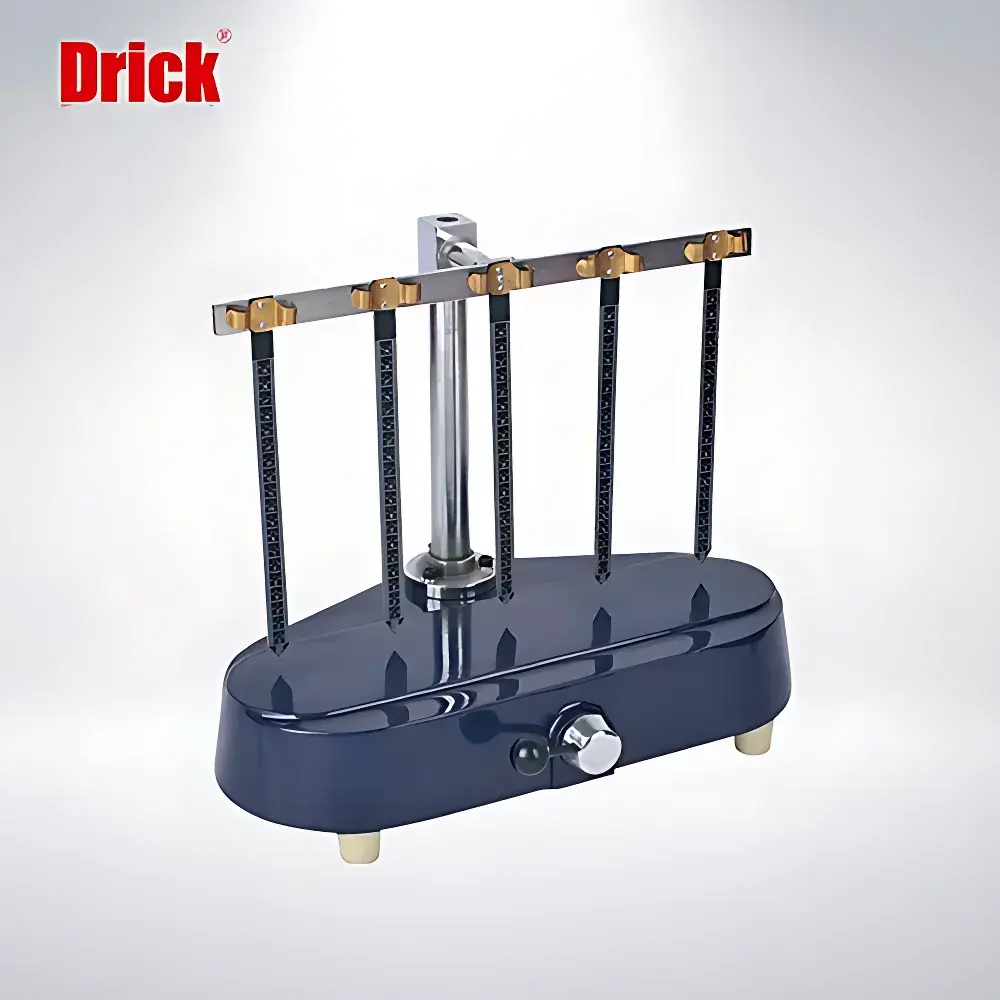
Drick DRK110B Capillary Absorption Tester for Paper and Paperboard
| Brand | Drick |
|---|---|
| Origin | Shandong, China |
| Manufacturer Type | Direct Manufacturer |
| Country of Origin | China |
| Model | DRK110B |
| Measurement Range | 5–200 mm |
| Sample Dimensions | 250 × 15 mm |
| Scale Division | 1 mm |
| Max. Simultaneous Samples | 10 strips |
| Number of Calibrated Scales | 5 |
| Compliance Standard | QB/T 1662 “Klemm Absorptiveness Tester” |
Overview
The Drick DRK110B Capillary Absorption Tester is a precision-engineered instrument designed to quantify the capillary rise behavior of un-sized paper and paperboard under standardized gravitational wetting conditions. It operates on the fundamental principle of vertical capillary action—measuring the height (in millimeters) to which water ascends along narrow, vertically oriented paper strips over defined time intervals (typically 10 minutes). This method directly reflects the material’s internal pore structure, fiber network openness, and intrinsic hydrophilicity—key determinants of printability, coating receptivity, and packaging barrier performance. Unlike dynamic or pressure-driven absorption methods, the DRK110B implements a passive, gravity-fed, static immersion protocol aligned with classical Klemm-type testing principles, ensuring high reproducibility across laboratories when operated per QB/T 1662.
Key Features
- Modular vertical test frame with five independently mounted, calibrated stainless-steel rulers (scale division: 1 mm), each supporting two parallel sample strips—enabling simultaneous evaluation of up to 10 specimens.
- Fixed-depth immersion trough with precisely machined edge alignment, ensuring consistent 10 mm submersion depth across all samples to eliminate operator-induced variability.
- Ergonomic, space-efficient housing constructed from corrosion-resistant anodized aluminum and reinforced polymer—designed for long-term stability in QC lab environments with minimal maintenance.
- Non-contact visual reading interface: high-contrast engraved scales paired with adjustable LED illumination facilitate accurate manual height measurement without parallax error.
- No moving parts, no electronics, and zero power requirement—ensuring operational reliability, calibration traceability, and compliance with GLP documentation requirements for manual instrumentation.
Sample Compatibility & Compliance
The DRK110B is validated for use with unsized, uncoated, or lightly sized paper and paperboard substrates exhibiting measurable capillary rise (>5 mm within 10 min). It is not suitable for highly calendered, synthetic-coated, or hydrophobic materials where capillary penetration is suppressed below detection threshold. The instrument conforms strictly to QB/T 1662–2021 “Klemm Absorptiveness Tester”, which defines dimensional tolerances, immersion geometry, environmental conditioning protocols (23 ± 1 °C, 50 ± 2 % RH), and reporting conventions (e.g., arithmetic mean of 10 replicate readings). While QB/T is a Chinese national standard, its methodology correlates closely with ISO 8787:1990 “Paper and board — Determination of water absorptiveness (Cobb test)” for low-absorption materials and serves as a functional complement to TAPPI T 441 “Water Absorptiveness of Paper (Cobb Test)”. All mechanical components are dimensionally certified and supplied with a factory calibration certificate referencing NIM-traceable length standards.
Software & Data Management
The DRK110B is a manually operated, analog measurement system and does not incorporate embedded firmware, digital sensors, or proprietary software. Data acquisition follows paper-based GLP-compliant recording: users log specimen ID, ambient temperature/humidity, immersion start time, and observed rise heights at specified intervals (e.g., 1, 2, 5, and 10 minutes) in bound laboratory notebooks or LIMS-integrated electronic forms. The absence of digital interfaces eliminates validation complexity associated with 21 CFR Part 11 compliance; however, full audit trails—including raw observations, technician signature, and review sign-off—must be retained per ISO/IEC 17025:2017 clause 7.5. Reports generated from DRK110B data may be exported to Excel or LIMS platforms via manual entry or OCR-assisted digitization, supporting trend analysis across production lots and supplier qualification workflows.
Applications
- Quality control of kraft linerboard and corrugating medium for moisture management in transit packaging.
- R&D screening of pulp refining degree and beating history effects on fiber bonding and porosity.
- Verification of surface sizing efficacy prior to flexographic or gravure printing processes.
- Comparative assessment of recycled fiber blends versus virgin pulp in tissue and blotting paper manufacturing.
- Supplier qualification testing per contractual absorbency specifications (e.g., ≤120 mm @ 10 min for food-grade wrapping paper).
FAQ
What standards does the DRK110B comply with?
It is engineered and verified per QB/T 1662–2021, the Chinese national standard for Klemm-type absorptiveness testers.
Can the DRK110B measure absorption rate beyond 10 minutes?
Yes—though the standard protocol specifies 10-minute readings, the 200 mm scale range permits extended timing (e.g., 30 or 60 min) for low-absorption substrates, provided environmental humidity remains controlled.
Is calibration required before each test?
No routine recalibration is needed; however, annual verification of scale linearity against NIST-traceable gauge blocks is recommended per ISO/IEC 17025.
Does the instrument support automated data logging?
No—it is a purely manual, visual-read system. Digital integration requires external capture tools such as calibrated imaging systems or operator-entered LIMS inputs.
Why is a minimum 5 mm rise specified for valid testing?
Rises below 5 mm fall within the combined uncertainty of scale reading (±0.5 mm) and meniscus estimation error, compromising statistical confidence in reported values per QB/T 1662 Annex B.