
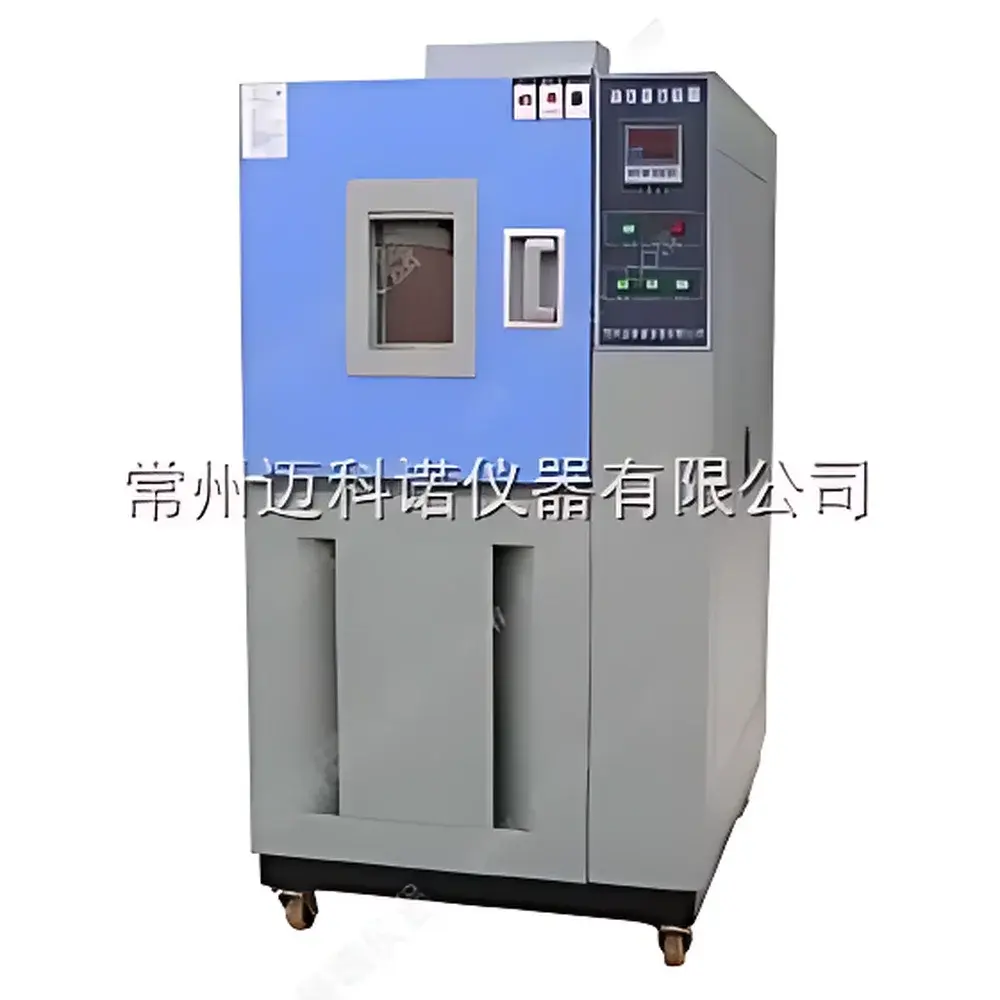
AB Series High-Low Temperature Alternating Environmental Test Chamber
| Origin | Zhejiang, China |
|---|---|
| Manufacturer Type | Authorized Distributor |
| Origin Category | Domestic (China) |
| Model | AB |
| Pricing | Available Upon Request |
| Temperature Range | -20 °C to +200 °C (selectable variants: -40 °C/–60 °C min |
| Temperature Uniformity | ±2 °C |
| Temperature Fluctuation | ±0.5 °C |
| Ramp Rate | 0.7–1.0 °C/min |
| Internal Chamber Dimensions (W×D×H) | 400×500×500 mm to 1000×1000×1000 mm |
| Construction | Interior – SUS304 brushed stainless steel |
| Control System | PID-based digital touchscreen controller (RKC or Fuji optional) |
| Refrigeration | Hermetic French Tecumseh compressor |
| Viewing Window | Dual-layer tempered conductive glass with anti-frost heating, integrated LED lighting |
| Test Port | One Φ50 mm cable port (imported sealed feedthrough) |
| Safety Protections | Over-temperature, over-pressure, phase failure/reversal, overload, and earth leakage detection |
Overview
The AB Series High-Low Temperature Alternating Environmental Test Chamber is a precision-engineered climatic simulation system designed for rigorous thermal stress evaluation of industrial components, electronic assemblies, automotive modules, aerospace subsystems, and materials under controlled, repeatable, and standards-compliant conditions. Operating on the principle of forced-air convection with dual-stage refrigeration and electric resistive heating, the chamber delivers stable, programmable temperature profiles across a broad operational envelope—from cryogenic lows of –60 °C to elevated highs of +200 °C. Its architecture conforms to the fundamental thermodynamic requirements of environmental testing as defined in IEC 60068-2-1 (cold), IEC 60068-2-2 (dry heat), and MIL-STD-810G Method 502.6, ensuring physical reproducibility and metrological traceability for qualification and reliability testing protocols.
Key Features
- Modular chamber configurations with five standard internal volumes (400×500×500 mm to 1000×1000×1000 mm), enabling scalability from benchtop validation to full-system thermal cycling.
- High-fidelity temperature control achieved via PID algorithm with adaptive tuning—implemented on RKC or Fuji digital controllers (user-selectable), delivering ±0.5 °C fluctuation and ±2 °C uniformity per ISO 16750-4 Annex A verification methodology.
- Robust thermal management system featuring a hermetic Tecumseh compressor, imported expansion valves, dry filters, and high-efficiency evaporator/condenser assemblies—engineered for continuous operation and long-term stability.
- Corrosion-resistant SUS304 stainless-steel inner chamber and powder-coated structural steel outer housing ensure mechanical integrity and chemical compatibility in lab and production environments.
- Integrated safety architecture includes redundant over-temperature cutoff, pressure monitoring, phase sequence protection, motor overload relays, and residual-current circuit breakers—fully compliant with IEC 61000-6-2 EMC immunity and IEC 61000-6-4 emission standards.
- Dual-pane, heated, conductive viewing window with LED illumination enables real-time visual inspection without thermal disruption or condensation buildup during extreme low-temperature operation.
Sample Compatibility & Compliance
The AB Series accommodates a wide range of test specimens—including PCBAs, battery packs, sensors, polymer enclosures, optical assemblies, and sealed mechanical subassemblies—via its standardized Φ50 mm cable port with IP65-rated feedthrough sealing. All models meet the structural, thermal, and performance criteria specified in GB/T 10589–2008 (Low-Temperature Test Chambers), GB/T 10586–2006 (Humidity Test Chambers), GB/T 2423.1–2023 (Test A: Cold), GB/T 2423.2–2023 (Test B: Dry Heat), GJB 150.3A–2009 (Low Temperature), and GJB 150.4A–2009 (Operational Temperature). Optional calibration certificates are available traceable to NIM (National Institute of Metrology, China) and accredited per ISO/IEC 17025:2017.
Software & Data Management
Equipped with embedded data logging firmware, the AB Series records time-stamped temperature values at user-defined intervals (1–60 seconds) and stores up to 30 days of continuous history internally. Export is supported via USB flash drive in CSV format for post-processing in MATLAB, JMP, or Minitab. While native PC software is not included, the controller’s RS485/Modbus RTU interface enables integration into centralized LabVIEW or SCADA systems for automated test sequencing and audit-ready reporting. The system supports GLP-compliant record retention when paired with external timestamped storage—meeting foundational requirements for FDA 21 CFR Part 11 electronic records where local regulatory policy permits.
Applications
- Pre-production thermal screening of automotive ECUs per ISO 16750-4 and SAE J1211.
- Accelerated life testing of lithium-ion battery cells under thermal cycling per UN 38.3 Section 4.3.
- Qualification of avionics hardware to DO-160G Section 4 (Temperature Variation) and Section 5 (Temperature Altitude).
- Material coefficient-of-thermal-expansion (CTE) characterization using dimensional metrology synchronized with chamber temperature ramps.
- Reliability assessment of solder joints and wire bonds through JEDEC JESD22-A104D thermal cycling profiles.
- Validation of packaging integrity for medical devices under ISO 11607-1 accelerated aging conditions.
FAQ
What temperature ramp rates are achievable across the full operating range?
The AB Series achieves nominal linear ramp rates of 0.7–1.0 °C/min between –40 °C and +150 °C under no-load conditions, verified per IEC 60068-3-5. Actual rate may vary depending on load mass, thermal mass distribution, and setpoint proximity to compressor operational limits.
Is remote monitoring or Ethernet connectivity supported?
Standard configuration includes RS485 Modbus RTU only. Optional Ethernet-to-Modbus gateways or third-party IoT adapters may be deployed for cloud-based telemetry—however, native web server or MQTT functionality is not provided.
Can the chamber be validated for IQ/OQ/PQ protocols?
Yes—comprehensive validation documentation packages (including sensor calibration reports, uniformity mapping templates, and alarm response logs) are available upon request to support installation qualification (IQ), operational qualification (OQ), and performance qualification (PQ) activities per ISO/IEC 17025 and GMP Annex 15 guidelines.
Are custom internal dimensions or extended temperature ranges available?
Custom chamber geometries and extended ranges (e.g., –70 °C or +250 °C) are offered subject to engineering review and additional lead time—requiring revalidation of refrigeration capacity, insulation integrity, and control loop stability.
What maintenance schedule is recommended for sustained accuracy?
Biannual preventive maintenance is advised: including refrigerant pressure verification, condenser coil cleaning, door gasket inspection, sensor recalibration (PT100 traceable to secondary standards), and safety interlock functional testing—aligned with manufacturer-recommended service intervals and ISO 55001 asset management principles.



