
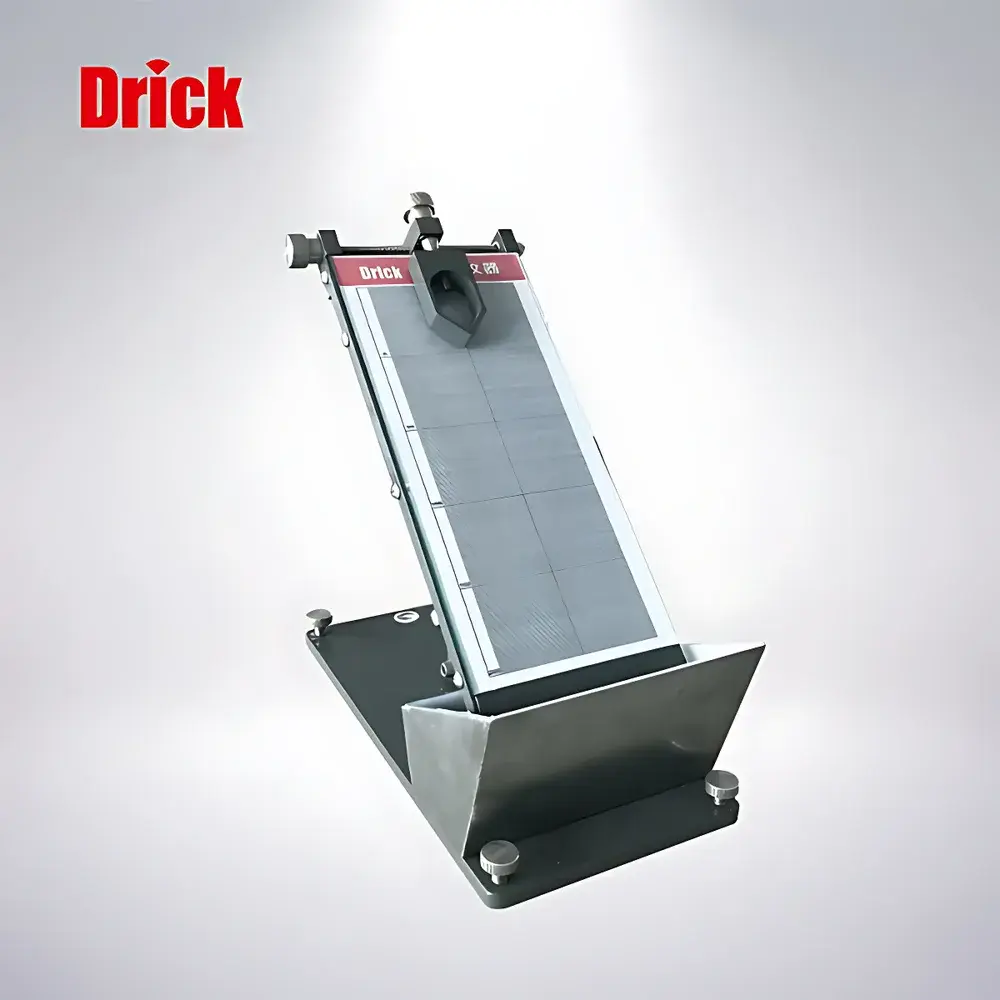
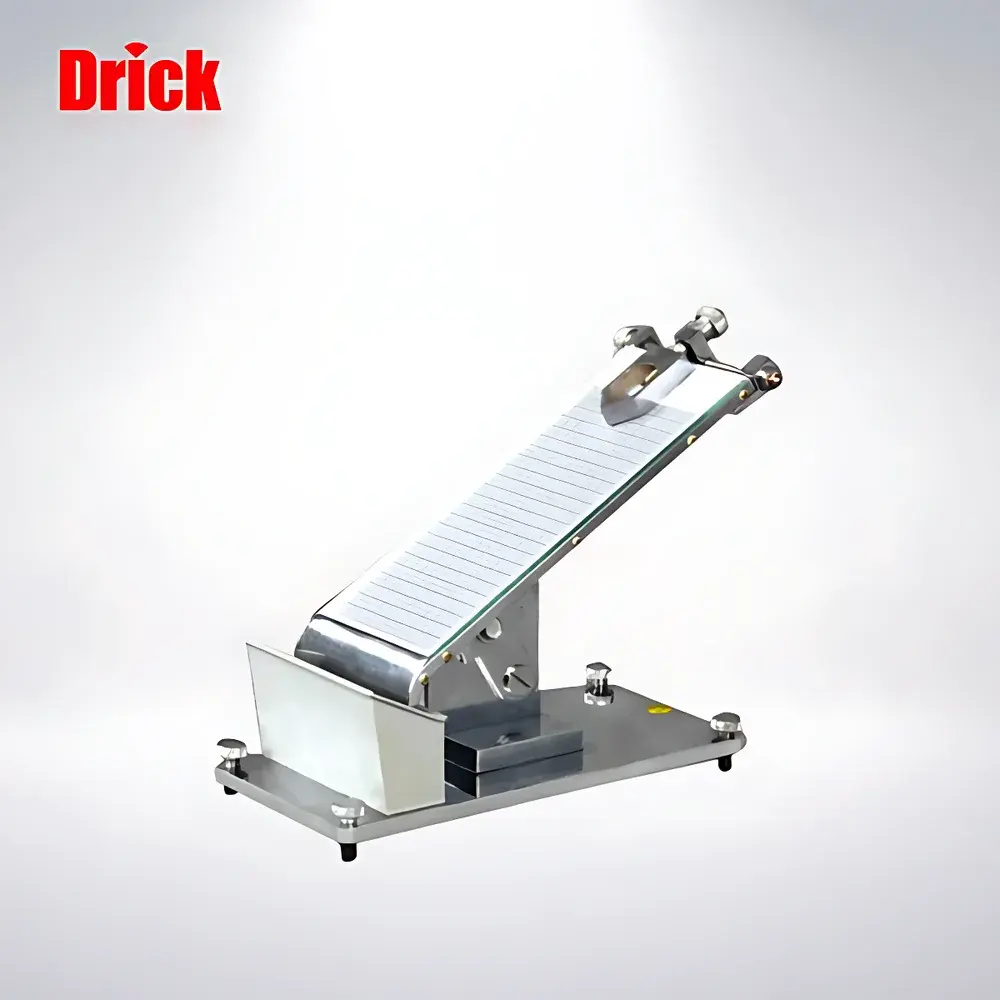
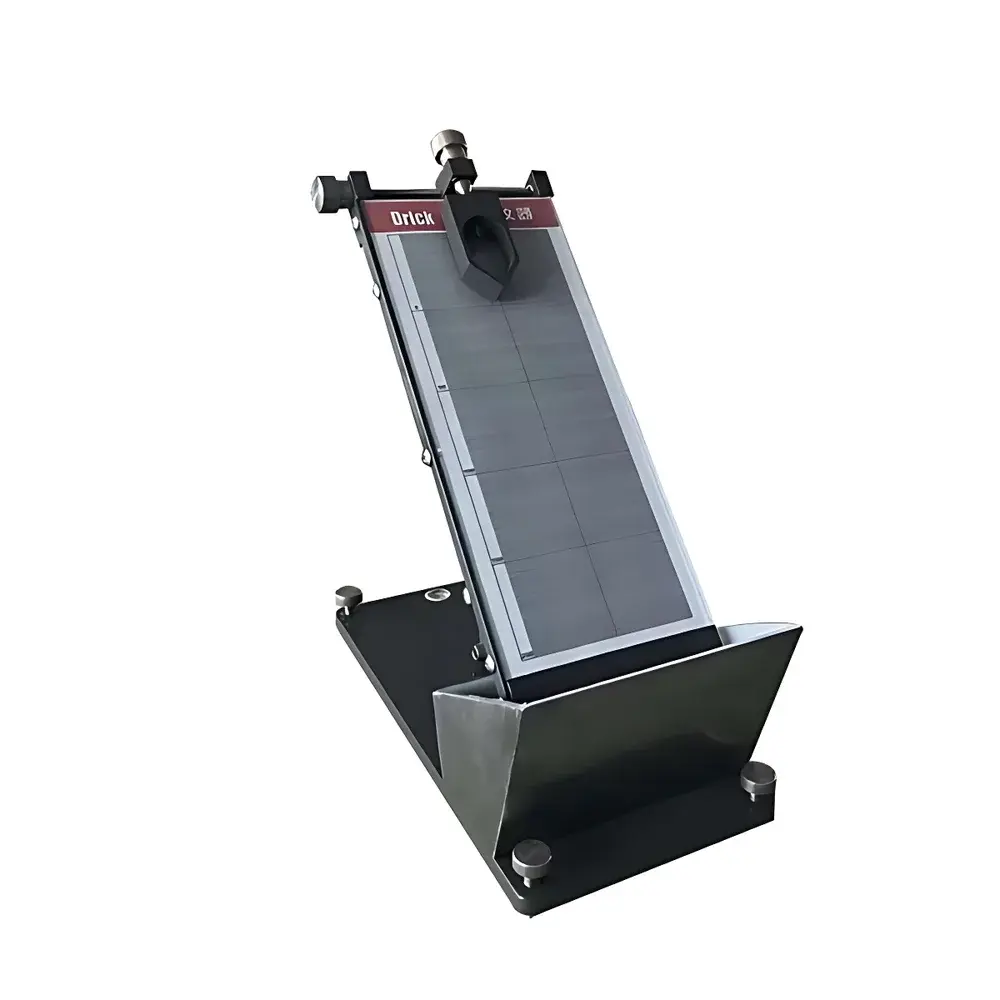
Drick DRK129 Initial Adhesion Tester for Pressure-Sensitive Tapes (Compliant with GB/T 4852–2002)
| Brand | Drick |
|---|---|
| Origin | Shandong, China |
| Manufacturer Type | Direct Manufacturer |
| Region of Origin | Domestic (China) |
| Model | DRK129 |
| Adjustable Incline Angle | 0–60° |
| Test Surface Width | 120 mm |
| Effective Test Width | 80 mm |
| Standard Steel Balls | 1/32″ to 1″ (ASTM E577–22 / JIS Z 2502 compliant diameters) |
| Dimensions (L×W×H) | 320 × 140 × 180 mm |
| Weight | ~8 kg |
| Compliance | GB/T 4852–2002, JIS Z 0237–2000 |
Overview
The Drick DRK129 Initial Adhesion Tester is a precision-engineered mechanical instrument designed specifically for evaluating the instantaneous tack — or initial adhesion — of pressure-sensitive adhesive (PSA) materials. It operates on the well-established inclined-plane rolling-ball principle defined in GB/T 4852–2002 and harmonized with JIS Z 0237–2000. In this method, a standardized steel ball is released from rest at the top of an adjustable incline plane coated with the adhesive specimen. The maximum ball diameter that adheres to the sample surface upon brief contact under controlled gravitational loading is recorded as the “ball number,” directly correlating to the material’s initial tack performance. This empirical, non-destructive test provides rapid, repeatable ranking of PSA formulations without requiring complex calibration or operator interpretation. The DRK129 is not a viscoelastic rheometer nor a peel strength tester; rather, it delivers a standardized, comparative metric essential for incoming QC, R&D screening, and batch-to-batch consistency verification across high-volume packaging and medical tape production environments.
Key Features
- Manually adjustable inclination angle from 0° to 60° in fine increments, enabling precise control over applied normal force during ball release.
- Rigid aluminum alloy frame with anodized finish ensures dimensional stability, long-term repeatability, and resistance to ambient humidity and minor mechanical shock.
- Optimized test platform geometry: 120 mm total width supports proper lateral alignment, while the 80 mm effective test zone conforms to GB/T 4852–2002 specimen mounting requirements.
- Included set of traceable steel balls (1/32″ to 1″, per ASTM E577–22 dimensional tolerances), each individually inspected and certified for sphericity (≤0.5 µm deviation) and surface roughness (Ra ≤ 0.05 µm).
- No electrical components, motors, or software dependencies — fully mechanical operation eliminates electromagnetic interference, power dependency, and firmware validation overhead.
- Compact footprint (320 × 140 × 180 mm) and low mass (~8 kg) facilitate integration into constrained lab spaces, cleanrooms (Class 8 compatible), or mobile QA carts.
Sample Compatibility & Compliance
The DRK129 accommodates flat, flexible PSA substrates up to 120 mm wide and ≥0.05 mm thick, including single- and double-coated tapes, transfer adhesives on release liners, medical transdermal patches, silicone-free protective films, and acrylic-based labeling stocks. Specimen preparation strictly follows GB/T 4852–2002: conditioning at 23 ± 2°C and 50 ± 5% RH for ≥2 h prior to testing; cutting to minimum 100 mm × 25 mm dimensions; and application onto standardized stainless-steel test plates using a 2 kg roller at 300 mm/min. Results are reported as the largest ball diameter (in inches or mm) that remains adhered after rolling contact — a value used internally for specification limits, supplier qualification, and ISO 9001 Clause 8.5.2 process validation. While not inherently GLP-compliant, the instrument supports audit-ready documentation when paired with controlled test logs, calibrated ball certificates, and environmental monitoring records.
Software & Data Management
The DRK129 is a stand-alone mechanical tester with no embedded electronics, firmware, or data output ports. All measurements are manually observed, recorded, and tabulated by the operator. This architecture eliminates requirements for computer validation, cybersecurity protocols, or 21 CFR Part 11 electronic record controls. Users maintain traceability through paper-based or LIMS-integrated test records that include: date/time, operator ID, ambient temperature/humidity, ball lot number, substrate lot ID, observed ball retention outcome, and pass/fail determination against pre-defined acceptance criteria. For laboratories operating under ISO/IEC 17025, the absence of digital subsystems simplifies uncertainty budgeting — dominant contributors being ball dimensional tolerance, incline angle repeatability (±0.3°), and human visual judgment threshold (±1 ball size grade).
Applications
- Quality control of pressure-sensitive backing layers in pharmaceutical blister packaging laminates.
- Tack screening of hot-melt and solvent-based adhesives during formulation development.
- Verification of shelf-life stability for medical-grade acrylic PSAs used in ECG electrodes and wound dressings.
- Supplier qualification audits for label stock vendors supplying retail packaging converters.
- Root-cause analysis of delamination events in multi-layer protective films for display manufacturing.
- Teaching laboratories demonstrating fundamental interfacial adhesion concepts in polymer science curricula.
FAQ
Does the DRK129 require annual recalibration?
No — as a purely mechanical device with no transducers or analog electronics, formal recalibration is not mandated. However, periodic verification using certified reference steel balls and an inclinometer (traceable to NIM or equivalent national metrology institute) is recommended every 6 months per ISO/IEC 17025 Clause 6.5.2.
Can the DRK129 be used for ISO 29621-compliant microbial barrier tape testing?
No — ISO 29621 addresses microbiological safety of medical device packaging materials, not physical adhesion properties. The DRK129 supports only mechanical tack assessment per GB/T 4852–2002 and JIS Z 0237–2000.
Is the test platform compatible with non-standard substrates such as foams or textiles?
Only if they meet the planarity, thickness uniformity, and surface energy prerequisites outlined in Annex A of GB/T 4852–2002. Non-rigid or highly porous samples may yield non-reproducible results due to localized deformation under ball impact.
What maintenance is required to ensure long-term measurement fidelity?
Daily wiping of the incline surface and ball raceway with lint-free cloth and isopropyl alcohol; quarterly inspection of ball sphericity using optical profilometry; and annual torque verification of all locking screws per manufacturer’s mechanical integrity checklist.





