
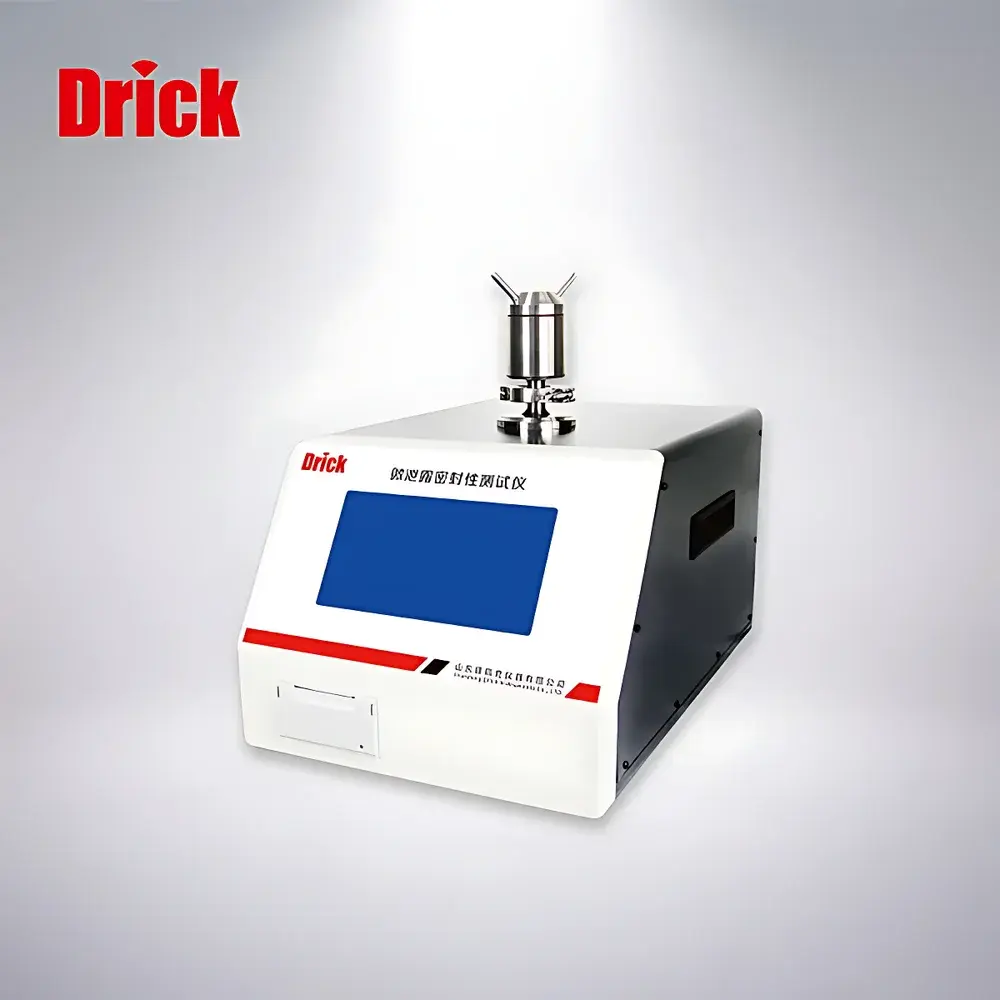
Drick DRK Micro-Leak Seal Integrity Tester for Pharmaceutical Packaging
| Brand | Drick |
|---|---|
| Origin | Shandong, China |
| Manufacturer Type | Direct Manufacturer |
| Country of Origin | China |
| Model | DRK |
| Price | USD 7,000 (FOB) |
| Vacuum Range | 0–100 kPa |
| Detection Sensitivity | 1–3 µm |
| Test Duration | ~30 s per sample |
| Operating Pressure | Ambient |
| Vacuum Source | External Vacuum Pump |
| Compliance | ASTM F2338-09, USP <1207> |
| Sample Compatibility | Vials, Ampoules, Prefilled Syringes |
| Data Security | Four-Tier User Authentication |
| Data Export | Immutable PDF & Local SQL Database |
| Interface | RS-232, Firmware OTA Upgrade Capability |
| Dimensions (L×W×H) | 550 × 330 × 320 mm |
| Weight | 20 kg |
| Operating Temperature | 20–30 °C |
Overview
The Drick DRK Micro-Leak Seal Integrity Tester is an engineered solution for non-destructive, quantitative leak detection in sterile pharmaceutical primary packaging. It implements the vacuum decay method—a pressure-based, deterministic physical measurement technique standardized under ASTM F2338-09 and USP . Unlike probabilistic dye ingress or subjective bubble emission tests, this system quantifies minute gas efflux through defects by monitoring real-time pressure transients in a sealed test chamber. The core principle relies on establishing a controlled pressure differential across the package wall: when evacuated, internal headspace gas migrates through micro-defects into the chamber; dual high-stability pressure sensors capture both absolute chamber pressure and differential decay kinetics over time. This dual-sensor, dual-cycle architecture eliminates thermal drift artifacts and enhances signal-to-noise ratio—critical for reliably detecting leaks as small as 1–3 µm in diameter without compromising throughput.
Key Features
- Non-destructive testing protocol preserves product sterility and integrity—samples remain fully usable post-test, supporting regulatory-compliant stability and release workflows.
- Modular test chamber design enables rapid interchange between vial, ampoule, and prefilled syringe configurations—no recalibration required, minimizing downtime and operational overhead.
- Four-level role-based access control (administrator, supervisor, analyst, viewer) enforces audit-ready user accountability in alignment with FDA 21 CFR Part 11 and EU Annex 11 requirements.
- Embedded data management architecture stores raw sensor traces, metadata (batch ID, operator, timestamp), and pass/fail verdicts in a tamper-evident local SQL database—exportable only as read-only PDF reports with cryptographic hash verification.
- Integrated thermal-compensated vacuum sensing and closed-loop pressure regulation ensure reproducible results across ambient temperature fluctuations (20–30 °C).
- RS-232 interface supports secure LAN integration with LIMS or MES platforms; over-the-air firmware updates maintain long-term compliance with evolving pharmacopeial revisions.
Sample Compatibility & Compliance
The DRK tester accommodates standard pharmaceutical container-closure systems including glass and polymer vials (2–50 mL), Type I glass ampoules (1–25 mL), and ISO-standard prefilled syringes (1–10 mL). All test chambers are custom-machined to ISO 8573-1 cleanroom-grade tolerances and validated per PQ protocol prior to shipment. Regulatory alignment extends beyond ASTM F2338-09 and USP : the instrument’s data handling architecture satisfies ALCOA+ principles (Attributable, Legible, Contemporaneous, Original, Accurate, Complete, Consistent, Enduring, Available), and its electronic signature implementation conforms to GMP Annex 11 and PIC/S PI 011-3. Full validation documentation—including IQ/OQ/PQ templates, traceable calibration certificates (NIST-traceable pressure transducers), and risk assessment (FMEA) files—is supplied with each unit.
Software & Data Management
The embedded HMI runs a deterministic real-time OS with deterministic loop timing (<10 ms resolution), ensuring precise synchronization between vacuum actuation, sensor sampling, and decay curve fitting. All test sequences are preconfigured via touchscreen interface with parameter locking to prevent unauthorized deviation. Audit trails record every action—including login/logout events, parameter modifications, and report generation—with immutable timestamps and user IDs. Raw pressure vs. time datasets are stored in binary-encoded .DRK files (not CSV) to prevent manual editing; conversion to PDF requires digital signature verification. Optional PC software provides advanced statistical process control (SPC) dashboards, trend analysis across batches, and automated SPC charting (X-bar/R, Cpk) compliant with ISO 13485 quality management systems.
Applications
- Final container-closure integrity verification for lyophilized and liquid-filled vials prior to market release.
- Stability study support: periodic retesting of aged samples to detect progressive seal degradation.
- Process validation of stoppering, crimping, or sealing operations in aseptic fill-finish lines.
- Root cause analysis of packaging-related sterility failures during investigations (e.g., CAPA initiation).
- Comparative evaluation of alternative closure components (e.g., rubber stopper formulations, aluminum cap torque settings).
- Regulatory submission support: generating repeatable, instrument-qualified data packages for ANDA, NDA, or MAA dossiers.
FAQ
Does the DRK tester require daily calibration?
No—sensor drift compensation is performed automatically during each test cycle using dual-reference pressure nodes; annual NIST-traceable calibration is recommended per ISO/IEC 17025.
Can it detect leaks in foil-sealed blister packs?
Not natively—the vacuum decay method requires a rigid, gas-tight headspace; blister packs must be tested using alternative methods such as helium mass spectrometry or laser-based headspace analysis.
Is remote diagnostics supported?
Yes—via optional Ethernet module with TLS 1.2 encrypted remote session capability for technical support and firmware troubleshooting.
How is data integrity enforced during export?
PDF exports embed SHA-256 hashes of underlying SQL records; any post-export modification invalidates the hash and triggers a warning upon re-import into the official DRK Data Viewer.
What vacuum pump specifications are required?
A two-stage rotary vane pump with ultimate vacuum ≤5 × 10⁻² mbar and pumping speed ≥12 m³/h is recommended; pump oil mist filtration is mandatory for ISO Class 5 cleanroom environments.





