
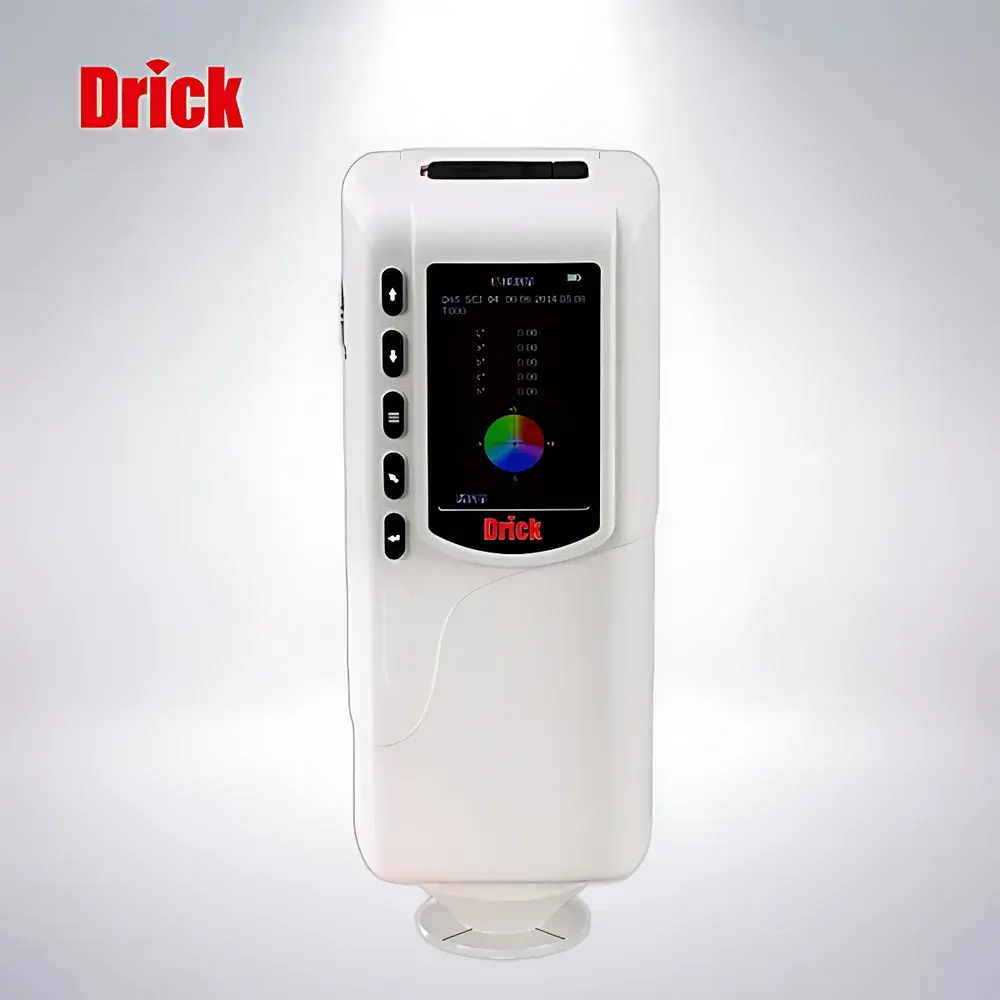
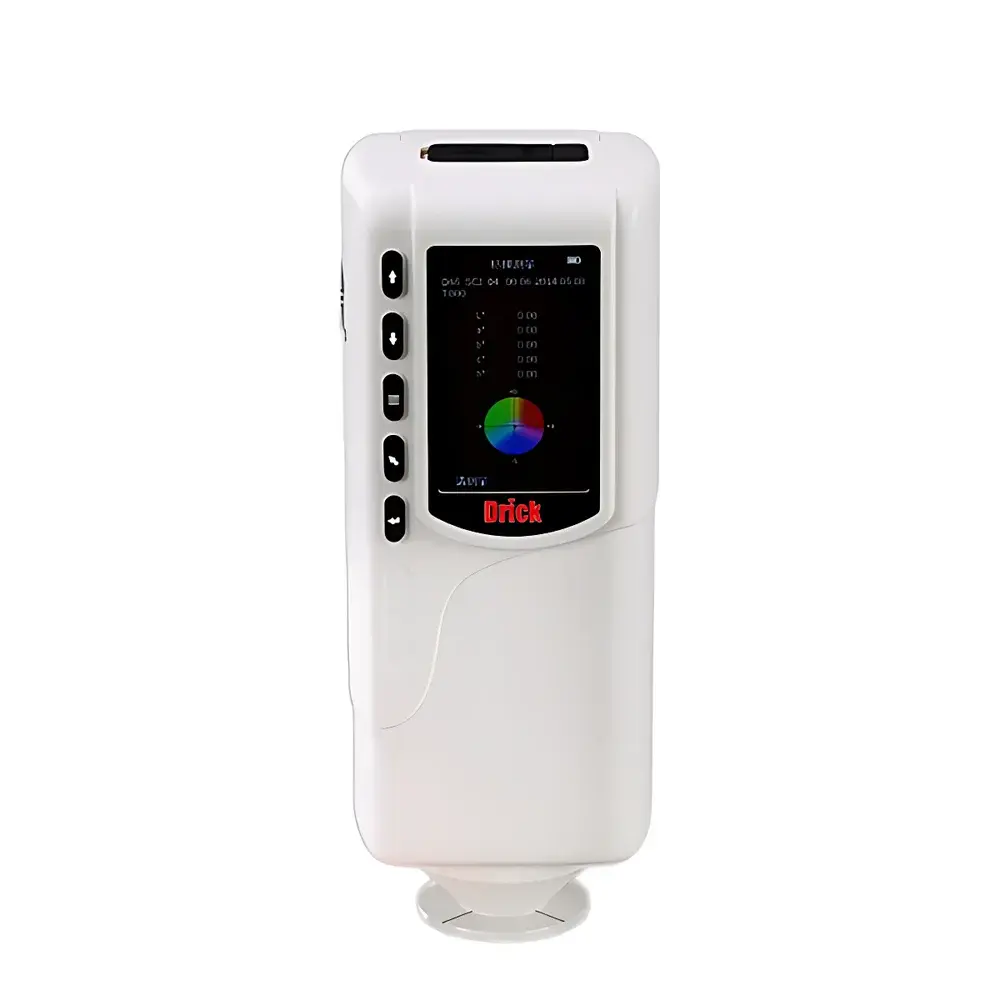
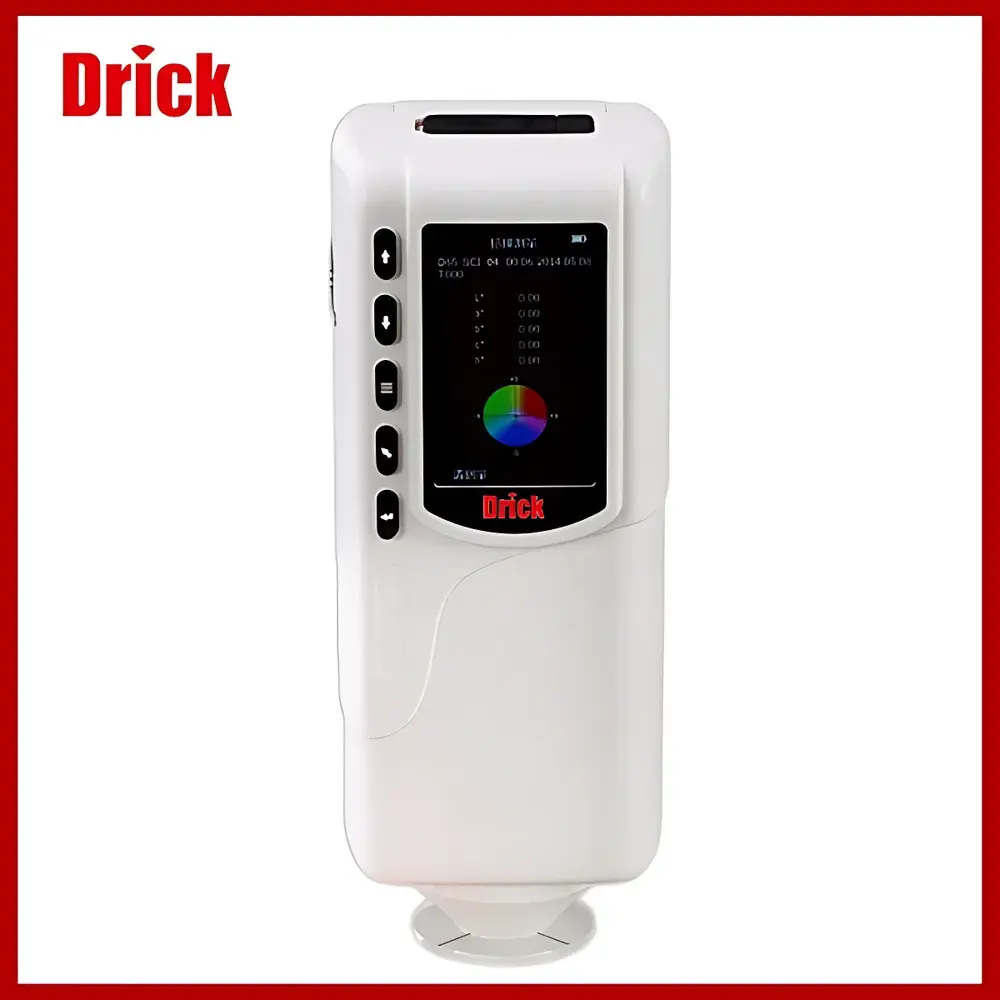
Drick DRK-4520 Whiteness Meter with Mirror Reflectance and Fluorescent Brightness Measurement Capability
| Brand | Drick |
|---|---|
| Origin | Shandong, China |
| Manufacturer Type | Direct Manufacturer |
| Country of Origin | China |
| Model | DRK-4520 |
| Price | USD 630 (FOB Qingdao, ex-factory basis) |
Overview
The Drick DRK-4520 Whiteness Meter is a dedicated optical measurement instrument engineered for precise quantification of whiteness, mirror reflectance (specular reflectance), and fluorescent brightness in solid planar materials. It operates on the CIE (Commission Internationale de l’Éclairage) standard illuminant D65 and 10° observer geometry, conforming to ISO 2470-1:2019 (Paper and board — Optical properties — Measurement of diffuse blue light reflectance factor — Part 1: Indoor daylight conditions), ISO 2471:2012 (Determination of opacity), and GB/T 7974–2013 (Chinese national standard for whiteness measurement). The instrument employs a dual-beam spectrophotometric architecture with a pulsed xenon lamp source and silicon photodiode array detection, enabling stable spectral acquisition across the visible range (400–700 nm) at 10 nm intervals. Its optical path incorporates a calibrated integrating sphere (d/0 geometry) with controlled specular component exclusion (SCE) and inclusion (SCI) modes—critical for distinguishing surface gloss effects from bulk optical properties. Designed for routine QC/QA in regulated production environments, the DRK-4520 delivers high reproducibility (<0.2 ΔW unit RSD over 24 h, n=10) under ambient laboratory lighting conditions.
Key Features
- Dual-mode optical configuration supporting both Specular Component Included (SCI) and Specular Component Excluded (SCE) measurements per ISO 2470 and ASTM E313
- Integrated UV excitation source (365 nm peak) for quantitative assessment of optical brightening agent (OBA) contribution to apparent whiteness
- Automatic calibration verification via built-in ceramic white reference tile traceable to NIM (National Institute of Metrology, China)
- Large-area sample port (Ø30 mm) accommodating irregular or textured substrates including paperboard, nonwovens, textiles, and plastic films
- Rugged industrial housing with anti-static coating and IP52-rated enclosure for use in packaging labs and production floor environments
- Real-time display of CIE Whiteness Index (WI), TAPPI Brightness (ISO Brightness), Y Brightness (CIE Y tristimulus value), and Fluorescence Compensation Index (FCI)
Sample Compatibility & Compliance
The DRK-4520 accommodates flat, opaque, or semi-opaque samples up to 5 mm thickness and minimum dimension 40 × 40 mm. Compatible substrates include uncoated and coated papers, kraft board, cotton linters, synthetic fibers, PVC sheets, and ceramic tiles. It supports compliance-driven workflows aligned with ISO/IEC 17025:2017 laboratory accreditation requirements—particularly in documentation of measurement uncertainty budgets, traceability of reference standards, and environmental condition logging (temperature: 15–30 °C; RH: 30–70 %). The instrument meets CE marking directives for electromagnetic compatibility (2014/30/EU) and low-voltage safety (2014/35/EU). While not FDA 21 CFR Part 11 validated out-of-the-box, its data export protocol (CSV/Excel) enables integration into validated LIMS or ELN systems where audit trails and electronic signatures are managed externally.
Software & Data Management
The DRK-4520 includes PC-based control software (Windows 10/11 compatible) supporting batch measurement, statistical process control (SPC) charting (X̄-R, Cp/Cpk), and comparative analysis against user-defined specification limits. Raw spectral data (30-point reflectance curve) and derived indices are stored with timestamp, operator ID, and calibration status metadata. Export formats include .csv (for Excel or Minitab), .pdf reports (with embedded calibration certificate), and .xml (compatible with LabWare LIMS). Software features GLP-compliant audit trail functionality—including modification history of measurement parameters, deletion logs, and user access level assignment (Admin / Operator / Viewer). Firmware updates are delivered via secure HTTPS portal with version-controlled release notes and validation checklists.
Applications
- Quality control of bleached chemical pulp and recycled fiber blends in paper mills
- Optimization of OBA dosage in tissue and printing paper formulations
- Comparative evaluation of surface coatings and pigment dispersion uniformity in board manufacturing
- Stability testing of whiteness retention in UV-exposed polymer films (e.g., food packaging laminates)
- Raw material acceptance testing for cotton, polyester, and viscose fibers in textile mills
- Regulatory submission support for ISO 11600 (adhesives) and ISO 12048 (packaging) whiteness-related clauses
FAQ
What is the difference between SCI and SCE measurement modes?
SCI includes specular reflection and measures total reflectance (bulk + surface), ideal for color-matching consistency. SCE excludes specular reflection to assess only diffuse reflectance, better correlating with visual perception under typical viewing conditions.
Can the DRK-4520 measure yellowing index (YI) or tint (TINT)?
Yes—software calculates ASTM E313 YI (D65/10°) and Ganz-Tint values directly from full-spectrum data; no external conversion required.
Is third-party calibration certification available?
Drick provides optional NIST-traceable calibration certificates issued by CNAS-accredited labs (certificate #CNAS LXXXXX), valid for 12 months.
How often must the instrument be recalibrated?
Daily zero calibration using black trap is mandatory; white tile calibration recommended before each measurement session or after ambient temperature shifts >2 °C.
Does the system support multi-language UI?
English and Simplified Chinese interfaces are pre-installed; additional languages (Spanish, Portuguese, Vietnamese) available upon request with firmware update.




