
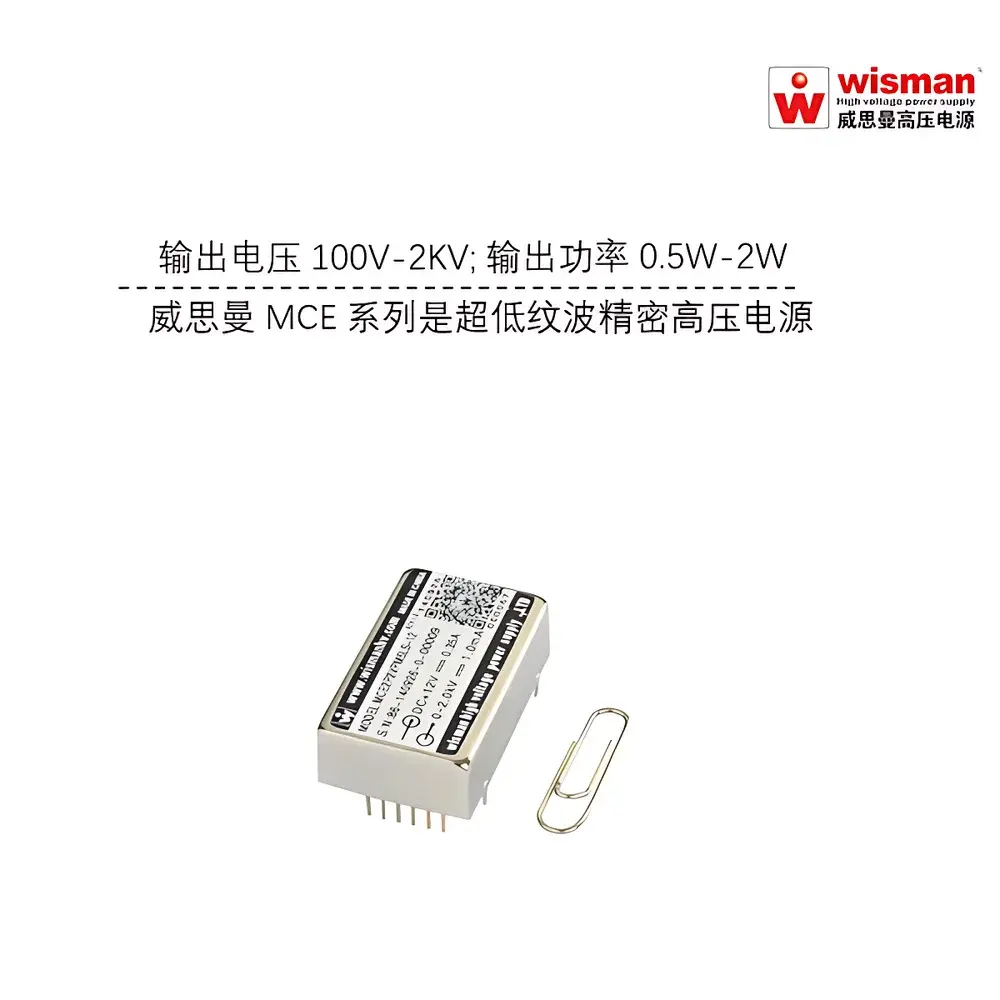
Wiseman MCE Series High-Voltage DC-DC Module Power Supply – 2 kV, 2 W
| Brand | Wiseman |
|---|---|
| Model | MCE |
| Output Voltage | ±2 kV (adjustable 0–2000 V) |
| Output Power | 2 W |
| Output Ripple & Noise | ≤5 mV<sub>pp</sub> |
| Stability | 0.001% per hour |
| Temperature Coefficient | 10 ppm/°C |
| Input Voltage | 12 V ±0.5 V (optional: 5 V, 15 V, or 24 V ±1 V) |
| Control Interface | 0–2.5 V analog voltage or 20 kΩ potentiometer |
| Dimensions | 40 × 25 × 12 mm |
| Weight | 25 g |
| Operating Temperature | -10°C to +50°C (commercial grade S), -25°C to +65°C (industrial grade G), -40°C to +95°C (extended grade T) |
| Protection | Reverse polarity, overcurrent, short-circuit, arc detection, continuous overload |
| Shielding | Six-sided EMI shielding |
| Mounting | PCB-mount |
| Compliance | Designed for OEM integration in analytical instrumentation requiring stable, low-noise bias supply |
Overview
The Wiseman MCE Series is a compact, high-reliability DC-DC high-voltage module engineered for precision biasing applications in scientific and analytical instrumentation. Based on zero-current resonant (ZCR) topology and proprietary high-voltage insulation design, the MCE delivers regulated output voltages up to ±2 kV with exceptional stability and ultra-low electromagnetic interference. Its core architecture minimizes parasitic capacitance and leakage current—critical for sensitive detector systems where signal integrity and dark-current suppression are paramount. Unlike general-purpose HV supplies, the MCE is purpose-built for embedded integration into OEM instruments such as mass spectrometers, electron multipliers, and radiation detectors, where board-level mounting, thermal robustness, and long-term drift performance directly impact measurement reproducibility.
Key Features
- Ultra-low output ripple and noise: ≤5 mVpp across full load and voltage range—validated under 2 kV / 1 mA conditions using 20 MHz bandwidth oscilloscope measurement per IEC 61000-4-3
- High short-term stability: 0.001% per hour (typical), verified under constant ambient temperature (±0.5°C) and fixed load
- Low thermal drift: 10 ppm/°C coefficient ensures minimal output deviation across industrial-grade operating ranges (-25°C to +65°C)
- Six-sided mu-metal and conductive polymer shielding provides >80 dB attenuation of radiated EMI in 10 kHz–1 GHz band
- Integrated protection circuitry includes reverse-input-polarity lockout, real-time arc detection with <10 µs response, current-limited short-circuit recovery, and auto-reset overtemperature shutdown
- Flexible control interface supports both analog voltage input (0–2.5 V, 100 kΩ input impedance) and potentiometer-based setpoint adjustment (20 kΩ ±2.5 kΩ)
- PCB-mount footprint (40 × 25 × 12 mm) enables direct integration into dense instrument backplanes without heatsink dependency
- Multiple environmental grades available: Commercial (S), Industrial (G), and Extended (T) — each qualified per MIL-STD-810G vibration profiles and thermal cycling (1000 cycles, -40°C ↔ +95°C)
Sample Compatibility & Compliance
The MCE module is routinely deployed as the high-voltage bias source for photomultiplier tubes (PMTs), microchannel plates (MCPs), ionization chambers, proportional counters, and G-M tubes—where low dark current and pulse-height consistency depend critically on supply stability and noise floor. It meets essential safety and EMC requirements for integration into Class I medical devices (IEC 60601-1), analytical instruments (IEC 61326-1), and laboratory equipment (UL 61010-1). While not pre-certified as a standalone end-product, the MCE’s design adheres to creepage/clearance distances per IPC-2221B (≥8 mm at 2 kV DC), reinforced insulation per IEC 60664-1, and transient immunity per IEC 61000-4-4 (Level 3, 2 kV EFT). For GLP/GMP-regulated environments, its analog control interface supports traceable voltage setpoint logging when paired with validated DAQ systems.
Software & Data Management
As a hardware-only analog module, the MCE does not include embedded firmware or digital communication interfaces. However, its analog control architecture is fully compatible with industry-standard data acquisition platforms—including National Instruments PXIe systems, Keysight DAQ970A, and Beckhoff EtherCAT terminals—enabling closed-loop voltage regulation, automated calibration sweeps, and timestamped stability monitoring. When integrated into validated instrument software (e.g., LabVIEW-based MS control suites), the MCE supports 21 CFR Part 11-compliant audit trails via external control signal logging and output voltage feedback digitization (using ≥16-bit ADCs). Optional external feedback modules (sold separately) provide 0–10 V isolated output proportional to actual HV, enabling real-time compensation for load-induced droop.
Applications
- Mass spectrometry: Detector bias for electron multipliers and Faraday cups; lens array focusing in quadrupole and TOF systems
- Nuclear instrumentation: PMT bias in scintillation detectors (NaI, LaBr3, plastic), proportional counter operation, and G-M tube quenching control
- Electron optics: Electrostatic lens bias in SEM, TEM, and focused ion beam (FIB) columns
- Electrophoresis and capillary electrophoresis: High-voltage drive for separation fields up to 30 kV/cm (multi-module stacking supported)
- Industrial NDT: X-ray tube filament bias and grid control in portable radiography units
- Research physics: Particle accelerator beamline steering electrodes, electrostatic precipitator test rigs, and plasma diagnostics
FAQ
Is the MCE module certified to UL or CE standards?
The MCE is supplied as a component-level power module—not a finished end-product—and therefore carries no standalone UL/CE mark. However, its design complies with insulation coordination, creepage, and emissions limits required for final equipment certification under UL 61010-1 and EN 61326-1.
Can multiple MCE modules be stacked to achieve higher output voltage?
Yes—modules may be series-connected with proper inter-module isolation and floating ground management. Wiseman provides application notes on cascading configurations, including voltage balancing resistors and common-mode transient suppression.
What is the recommended method for verifying long-term stability in a lab environment?
Use a calibrated high-impedance HV meter (e.g., Keithley 237 or Trek 632B) with 10 GΩ input resistance, record output every 10 minutes over 24 hours under constant load and ambient temperature, and calculate standard deviation relative to nominal output.
Does the MCE support remote sensing or load regulation compensation?
No—remote sense capability is not implemented. For applications requiring tight regulation under variable cable drop, users must either minimize lead length (<15 cm) or incorporate external feedback loops using optional HV monitor modules.
Are custom output voltage ranges available beyond ±2 kV?
Yes—Wiseman offers OEM customization including ±500 V, ±5 kV, and bipolar ±1 kV configurations. Minimum order quantities and NRE fees apply; lead time is typically 8–12 weeks.



