
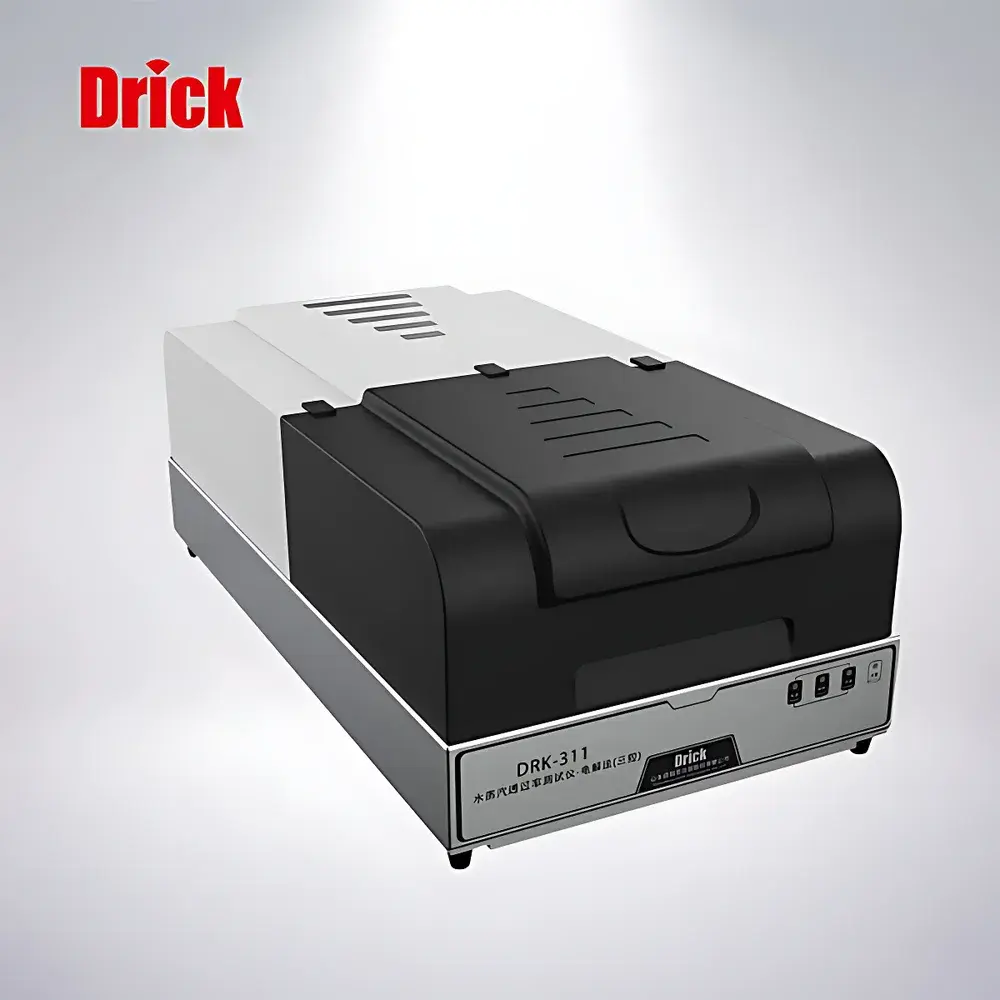
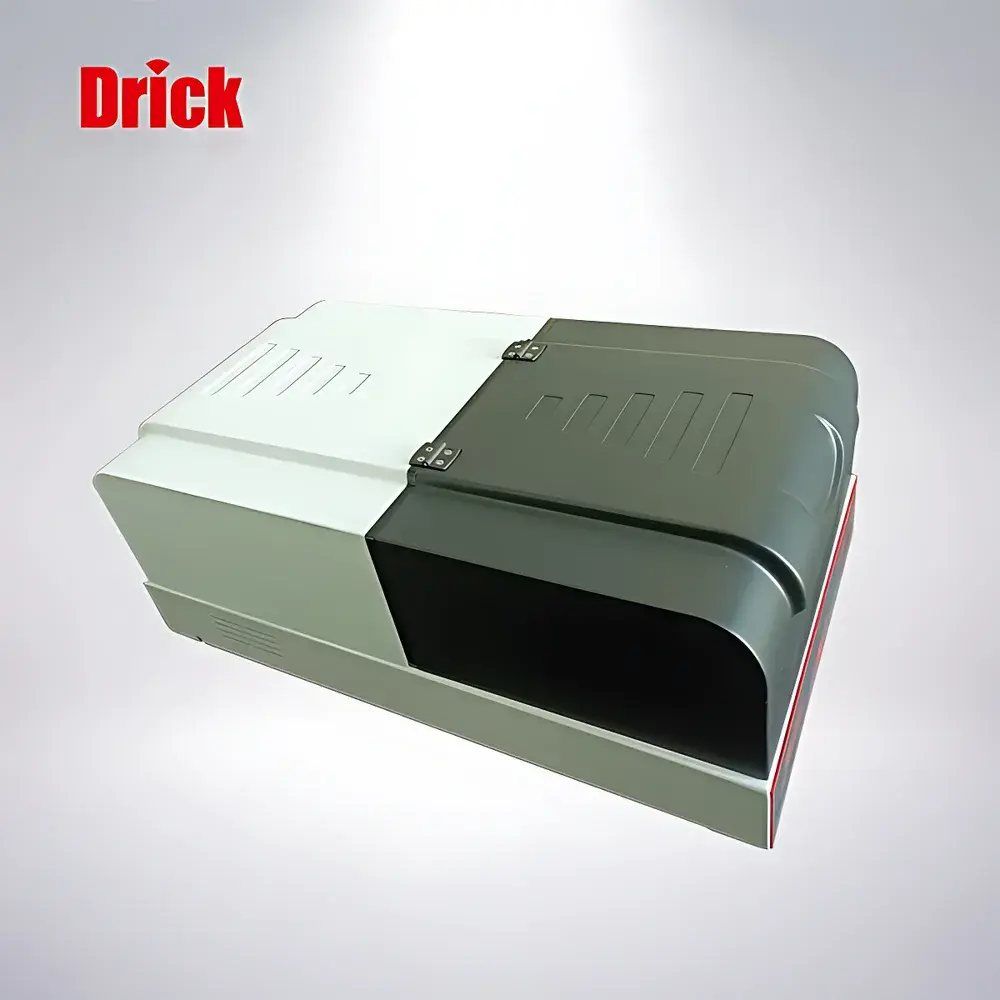
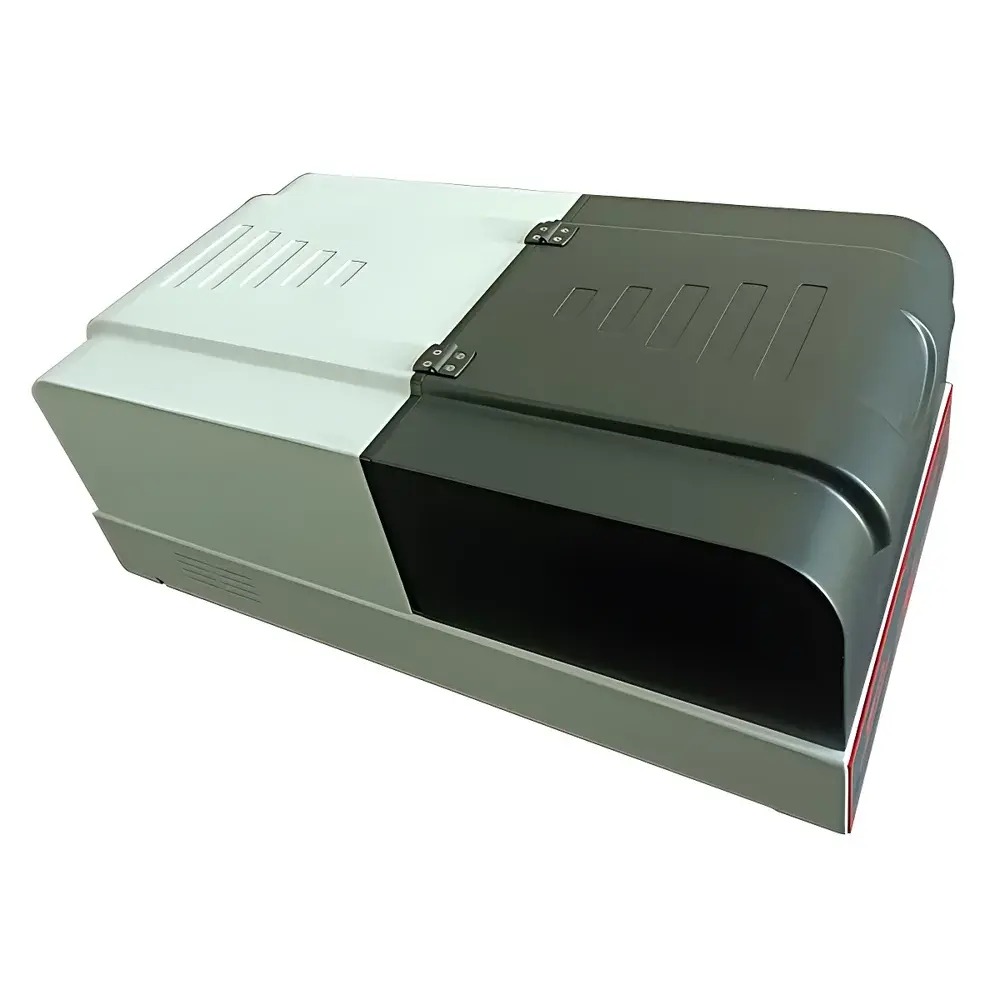
Drick DRK311 Water Vapor Transmission Rate (WVTR) Tester for Plastic Films per GB/T 26253
| Brand | Drick |
|---|---|
| Origin | Shandong, China |
| Manufacturer Type | Direct Manufacturer |
| Country of Origin | China |
| Model | DRK311 |
| Test Chambers | 3 independent |
| WVTR Range | 0.001–40 g/(m²·24h) |
| Resolution | 0.001 g/(m²·24h) |
| Test Area | 50 cm² |
| Specimen Size | 105 mm × 120 mm |
| Max Thickness | ≤3 mm |
| Temperature Control | 15–55 °C (±0.1 °C) |
| Humidity Control | 50–90 %RH (±2 %RH) |
| Carrier Gas | Ultra-high-purity N₂ (99.999%) |
| Flow Rate | 100 mL/min |
| Power Supply | AC 220 V, 50 Hz |
| Dimensions | 380 × 680 × 280 mm (L×W×H) |
| Net Weight | 72 kg |
Overview
The Drick DRK311 Water Vapor Transmission Rate (WVTR) Tester is a gravimetric-permeation-based instrument engineered for precise, standardized measurement of water vapor permeation through flexible barrier materials. It operates on the principle of dynamic carrier-gas coulometric detection: a conditioned nitrogen stream (controlled humidity) flows across one side of a clamped specimen, while dry, high-purity nitrogen sweeps the opposite side. The resulting moisture gradient drives water vapor diffusion through the film; the permeated vapor is transported by the dry carrier gas to a highly sensitive relative humidity sensor—calibrated to output a linear electrical signal proportional to mass flux. This signal is digitally integrated and converted into standardized WVTR values in g/(m²·24h), fully compliant with the Chinese national standard GB/T 26253–2010, which aligns methodologically with ISO 15106-2 (infrared detection) and ASTM F1249 (modulated infrared detection) for comparative validity.
Key Features
- Triple independent test chambers enable concurrent evaluation of up to three specimens—identical or dissimilar—without cross-interference, significantly improving throughput for QC laboratories handling multi-batch validation.
- Precision environmental control system maintains temperature within ±0.1 °C (15–55 °C range) and relative humidity within ±2 %RH (50–90 %RH), ensuring strict adherence to standardized conditioning protocols required for reproducible barrier performance assessment.
- Automated computer-controlled operation supports multiple test logic modes: standard fixed-duration testing, proportional endpoint determination (based on signal slope stability), and continuous real-time monitoring—facilitating both routine compliance checks and R&D kinetic profiling.
- High-resolution detection capability (0.001 g/(m²·24h)) enables reliable quantification of ultra-low-permeability films used in pharmaceutical blister packaging, medical device pouches, and high-barrier food packaging laminates.
- Modular gas delivery architecture uses certified 99.999% pure nitrogen as carrier gas at a stable 100 mL/min flow rate, minimizing baseline drift and eliminating interference from ambient moisture or trace contaminants.
- Compliant mechanical design includes a rigid aluminum alloy frame, precision-machined stainless steel test cells, and sealed pneumatic clamping to ensure uniform specimen tension and leak-free sealing over repeated cycles.
Sample Compatibility & Compliance
The DRK311 accommodates flat, non-porous sheet materials up to 3 mm thickness and 105 mm × 120 mm dimensions, with an effective test area of 50 cm². It is validated for plastic films (e.g., PET, PE, PP, PVDC-coated substrates), metallized laminates, aluminum foil composites, pharmaceutical-grade sterile barrier films (per ISO 11607-1), and construction-grade vapor retarders. All operational parameters—including temperature ramp profiles, humidity setpoints, and data acquisition intervals—are configurable to meet internal SOPs and external regulatory expectations. The system supports audit-ready documentation workflows aligned with GLP and GMP principles, including user access logging, parameter change tracking, and electronic signature-capable reporting—compatible with 21 CFR Part 11 readiness when deployed with validated LIMS or ELN integration.
Software & Data Management
Built-in Windows-based control software provides real-time graphical display of sensor response curves, automatic calculation of WVTR, induction period estimation, and permeability coefficient derivation (if thickness is entered). Raw data (time-stamped sensor voltage, chamber T/RH, flow rate) are stored in .csv format and exportable via USB 2.0 interface. Software includes built-in calibration verification routines, pass/fail threshold alerts, batch report generation (PDF/Excel), and optional CSV-to-LIMS pipeline configuration. All data files retain embedded metadata: operator ID, test date/time, chamber ID, specimen ID, and environmental setpoints—ensuring full traceability per ISO/IEC 17025 requirements.
Applications
- Quality control of food packaging films to verify shelf-life predictions under accelerated storage conditions.
- Development and validation of barrier coatings for flexible electronics encapsulation (OLED, organic photovoltaics).
- Regulatory submission support for medical device packaging per ISO 11607-2, including aging studies and sterilization cycle impact assessment.
- Comparative analysis of biodegradable film formulations (PLA, PHA, starch blends) under controlled humidity gradients.
- Supplier qualification testing for automotive interior trim films where condensation resistance affects fogging performance.
- Research into humidity-dependent permeation kinetics for hydrophilic/hydrophobic nanocomposite membranes.
FAQ
What standards does the DRK311 comply with?
It is designed and verified to meet GB/T 26253–2010; its methodology is technically equivalent to ISO 15106-2 and ASTM F1249 for water vapor transmission measurement.
Can the system be used for non-film materials such as foams or textiles?
No—it requires planar, gas-tight specimens with defined thickness and surface integrity; porous or fibrous substrates introduce edge leakage and invalid diffusion assumptions.
Is nitrogen purity critical for accurate results?
Yes: impurities (e.g., O₂, H₂O, hydrocarbons) in carrier gas cause sensor drift and false-positive signals; only ≥99.999% N₂ is recommended.
How often does the humidity sensor require recalibration?
Annual traceable recalibration against NIST-traceable RH standards is advised; field verification using saturated salt solutions is supported in software.
Does the system support automated pass/fail judgment against specification limits?
Yes—user-defined upper/lower WVTR thresholds trigger visual alerts and auto-flag results during acquisition and reporting.




