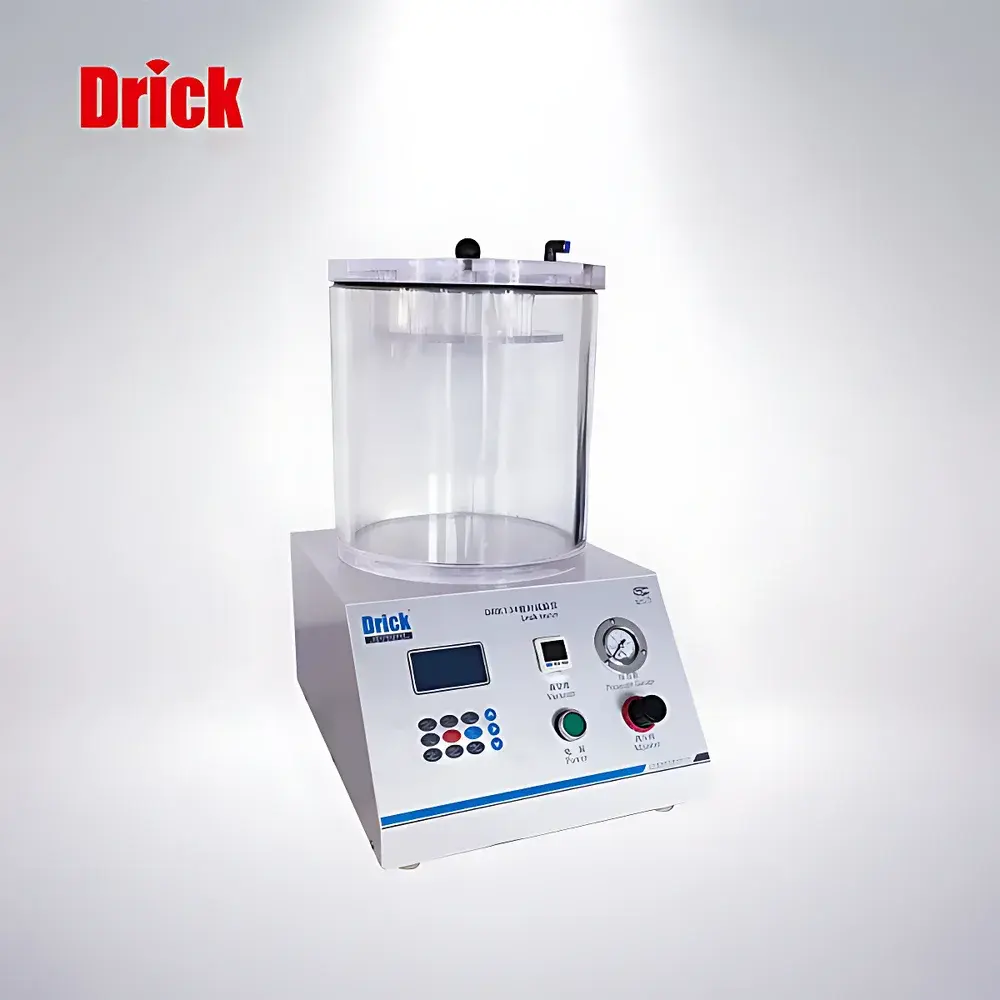
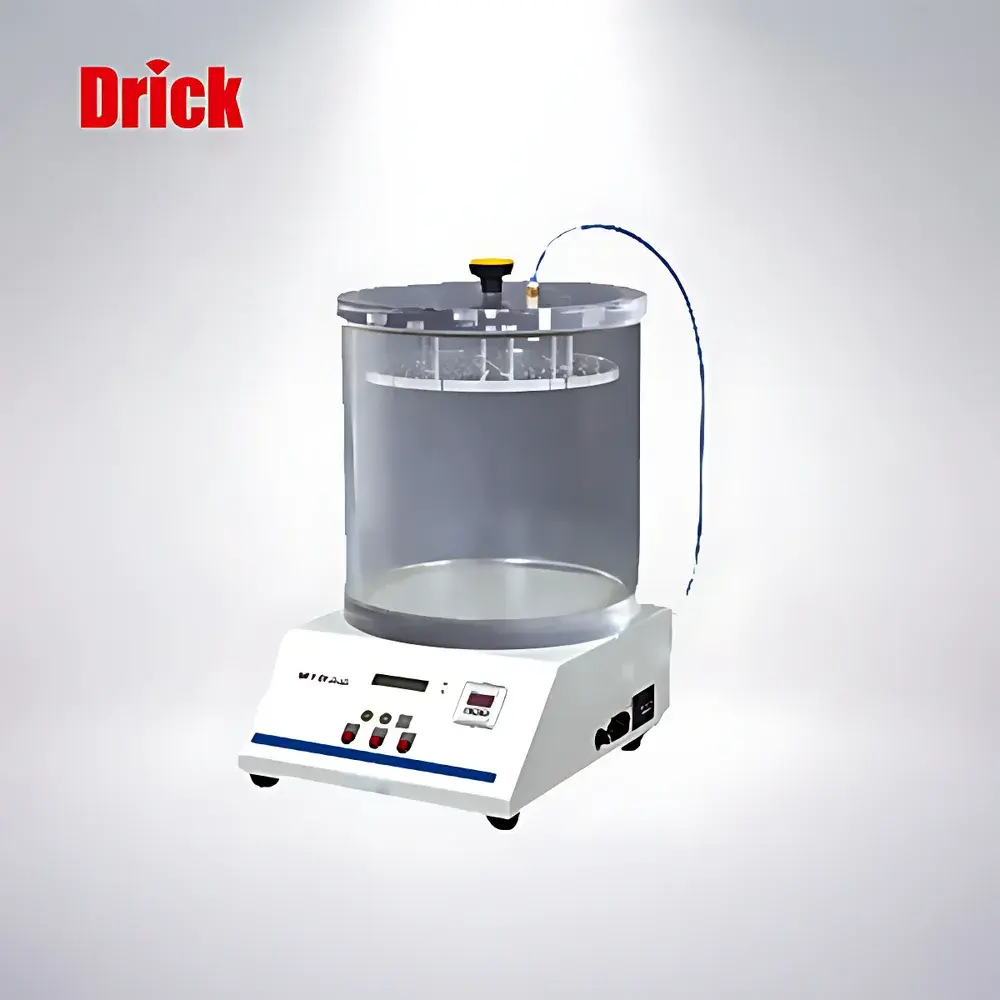
Drick DRK134 Seal Integrity Tester for Flexible Packaging – Compliant with GB/T 15171 and ASTM D3078
| Brand | Drick |
|---|---|
| Origin | Shandong, China |
| Manufacturer Type | Direct Manufacturer |
| Region | Domestic (China) |
| Model | DRK134 |
| Price | USD 7,000 (FOB Qingdao) |
| Accuracy Class | Class 1 |
| Vacuum Range | 0 to –90 kPa |
| Vacuum Chamber Dimensions (Standard) | Φ270 mm × 210 mm (H) |
| Optional Chambers | Φ360 mm × 585 mm (H), Φ460 mm × 330 mm (H) |
| Air Supply Pressure | 0.7 MPa (user-provided) |
| Air Inlet Fitting | Φ6 mm polyurethane tubing |
| Overall Dimensions | 300 mm (L) × 380 mm (W) × 450 mm (H) |
| Power Supply | AC 220 V, 50 Hz |
| Net Weight | 12 kg |
Overview
The Drick DRK134 Seal Integrity Tester is a precision-engineered instrument designed to evaluate the integrity of seals in flexible packaging systems—primarily pouches, sachets, blister packs, laminated tubes, and sealed bottles—according to internationally recognized test protocols. It operates on the principle of vacuum decay and bubble emission analysis, as defined in GB/T 15171–1994 “Test Method for Seal Integrity of Flexible Packages” and ASTM D3078–2022 “Standard Test Method for Determination of Leaks in Flexible Packaging by Bubble Emission.” The device subjects a submerged specimen to controlled negative pressure within a calibrated vacuum chamber; leakage is detected either by visual observation of air bubbles escaping from seal defects or by monitoring dimensional deformation (e.g., expansion under vacuum and elastic recovery upon pressure release). This dual-mode assessment provides objective, repeatable pass/fail criteria aligned with quality assurance requirements in regulated manufacturing environments.
Key Features
- Microprocessor-based control system with backlit LCD interface and intuitive PVC membrane keypad for real-time parameter input and status monitoring.
- Digital presetting of target vacuum level (0 to –90 kPa) and dwell time ensures consistent test conditions across multiple samples and operators.
- Integrated pressure gauge for inlet air supply (0.7 MPa nominal), enabling continuous verification of pneumatic stability and protecting solenoid valves and pressure regulators from overpressure events.
- Imported pneumatic components—including high-cycle-life solenoid valves and proportional pressure regulators—support automatic pressure maintenance, timed vacuum hold, end-of-test depressurization, and reverse-air purge for rapid chamber unloading.
- Class 1 accuracy per JJG 539–2016 (Chinese metrological verification regulation for vacuum gauges), validated traceably to national standards.
- Modular vacuum chamber design: standard chamber (Φ270 × 210 mm H) accommodates most pharmaceutical and food pouches; optional larger chambers support oversized or multi-unit testing configurations (Φ360 × 585 mm H and Φ460 × 330 mm H available upon request).
Sample Compatibility & Compliance
The DRK134 accepts a broad range of package formats including heat-sealed plastic pouches, aluminum-laminated sachets, Tyvek®-based medical device trays, PE-coated paperboard cartons, and rigid-plastic containers with foil or film lidding. Its operational methodology satisfies critical regulatory expectations: test data generated supports compliance with ISO 11607–2:2019 (Packaging for terminally sterilized medical devices), USP (Package Integrity Evaluation), and FDA guidance on container closure integrity testing (CCIT) for sterile products. While not a quantitative leak-rate instrument, its qualitative output is accepted for routine QC screening where correlation to deterministic methods (e.g., helium mass spectrometry or high-voltage leak detection) has been established per internal validation protocols.
Software & Data Management
The DRK134 operates as a standalone hardware platform without proprietary PC software. All test parameters and outcomes are recorded manually or via external lab notebooks. However, the instrument’s digital controls log vacuum setpoint, actual achieved vacuum (±1 kPa resolution), hold duration, and cycle completion status—enabling full traceability when integrated into GLP/GMP documentation workflows. For audit readiness, users may pair the unit with time-stamped video recording of bubble observation or deformation behavior. No electronic records are stored onboard; therefore, it inherently complies with 21 CFR Part 11 requirements for non-electronic record systems—eliminating validation overhead associated with data integrity modules.
Applications
- Pharmaceutical packaging: verification of peel seals on blister cards, pouches for oral solids, and barrier-laminated sachets for moisture-sensitive APIs.
- Medical device packaging: functional testing of Tyvek®/PET–PE pouches used for sterile barrier systems per ISO 11607–1.
- Food & beverage: detection of micro-leaks in retort pouches, vacuum-packed meat trays, and nitrogen-flushed snack bags prior to distribution.
- Consumer health & cosmetics: evaluation of tube crimp seals, flip-top cap integrity, and laminate pouch durability after accelerated aging.
- Electronics: screening of ESD-safe static-shielding bags for pinhole defects or seal delamination that could compromise component protection.
FAQ
Does the DRK134 provide quantitative leak rate measurements?
No. It delivers qualitative pass/fail results based on observable bubble emission or physical deformation under standardized vacuum stress. Quantitative CCIT requires complementary instrumentation such as pressure decay testers or mass spectrometers.
Is calibration certification included with shipment?
A factory calibration report referencing traceable pressure standards is supplied. Users must perform periodic verification using a certified reference vacuum gauge per internal SOPs or ISO/IEC 17025 guidelines.
Can the DRK134 be used for testing rigid containers like glass vials or HDPE bottles?
Yes—provided the specimen fits within the selected vacuum chamber and exhibits sufficient flexibility or seal geometry to permit detectable gas escape or deformation under –90 kPa differential pressure.
What maintenance is required for long-term reliability?
Routine inspection of O-rings, chamber gasket integrity, and pneumatic tubing for cracks or swelling is recommended quarterly. Solenoid valves should be cleaned annually with isopropyl alcohol if exposed to humid or particulate-laden air supplies.
Is technical support available outside China?
Drick provides remote troubleshooting and application guidance via email and video call. Distributor networks in Southeast Asia, the Middle East, and Latin America offer localized service contracts and spare parts logistics.