
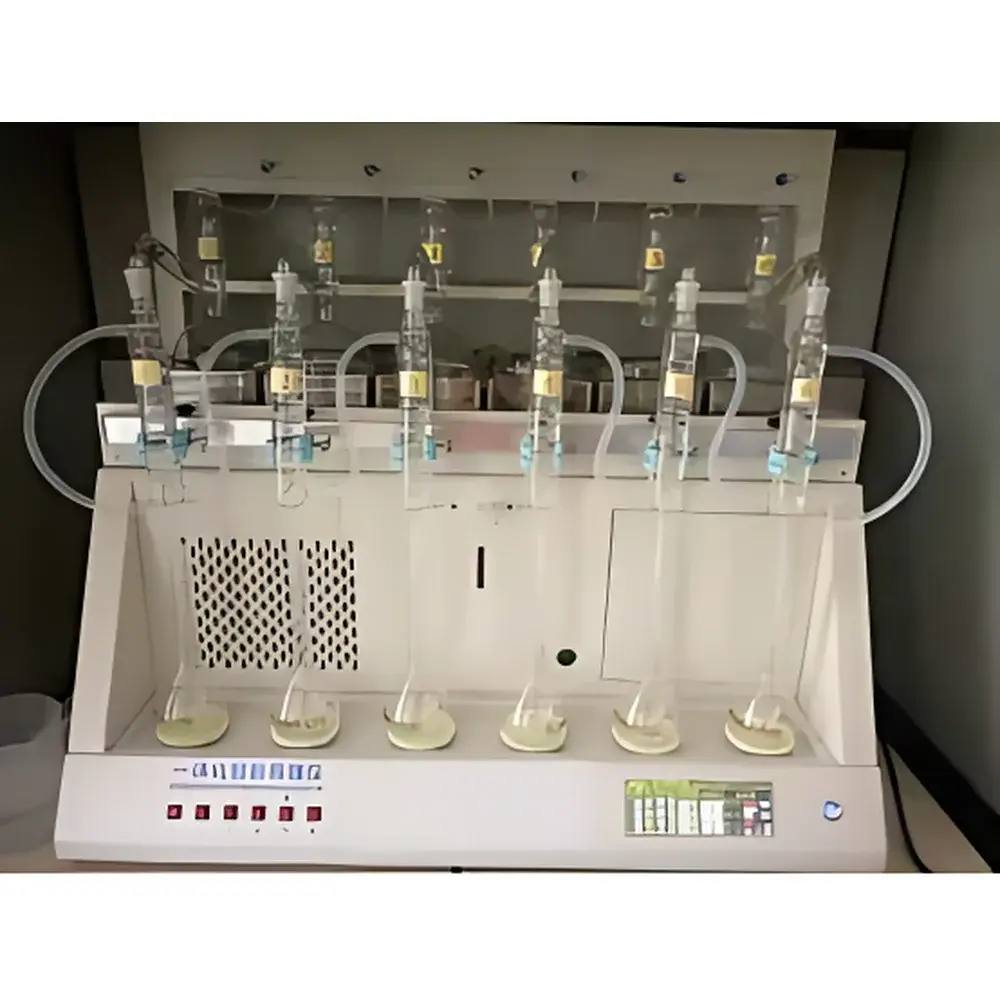
HEB-603 Integrated Intelligent Distillation Apparatus by Jihepu (Jinan Hopu)
| Brand | Jihepu (Jinan Hopu) |
|---|---|
| Origin | Shandong, China |
| Manufacturer Type | Authorized Distributor |
| Country of Origin | China |
| Model | HEB-603 |
| Instrument Type | Quartz Glass Distillation System |
| Heating Method | Far-Infrared Ceramic Heater (Flameless, Waterproof) |
| Display | LCD Touchscreen Interface |
| Heating Units | 1–6 Independent Channels |
| Ramp Time | 5–8 min |
| Distillation Rate | 12 mL/min |
| Endpoint Control | Dual-mode (Time + Mass), ±2 mL Accuracy |
| Max Power per Heater | 0–800 W (Adjustable) |
| Total Rated Power | 4800 W (Adjustable) |
| Voltage/Frequency | 220 V / 50 Hz |
| Cooling System | Closed-loop Internal Recirculation with Fan + Compressor Refrigeration |
| Anti-Suckback | Solenoid Vacuum Valve |
| Timer Range | 0–200 min |
| Distillation Flask Capacity | 500 mL × 6 (Custom Options Available) |
| Receiving Flask Capacity | 250 mL × 6 (Custom Options Available) |
Overview
The HEB-603 Integrated Intelligent Distillation Apparatus is an engineered solution for standardized, reproducible distillation in analytical laboratories requiring precise volatile analyte isolation—particularly for environmental, public health, and industrial water quality testing. Designed around the fundamental principle of controlled thermal separation under atmospheric or reduced pressure, the system integrates far-infrared ceramic heating, real-time endpoint detection, and closed-loop refrigerated condensation into a single compact platform. Unlike conventional open-bath or oil-heated distillation setups, the HEB-603 eliminates flame hazards and external cooling water dependencies while maintaining strict thermal uniformity across up to six parallel channels. Its architecture supports method-defined distillation protocols aligned with standard test procedures including EPA Method 410.2 (oil & grease), ISO 6439 (cyanide), ISO 5664 (ammonia nitrogen), and HJ 501–2009 (phenolic compounds) used widely in Chinese and international regulatory labs.
Key Features
- Fully independent 1–6 channel operation: Each heating unit features individual power regulation (0–800 W), temperature ramp control, and programmable start delay—enabling heterogeneous sample batches without cross-interference.
- Dual-mode distillation endpoint detection: Simultaneous time-based and mass-based termination logic ensures compliance with method-specified collection volumes (e.g., 200 mL for phenol distillation per HJ 501–2009), with volumetric accuracy maintained within ±2 mL through high-resolution load-cell feedback.
- Far-infrared ceramic heating elements: Provide rapid, uniform thermal transfer to quartz glass flasks (500 mL standard), eliminating hot spots and reducing risk of bumping or localized decomposition—critical for thermally labile analytes such as free cyanide or volatile phenols.
- Integrated closed-loop cooling: Combines axial fan-assisted airflow with a dedicated refrigeration compressor to maintain condenser surface temperatures ≤5 °C, achieving >95% condensation efficiency without tap water consumption or external chiller interfaces.
- Active anti-suckback protection: A solenoid-controlled vacuum isolation valve automatically seals the distillate path upon pressure reversal—preventing contamination of absorption solutions during low-pressure cyanide or phenol analysis where the receiving tube is submerged below liquid level.
- LCD touchscreen interface with embedded method library: Preloaded templates for common parameters (e.g., ammonia nitrogen: 150 min @ 700 W; cyanide: 120 min @ 600 W) support GLP-compliant workflow execution and reduce operator-induced variability.
Sample Compatibility & Compliance
The HEB-603 accommodates standard quartz glass distillation assemblies (including 500 mL boiling flasks and 250 mL receiving vessels), with optional adapters for alternative flask geometries (e.g., 1000 mL, 250 mL micro-distillation). It is validated for use with aqueous matrices containing suspended solids, surfactants, or moderate organic load—common in wastewater, drinking water, and biological digests. The system meets essential safety and performance criteria outlined in GB/T 27404–2008 (Laboratory Quality Control Guidelines) and supports audit readiness for CNAS-accredited laboratories. While not FDA 21 CFR Part 11–certified out-of-the-box, its logged endpoint events, power profiles, and user-access timestamps provide traceable data for internal QA review and GMP-aligned documentation practices.
Software & Data Management
The onboard firmware records operational metadata—including start/stop timestamps, per-channel power history, actual distillate mass, and error flags (e.g., overtemperature, vacuum loss)—to internal non-volatile memory. Data export is supported via USB 2.0 to CSV format for integration with LIMS or Excel-based reporting. No cloud connectivity or remote access functionality is included, preserving data sovereignty and aligning with institutional IT security policies typical in government and academic labs. Audit trails are retained for ≥10,000 cycles and can be password-protected to restrict configuration changes per GLP requirement.
Applications
- Environmental monitoring: Quantification of volatile phenols (HJ 502–2009), total cyanide (HJ 484–2009), ammonia nitrogen (HJ 537–2009), and Kjeldahl nitrogen (HJ 717–2014) in surface water, wastewater, and soil extracts.
- Public health laboratories: Routine distillation pretreatment prior to colorimetric or ion-selective electrode analysis per WHO and CDC-recommended protocols.
- Food & agriculture testing: Moisture determination in oils and fats (AOAC 925.10–compatible setup), and separation of volatile flavor compounds.
- Academic research: Teaching distillation fundamentals, method development for novel analytes, and inter-laboratory comparison studies requiring high inter-run reproducibility (CV < 3.2% observed in certified reference material recovery tests).
FAQ
Is the HEB-603 compatible with non-quartz glass distillation assemblies?
Yes—standard borosilicate glassware (e.g., Pyrex) may be used, though quartz is recommended for high-temperature stability and UV transparency during post-distillation photometric analysis.
Can the system operate continuously for extended batch runs?
It supports unattended operation for up to 200 minutes per cycle; however, thermal duty cycle management is advised when running >4 consecutive batches to maintain heater longevity and condenser efficiency.
Does the apparatus meet ISO/IEC 17025 calibration requirements?
While the unit itself is not supplied with accredited calibration certificates, its modular design allows third-party verification of temperature, mass, and timing subsystems using NIST-traceable standards.
What maintenance is required for the refrigeration module?
The sealed compressor system requires no routine refrigerant servicing; annual inspection of condenser coil cleanliness and fan operation is recommended to sustain thermal performance.
Is method validation documentation available for regulatory submissions?
Jihepu provides a technical validation report detailing recovery rates (>95% for phenol, cyanide, and ammonia standards), precision data (RSD ≤ 2.8%), and interference testing—suitable for inclusion in SOP appendices or QA packages.



