
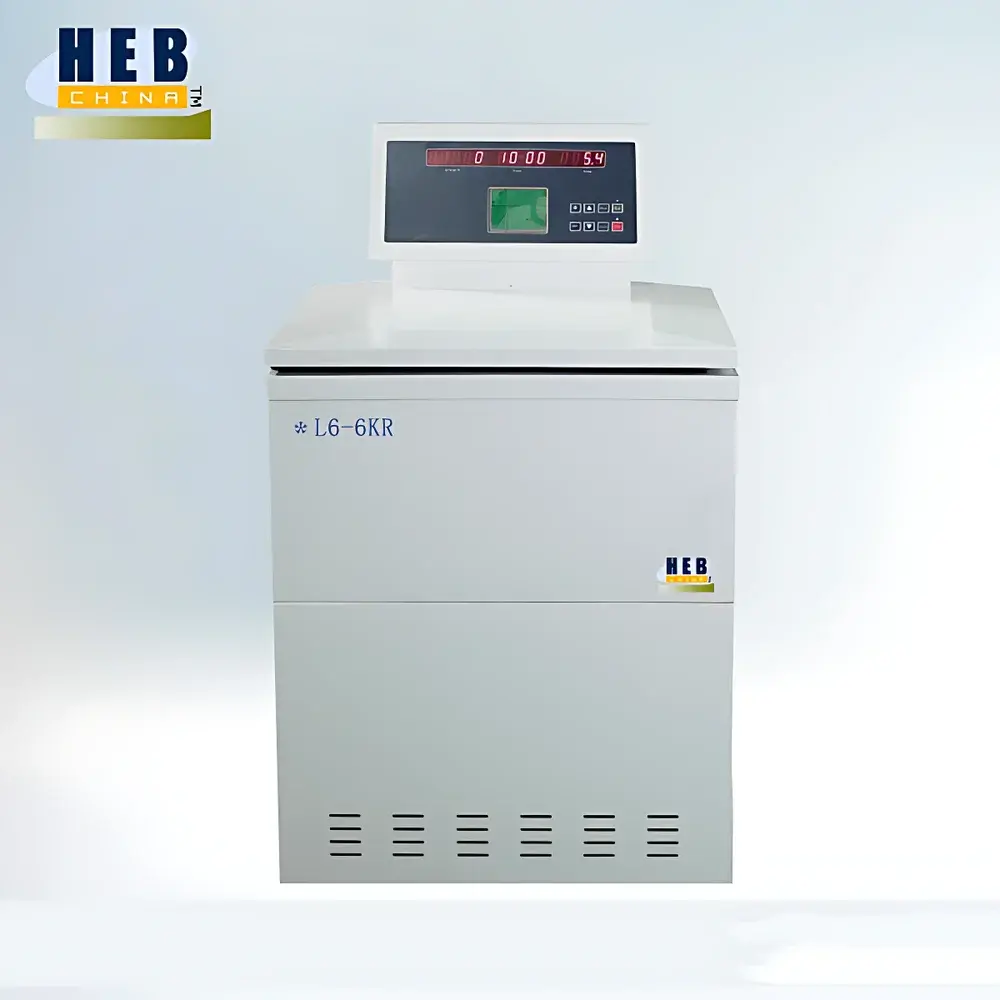
HePu L6-6K Floor-standing High-Capacity Low-Speed Refrigerated Centrifuge
| [Brand | HePu |
|---|---|
| Origin | Shandong, China |
| Model | L6-6K |
| Type | Floor-standing refrigerated centrifuge |
| Max. Speed | 6500 rpm |
| Max. RCF | 6680 × g |
| Max. Capacity | 6 × 1000 mL |
| Acceleration/Deceleration | Programmable |
| Speed Increment | 100 rpm |
| Speed Accuracy | ±20 rpm |
| Timer Range | 1 min – 23 h 59 min |
| Noise Level | ≤65 dB(A) |
| Chamber Diameter | Φ600 mm |
| Dimensions (W×D×H) | 840 × 730 × 1240 mm |
| Net Weight | 190 kg |
| Power Supply | AC 220 V ±10%, 50 Hz, 30 A |
| Total Power | 1500 W |
| Motor | Brushless frequency-controlled |
| Safety Features | Imbalance detection, overspeed protection, overtemperature monitoring, interlocked door, automatic shutdown] |
Overview
The HePu L6-6K is a floor-standing, high-capacity, low-speed refrigerated centrifuge engineered for large-volume biological separation tasks in blood banking, biopharmaceutical manufacturing, and clinical diagnostics laboratories. It operates on the principle of sedimentation under controlled gravitational force (RCF), enabling efficient separation of whole blood components—including red blood cells, white blood cells, platelets, and plasma—based on density differentials. Designed specifically for compatibility with standard blood collection systems, the L6-6K supports both single-use and reusable containers up to 1000 mL per position, delivering reproducible separation outcomes at speeds ranging from 200 to 6500 rpm. Its integrated refrigeration system maintains sample temperature between –20 °C and +40 °C during operation, preserving thermolabile biomolecules and ensuring compliance with AABB, ISO 22870, and CLSI GP44-A4 standards for blood component processing.
Key Features
- Brushless frequency-controlled motor ensures maintenance-free operation, extended service life, and consistent torque delivery across speed ranges.
- Programmable acceleration and deceleration profiles minimize shear stress on delicate cellular fractions—critical for platelet-rich plasma (PRP) and buffy coat isolation.
- Real-time imbalance detection with auto-correction logic: alerts and halts operation upon detection of mass asymmetry exceeding ±150 g (equivalent to three 50 mL blood bags), eliminating manual balancing requirements for routine blood bag processing.
- Triple-layer safety architecture: mechanical door interlock, electronic RCF-based overspeed cutoff, and thermal cutout for rotor chamber and compressor—fully compliant with IEC 61010-2-020 for laboratory centrifuges.
- Acoustically optimized chassis design achieves ≤65 dB(A) operational noise, suitable for shared laboratory environments without dedicated acoustic enclosures.
- Stainless-steel reinforced frame with vibration-dampening feet ensures structural stability during high-load runs, even at maximum capacity (6 × 1000 mL).
Sample Compatibility & Compliance
The L6-6K accommodates a range of standardized clinical and industrial containers, including FDA-cleared blood bags (e.g., CPDA-1, AS-1, PAS-C), platelet transfer bags (up to 100 mL), and sterile bioprocess bottles. Its horizontal square-bucket rotor (6 × 1000 mL) is validated for simultaneous processing of six 400 mL leukoreduced whole blood units or twenty-four 100 mL platelet units—meeting WHO TRS 984 Annex 4 requirements for blood center throughput. All rotors are certified to ISO 15659:2020 for fatigue resistance and undergo full traceable calibration per ISO/IEC 17025-accredited procedures. The unit supports GLP/GMP documentation workflows via optional audit trail logging and user access control.
Software & Data Management
Equipped with an embedded 7-inch capacitive touchscreen interface, the L6-6K provides intuitive parameter entry, real-time RCF and time-to-completion estimation, and persistent storage of ≥1000 run protocols. Exportable CSV logs include timestamped speed, temperature, RCF, elapsed time, and event flags (e.g., “imbalance detected”, “door opened mid-run”). Optional Ethernet connectivity enables integration into LIMS platforms and remote monitoring via SNMP-compatible network infrastructure. Software firmware adheres to FDA 21 CFR Part 11 requirements for electronic records and signatures when paired with role-based user authentication and immutable log archiving.
Applications
- Blood bank operations: Separation of whole blood into packed RBCs, fresh frozen plasma (FFP), and platelet concentrates per AABB Standard 5.1.1.
- Biopharmaceutical downstream processing: Clarification of mammalian cell culture harvests prior to filtration or chromatography.
- Vaccine development: Pellet recovery of virus-like particles (VLPs) and adjuvant formulations requiring gentle, high-volume pelleting.
- Stem cell banking: Isolation of mononuclear cells (MNCs) from cord blood using density gradient media-compatible buckets.
- Quality control labs: Routine testing of blood product sterility, hemoglobin content, and residual leukocyte counts per USP and .
FAQ
What is the minimum and maximum operating temperature range?
The refrigerated chamber maintains temperatures from –20 °C to +40 °C, adjustable in 1 °C increments.
Does the L6-6K support rotor validation and calibration documentation?
Yes—each rotor is supplied with a factory-issued calibration certificate traceable to NIST standards, and the system supports user-initiated performance verification per ISO 20816-1.
Can the centrifuge be integrated into a hospital’s central monitoring system?
Via optional RS485 or Ethernet modules, the L6-6K transmits operational status, alarms, and cycle completion signals to BMS or SCADA platforms using Modbus RTU/TCP protocol.
Is the horizontal square-bucket rotor compatible with non-HePu branded blood bags?
Yes—the bucket geometry conforms to ISO 7808:2017 dimensional specifications and accepts all CE-marked, ISO 3826-compliant blood bags with standard hanger configurations.
What safety certifications does the L6-6K hold?
It complies with IEC 61010-1 (safety), IEC 61000-6-3 (EMC), and carries CE marking under the EU Medical Device Regulation (MDR 2017/745) Class IIa for in vitro diagnostic use.



