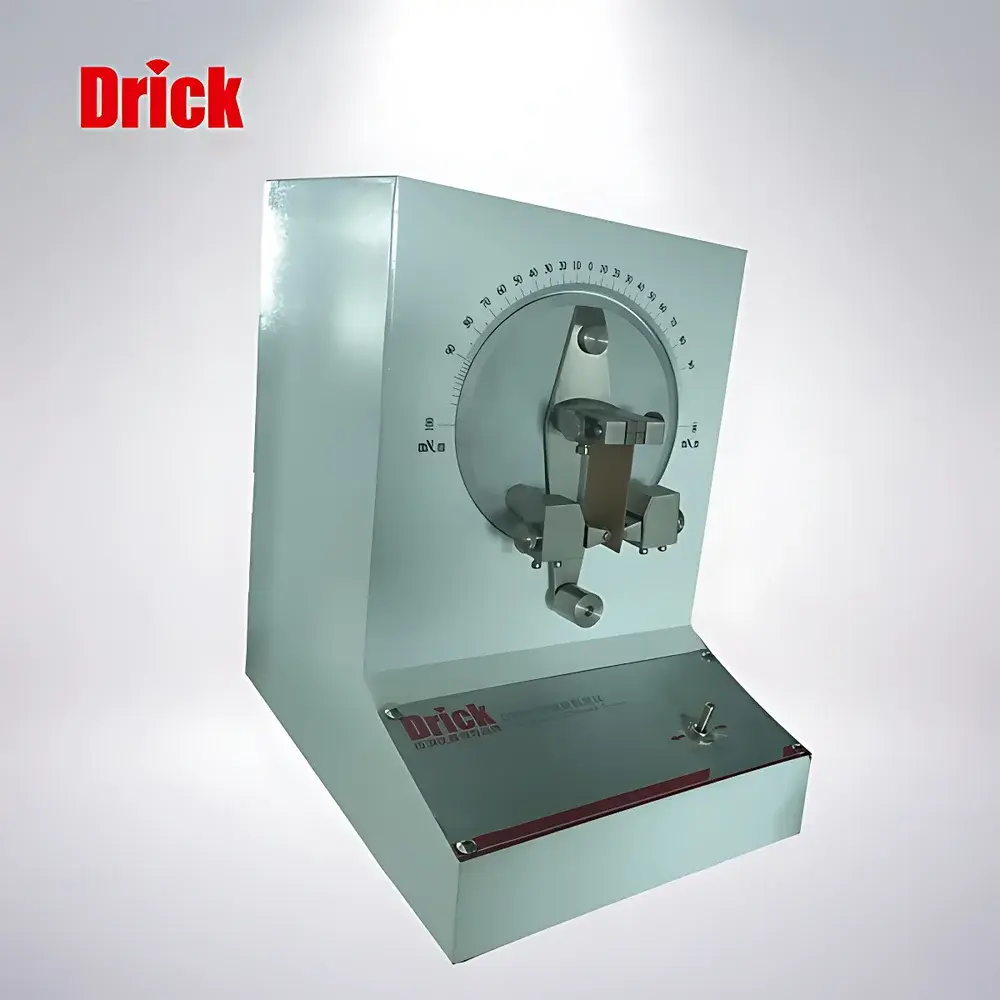
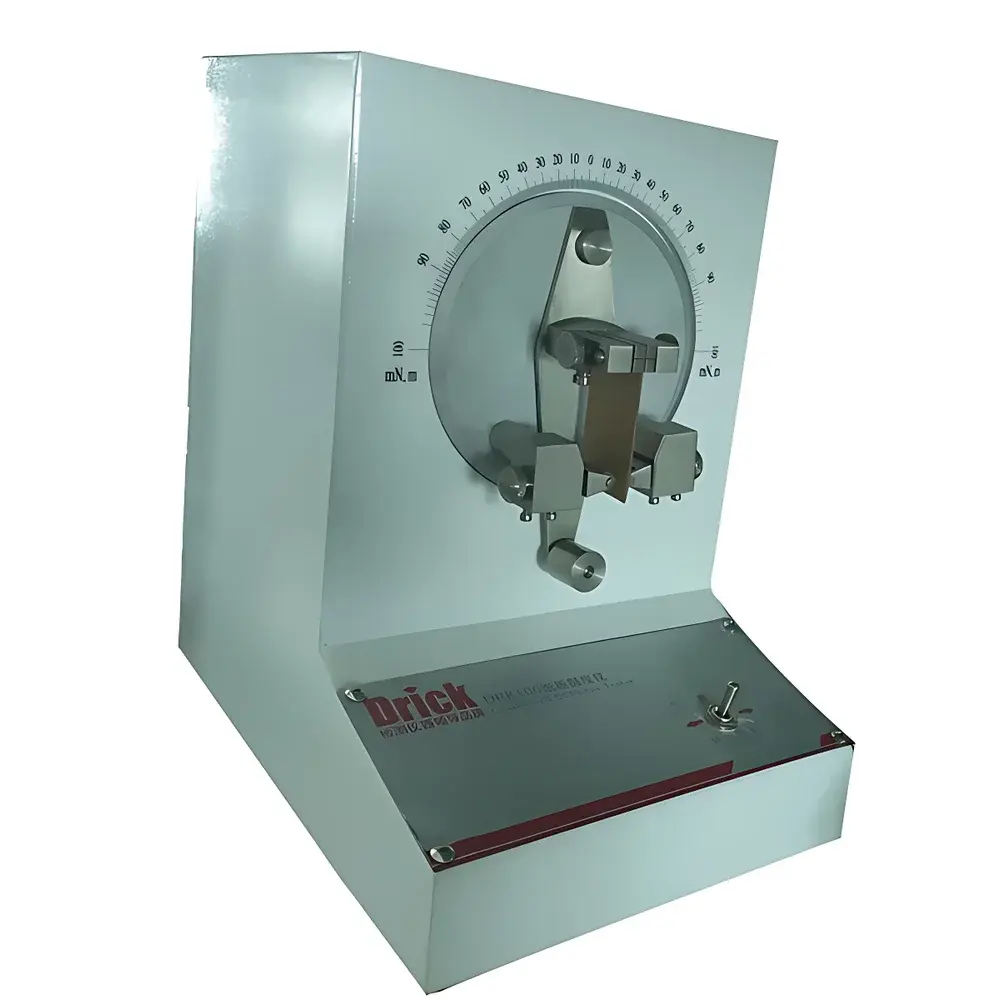
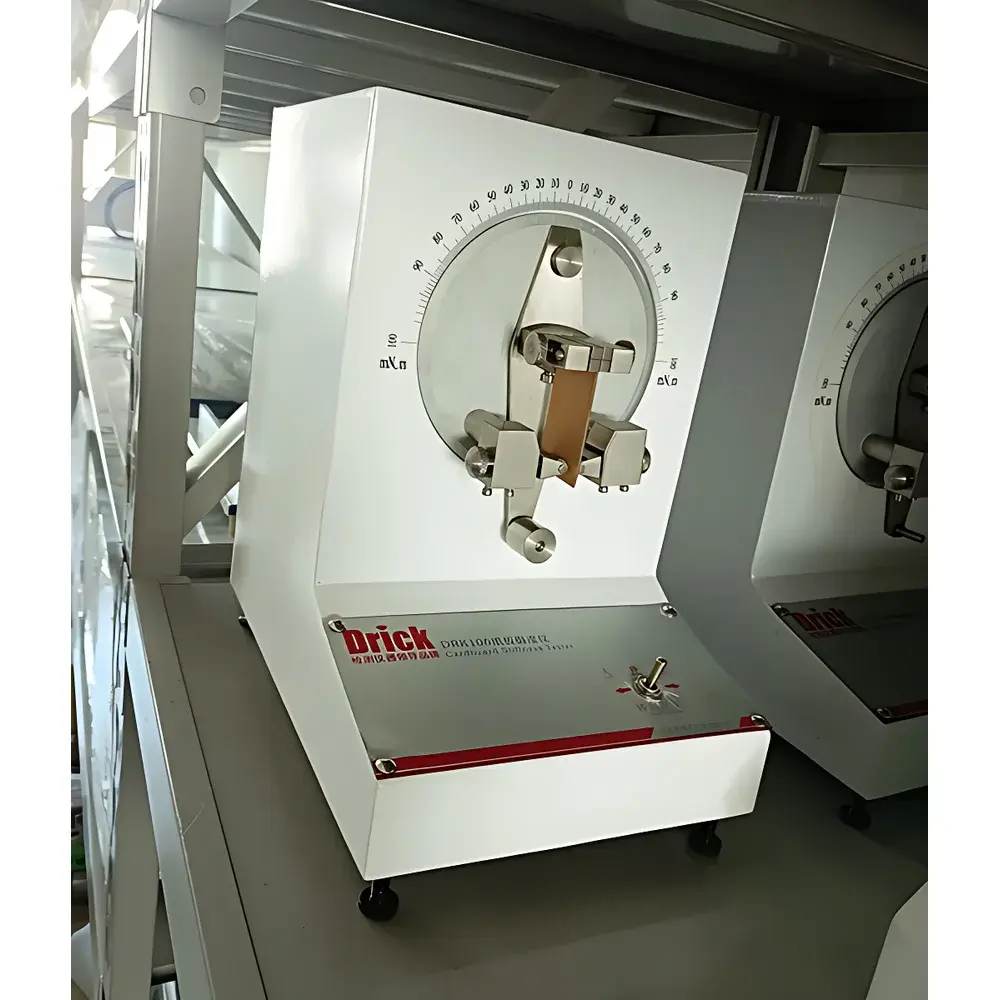
Drick DRK106 Taber-Type Paperboard Bending Stiffness Tester Compliant with GB/T 2679.3, ISO 2493, and ISO 5628
| Brand | Drick |
|---|---|
| Origin | Shandong, China |
| Manufacturer | Yes |
| Country of Origin | China |
| Model | DRK106 |
| Measurement Range | 1–500 mN·m |
| Accuracy | ±2% (within 10–90% of full scale) |
| Repeatability | ≤2% (within 10–90% of full scale) |
| Pendulum Arm Length | 100 mm |
| Load Arm Length | 50 mm |
| Deflection Angles | 7.5°±0.3° and 15°±0.3° |
| Sample Size | 70 mm × 38 mm |
| Operating Temperature | 20±10°C |
| Relative Humidity | <85% RH |
| Dimensions (L×W×H) | 220 × 320 × 390 mm |
| Weight | ~20 kg |
Overview
The Drick DRK106 Taber-Type Paperboard Bending Stiffness Tester is an electromechanical instrument engineered for precise determination of bending stiffness—defined as the resistance of paperboard to angular deflection under a controlled moment load—according to internationally recognized standards including ISO 2493, ISO 5628, and GB/T 2679.3. It operates on the classical Taber principle: a standardized specimen is clamped at one end and subjected to a defined bending moment via a calibrated pendulum system, with the resulting resisting torque (expressed in millinewton-meters, mN·m) measured directly. This method quantifies the material’s flexural rigidity, a critical parameter influencing foldability, crease performance, packaging integrity, and print run stability. The DRK106 is specifically optimized for low-basis-weight boards and substrates with thicknesses below 1.0 mm—common in folding cartons, corrugated liners, and premium packaging grades—where conventional beam-bending or cantilever methods lack resolution or reproducibility.
Key Features
- Microcontroller-based digital control architecture with integrated single-chip microprocessor for real-time signal acquisition, closed-loop motor positioning, and automatic zero compensation.
- High-precision digital servo motor drive system ensuring consistent angular displacement at both standard deflection angles (7.5° and 15°), minimizing mechanical hysteresis and operator-induced variability.
- Dual-range torsional measurement capability spanning 1–500 mN·m, calibrated across full scale with traceable NIST-equivalent verification protocols.
- Optimized mechanical design featuring rigid cast-aluminum frame, hardened steel bearing surfaces, and minimal backlash in the pendulum-load arm linkage to ensure long-term dimensional stability.
- Intuitive front-panel interface with LED display and tactile push-button controls; no external PC required for basic operation or calibration verification.
- Compliance-ready architecture supporting audit trails and data integrity requirements aligned with GLP and GMP documentation practices.
Sample Compatibility & Compliance
The DRK106 accepts specimens measuring exactly 70 mm × 38 mm—cut perpendicular to grain direction per ISO 2493 specifications—to ensure statistical comparability across laboratories. It accommodates paperboards ranging from 0.15 mm to 0.95 mm in thickness, including coated unbleached kraft (CUK), solid bleached sulfate (SBS), recycled fiberboard, and lightweight laminated composites. All mechanical and metrological characteristics are validated against ISO/IEC 17025–accredited reference standards. The instrument meets mandatory requirements of GB/T 2679.3–2022 (Chinese National Standard), ISO 2493:2018 (Paper and board — Determination of bending stiffness — Taber method), and ISO 5628:1997 (Paper and board — Determination of bending resistance — Constant-rate-of-bend method). Its design supports routine verification using certified reference materials traceable to national metrology institutes.
Software & Data Management
The DRK106 includes embedded firmware with optional Windows-compatible application software (DRK-Stiffness Suite v3.x) for advanced data management. The software enables automated test sequencing, multi-sample batch processing, statistical analysis (mean, SD, CV%, min/max), and customizable report generation compliant with internal QA templates. Raw torque vs. time waveforms are exportable in CSV format. Audit trail functionality records user ID, timestamp, calibration events, and parameter modifications—supporting compliance with FDA 21 CFR Part 11 where electronic records are subject to regulatory review. All firmware updates are delivered via secure USB interface with version-controlled checksum validation.
Applications
- Quality assurance of folding carton blanks during incoming raw material inspection and final production release.
- R&D evaluation of fiber furnish modifications, refining intensity, coating formulations, and calendering effects on board stiffness profiles.
- Correlation studies between Taber stiffness and other mechanical properties such as tensile strength, compression resistance (ECT), and burst index.
- Supplier qualification testing per contractual specifications referencing ISO 2493 or GB/T 22364 (which adopts identical methodology to ISO 2493).
- Validation of process stability in converting lines where inconsistent stiffness leads to creasing defects, poor glue adhesion, or automated packaging jamming.
FAQ
What standards does the DRK106 comply with?
It conforms to ISO 2493:2018, ISO 5628:1997, GB/T 2679.3–2022, and GB/T 22364–2008—all specifying the Taber-type bending stiffness test method.
Can the DRK106 test materials thicker than 1 mm?
No. It is designed exclusively for paperboard ≤0.95 mm thick; specimens exceeding this dimension fall outside the validated operating range and may compromise measurement linearity and repeatability.
Is calibration certificate included with shipment?
A factory calibration report is provided; users are advised to perform periodic verification using certified reference standards and maintain calibration logs per ISO/IEC 17025 requirements.
Does the instrument support dual-angle testing without manual reconfiguration?
Yes. The microprocessor automatically selects the appropriate load arm geometry and scaling factor when switching between 7.5° and 15° deflection modes via front-panel menu navigation.
What environmental conditions are required for valid measurements?
Testing must be conducted in conditioned air at 23±1°C and 50±2% RH per ISO 187; however, the DRK106 maintains operational stability within ambient ranges of 10–30°C and <85% RH for non-certified screening use.