
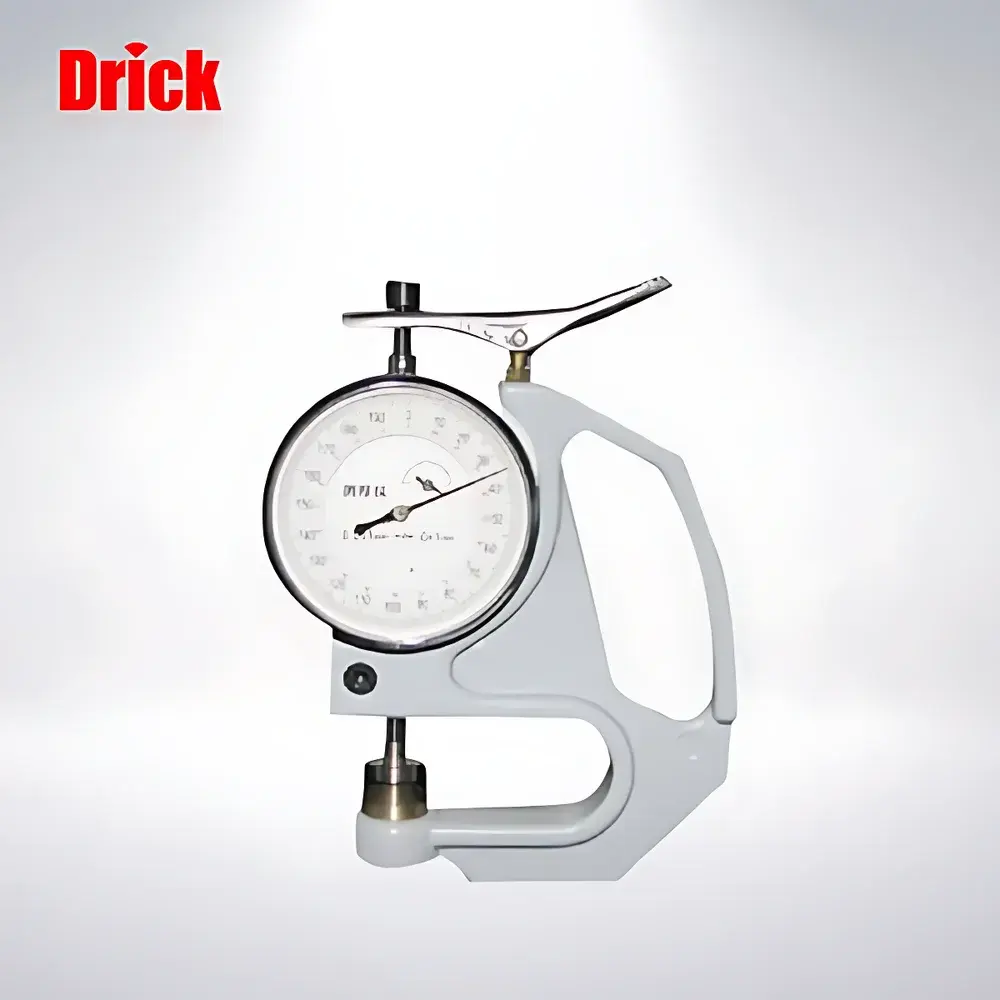
Drick DRK203B Handheld Thickness Gauge for Plastic Films, Foils, Paper, and Paperboard
| Brand | Drick |
|---|---|
| Origin | Shandong, China |
| Manufacturer Type | Direct Manufacturer |
| Country of Origin | China |
| Model | DRK203B |
| Measurement Range | 0–1 mm |
| Resolution | 0.001 mm |
| Measuring Force | 0.1–1.0 N (configurable per probe geometry) |
| Probe Configurations | Flat upper probe (Ø6 mm) + flat lower anvil |
| Compliance | GB/T 6672–2001 (equivalent to ISO 4593:1993) |
| Standard Accessories | Main unit, Certificate of Conformance |
Overview
The Drick DRK203B Handheld Thickness Gauge is a precision mechanical thickness measurement instrument engineered for rapid, non-destructive evaluation of planar, flexible sheet materials in packaging, converting, and quality control environments. It operates on the principle of direct mechanical contact displacement measurement—utilizing a calibrated spring-loaded measuring head that translates physical compression into a high-resolution analog or digital thickness reading. Unlike optical or ultrasonic methods, the DRK203B delivers traceable, tactile measurements fully compliant with standardized mechanical gauging protocols defined in GB/T 6672–2001 and its internationally harmonized counterpart, ISO 4593:1993. This makes it particularly suitable for routine QC checks where reproducibility, operator independence, and audit-ready documentation are required—especially in facilities operating under GLP, GMP, or ISO 9001 frameworks. The gauge is explicitly designed for flat, unembossed specimens; it is not recommended for textured, embossed, or highly compressible substrates where surface topography may compromise measurement validity.
Key Features
- High-resolution mechanical measurement system with 0.001 mm resolution across a 0–1 mm range, enabling detection of subtle thickness variations critical in film lamination and coating processes.
- Dual-probe configuration options: interchangeable upper measuring heads—including a standard Ø6 mm flat probe (applying 0.5–1.0 N force) and optional radius-curved probes (R15–R50 mm, applying 0.1–0.5 N force)—to accommodate material compliance without deformation artifacts.
- Ergonomic handheld design with balanced weight distribution and tactile feedback mechanism, minimizing operator-induced variability during manual measurement cycles.
- Robust all-metal housing and hardened stainless-steel measuring surfaces ensure long-term dimensional stability and resistance to wear in industrial environments.
- No external power source required for basic operation—ideal for field use, production line spot checks, and cleanroom-adjacent applications where electrical interference or battery dependency must be avoided.
Sample Compatibility & Compliance
The DRK203B is validated for use with rigid to semi-flexible planar materials including polyethylene (PE), polypropylene (PP), polyester (PET), polyamide (PA), aluminum foil, paper, cardboard, silicon wafers (uncoated), and thin metal foils. Its mechanical method ensures compatibility with electrically conductive, opaque, or optically heterogeneous substrates where laser or capacitance-based systems may fail. The instrument conforms to GB/T 6672–2001, which adopts ISO 4593:1993 with technical equivalence. This alignment supports international test report acceptance and facilitates cross-border supply chain validation. While not certified to ASTM D6988 or ISO 534, its methodology is functionally consistent with the mechanical thickness assessment principles referenced therein. Users performing regulated testing should validate probe selection and force settings against their internal SOPs and material-specific calibration standards.
Software & Data Management
The base DRK203B model operates as a standalone mechanical gauge with analog dial or digital display (depending on variant), requiring manual data entry into LIMS or Excel-based tracking systems. Optional digital output variants (e.g., RS-232 or USB interface) support integration with third-party data acquisition software for automated logging, statistical process control (SPC) charting, and PDF report generation. When used in regulated environments, operators may implement manual audit trails—including operator ID, sample ID, date/time stamp, and environmental conditions (temperature/humidity)—in accordance with 21 CFR Part 11 guidance for non-electronic records. Calibration certificates include traceability to national metrology institutes via accredited secondary standards.
Applications
- Quality assurance of extruded plastic films prior to slitting and packaging.
- Thickness uniformity verification of metallized PET or BOPP films in flexible packaging lines.
- Incoming inspection of corrugated board liners and folding carton stock.
- R&D screening of prototype laminates and coated papers for caliper consistency.
- Process validation for gravure or flexographic printing substrates where thickness affects ink transfer and registration stability.
- Supplier qualification audits requiring ISO/GB-compliant mechanical thickness data.
FAQ
Is the DRK203B suitable for measuring embossed or textured films?
No. The instrument requires flat, non-deformable contact surfaces. Embossed, stippled, or heavily calendered materials may yield non-representative readings due to localized compression or probe bridging.
Can I use this gauge for metallic foils thinner than 10 µm?
Yes—provided the foil exhibits sufficient tensile stiffness to resist buckling under the selected probe force. For foils below 25 µm, the low-force curved probe (R30 mm, 0.1–0.3 N) is strongly recommended.
Does the DRK203B require periodic recalibration?
Yes. Annual recalibration against certified gauge blocks (e.g., Class AA, 0.001 mm tolerance) is advised. Calibration intervals should be adjusted based on usage frequency and environmental conditions per ISO/IEC 17025 guidelines.
Is the device compliant with FDA or EU regulatory requirements?
The DRK203B itself is not FDA-listed or CE-marked as a medical device, but its measurement methodology satisfies technical requirements for thickness verification in pharmaceutical packaging (e.g., blister foil, pouch laminates) when used within a validated QA system adhering to USP and Annex 1.





