
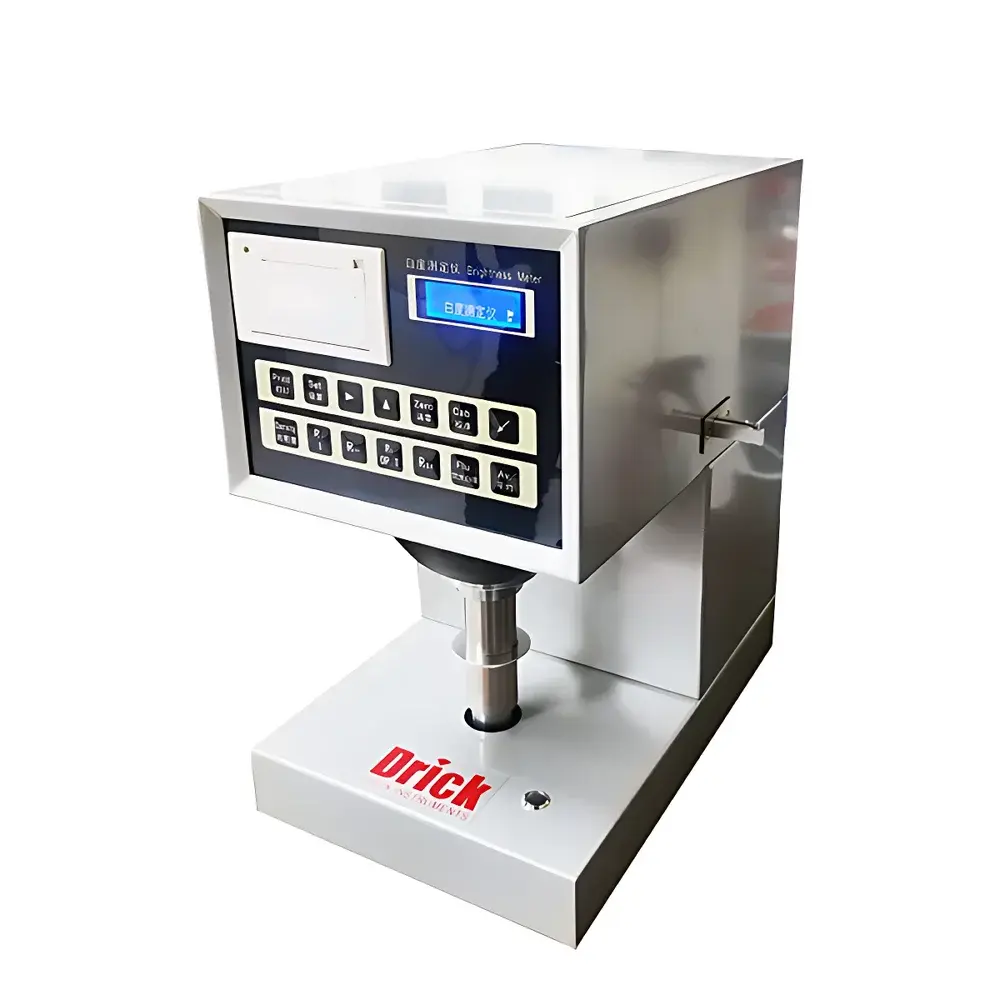
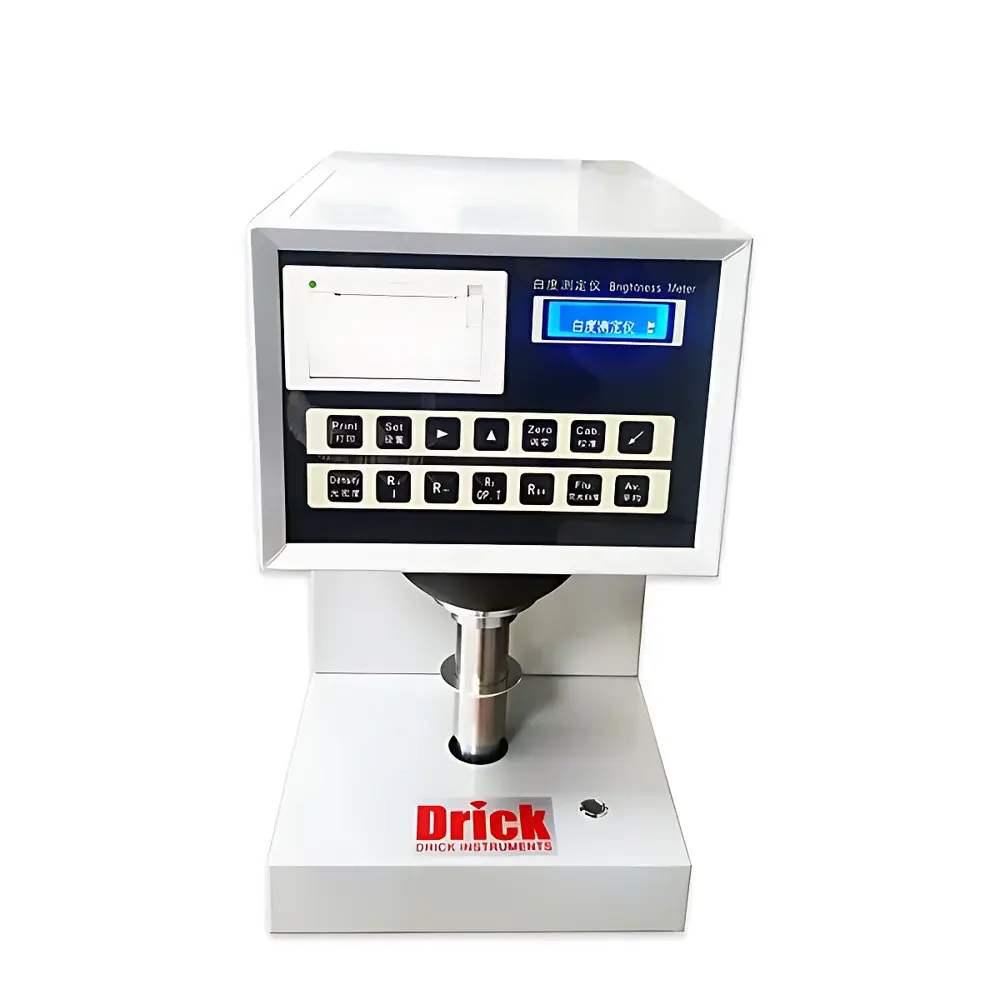
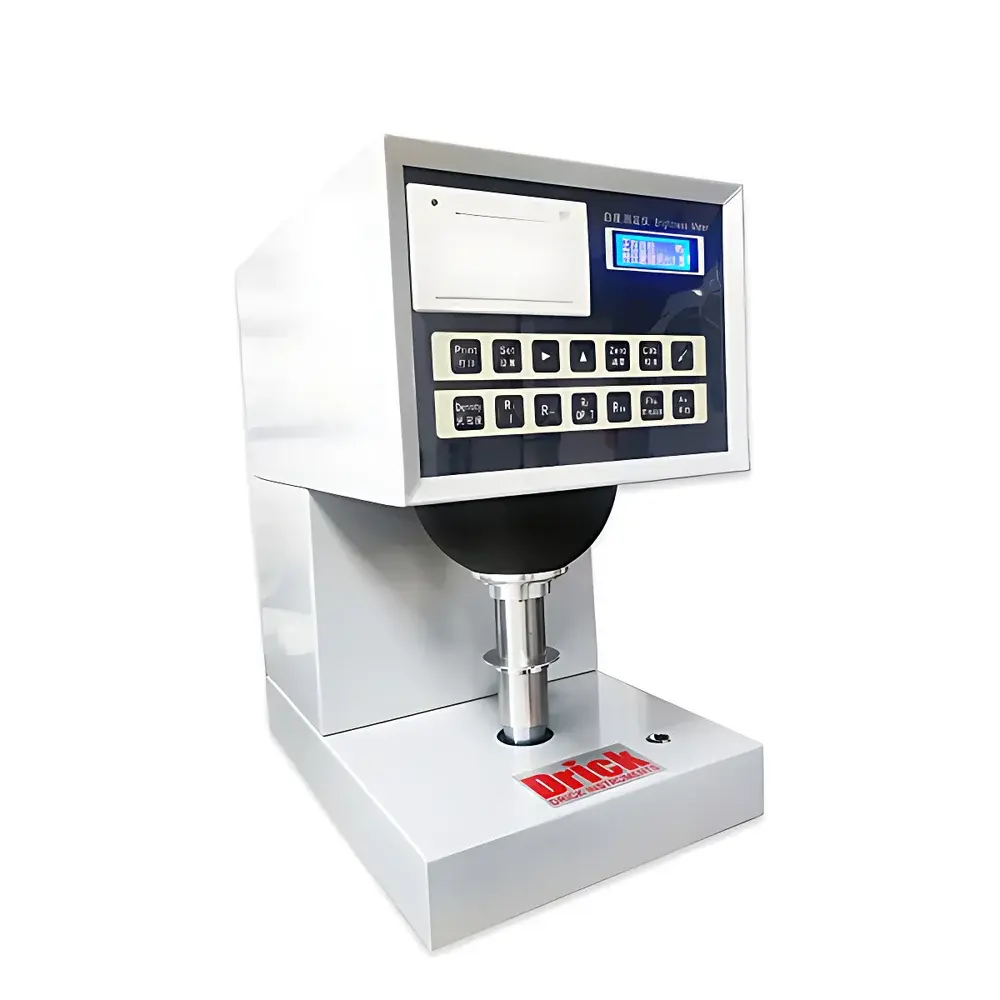

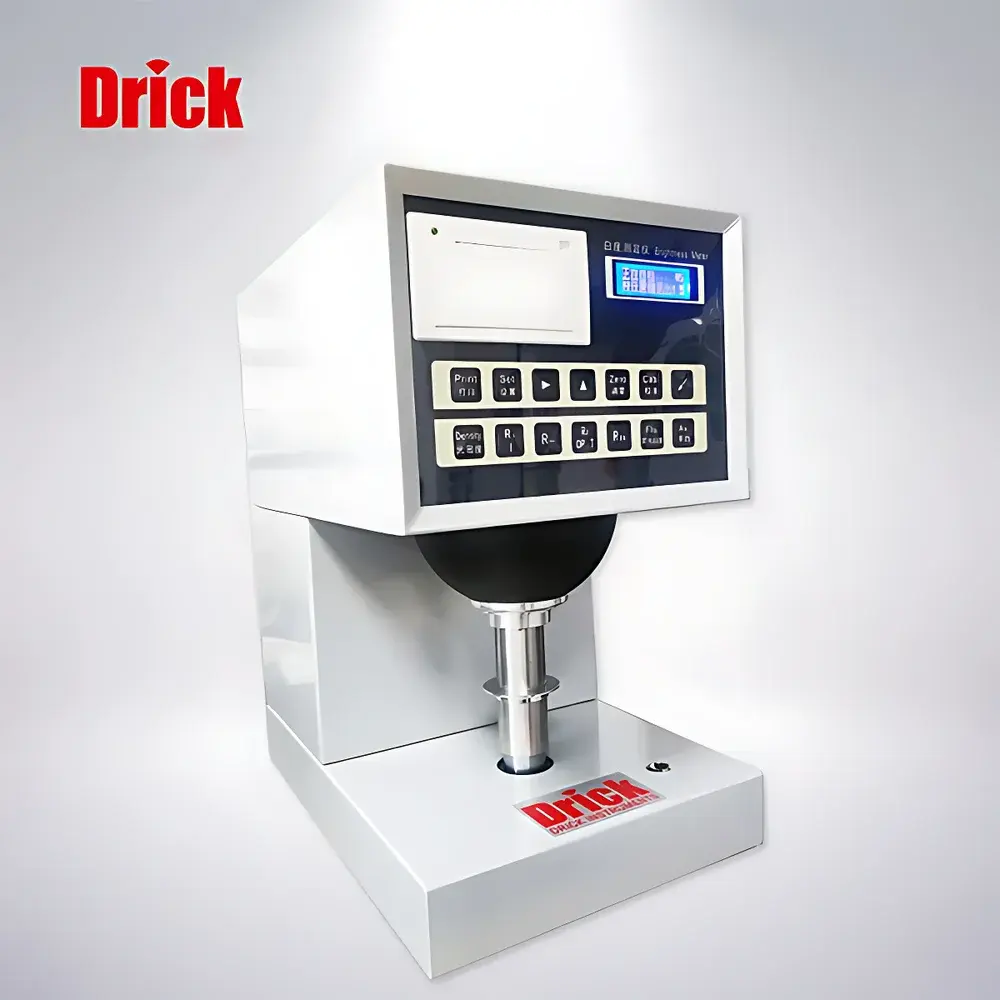
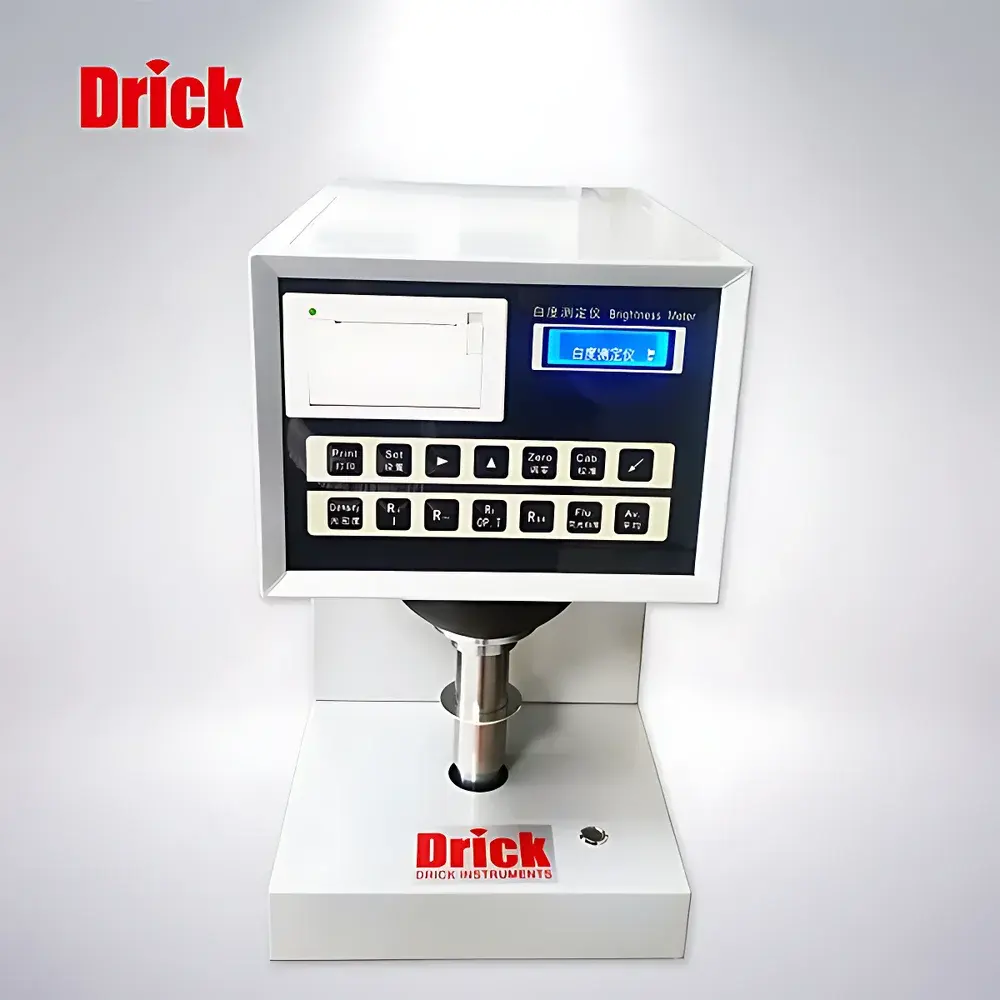
Drick DRK103A Paper & Textile Whiteness Tester
| Brand | Drick |
|---|---|
| Origin | Shandong, China |
| Manufacturer Type | Direct Manufacturer |
| Country of Origin | China |
| Model | DRK103A |
| Price | USD 7,000 (FOB) |
| Illumination Geometry | d/0 (ISO 2469) |
| Integrating Sphere Diameter | φ150 mm |
| R₄₅₇ Optical System | Peak Wavelength 457 nm, FWHM 44 nm |
| RY Optical System | Compliant with GB/T 3979–1983 |
| Zero Drift | ≤0.1 |
| Indication Drift | ≤0.1 |
| Indication Error | ≤0.5 |
| Repeatability Error | ≤0.1 |
| Specular Reflection Error | ≤0.1 |
| Sample Aperture | ≥φ30 mm or ≥φ19 mm |
| Max Sample Thickness | 40 mm |
| Power Supply | 220 V ±10%, 50 Hz, 0.3 A |
| Operating Temperature | 0–40 °C |
| Relative Humidity | ≤85% RH |
| Dimensions (L×W×H) | 345×260×425 mm |
| Net Weight | 11 kg |
Overview
The Drick DRK103A Paper & Textile Whiteness Tester is a precision optical instrument engineered for quantitative whiteness evaluation in quality control and regulatory compliance workflows across papermaking, textile manufacturing, pigment formulation, and packaging material production. It operates on the principle of diffuse reflectance photometry under standardized illumination and viewing conditions—specifically conforming to the d/0 (diffuse illumination / normal viewing) geometry defined in ISO 2469:2014, which eliminates specular reflection artifacts through an integrated light trap. The instrument incorporates dual optical measurement systems: the R457 system, calibrated to the CIE standard illuminant D65 and optimized for peak spectral sensitivity at 457 nm (FWHM = 44 nm), is universally adopted for paper industry white point assessment per ISO 2470-1; the RY system adheres to GB/T 3979–1983 for general object colorimetry, enabling comparative evaluation of chromaticity coordinates in non-paper substrates such as textiles, plastics, and ceramic glazes. Its integrating sphere (φ150 mm) ensures uniform illumination distribution and high signal-to-noise ratio, critical for detecting subtle variations in optical brightener content or aging-induced yellowing.
Key Features
- Compliance with international and national standards: ISO 2469, ISO 2470-1, GB/T 3978–1983 (standard illuminants), and GB/T 3979–1983 (colorimetric methodology)
- Dual optical channel architecture supporting both R457 (paper industry benchmark) and RY (general-purpose colorimetric) measurement modes
- Integrated specular component exclusion (SCE) via internal light absorber, ensuring measurement robustness across glossy, coated, or laminated surfaces
- High-stability photodetector system with zero drift ≤0.1 and repeatability error ≤0.1, validated over 8-hour continuous operation
- Non-volatile memory preserving calibration offsets, zero-point settings, and reference standard values—even after prolonged power interruption
- Modular sample stage accommodating flat specimens ≥φ30 mm (or ≥φ19 mm) and thickness up to 40 mm, compatible with sheets, powders (with optional constant-pressure powder press), and granular materials
- Pre-installed reference standards: two non-fluorescent white tiles and one fluorescent whitening agent (FWA)-calibrated tile traceable to NIM (National Institute of Metrology, China)
Sample Compatibility & Compliance
The DRK103A supports heterogeneous sample types common in packaging and process industries—including uncoated and clay-coated paperboard, bleached kraft pulp sheets, woven and nonwoven textiles, synthetic fibers, TiO2-loaded plastics, precipitated calcium carbonate (PCC), sodium chloride crystals, and food-grade starches. Its optical design enables simultaneous determination of whiteness index (WI), opacity, transparency, and derived optical coefficients (scattering coefficient *s*, absorption coefficient *a*) per TAPPI T 425 and ISO 2471 methodologies. All measurements comply with GLP documentation requirements: audit trails for operator ID, timestamped calibration events, and version-controlled firmware ensure traceability for FDA 21 CFR Part 11–aligned environments. Instrument validation protocols align with ASTM E308 and ISO/IEC 17025–2017 clause 6.4 for measurement uncertainty estimation.
Software & Data Management
The DRK103A operates via embedded firmware with RS-232 and USB-B interfaces for bidirectional data exchange. Measurement sequences—including multi-point averaging (up to 10 readings per sample)—are stored locally with ISO 8601 timestamps and exported in CSV format for integration into LIMS or SAP QM modules. Optional PC software (DRK-DataLink v3.2) provides statistical process control (SPC) charts, trend analysis across batches, and automated report generation compliant with ISO 105-X12 for textile whiteness grading. All calibration logs and user interventions are cryptographically hashed and archived to prevent post-hoc modification—meeting ALCOA+ principles for data integrity in regulated manufacturing.
Applications
- Quality assurance of bleaching efficiency in pulp mills and recycled fiber lines
- Optimization of optical brightener dosing in paper coating formulations
- Batch release testing of cotton, polyester, and blended fabrics per AATCC Test Method 110
- Raw material verification for food-contact packaging substrates (e.g., board whiteness per FDA 21 CFR 176.170)
- Stability monitoring of pigmented films and laminates during accelerated aging studies
- Regulatory submissions requiring documented whiteness conformity for pharmaceutical excipients (e.g., microcrystalline cellulose)
- Third-party inspection labs performing CNAS-accredited testing per GB/T 7974–2013
FAQ
What standards does the DRK103A officially comply with?
It conforms to ISO 2469, ISO 2470-1, GB/T 3978–1983, GB/T 3979–1983, and TAPPI T 425 for opacity and scattering coefficient derivation.
Can it measure samples with surface gloss or coatings?
Yes—the d/0 geometry with built-in specular reflection compensation ensures accurate readings on calendered paper, PE-laminated boards, and metallized films.
Is firmware upgrade supported remotely?
Firmware updates are delivered via signed .bin files through USB flash drive; no cloud connectivity or internet dependency is required for security-critical installations.
How is traceability maintained for calibration standards?
Each supplied white tile carries a unique serial number and NIM-traceable certificate with uncertainty budget (k=2); recalibration intervals are programmable within the device UI.
Does it support GLP-compliant electronic signatures?
While the base unit lacks biometric authentication, its data export structure and immutable audit log meet foundational GLP requirements; full 21 CFR Part 11 compliance requires integration with validated third-party ELN systems.






