
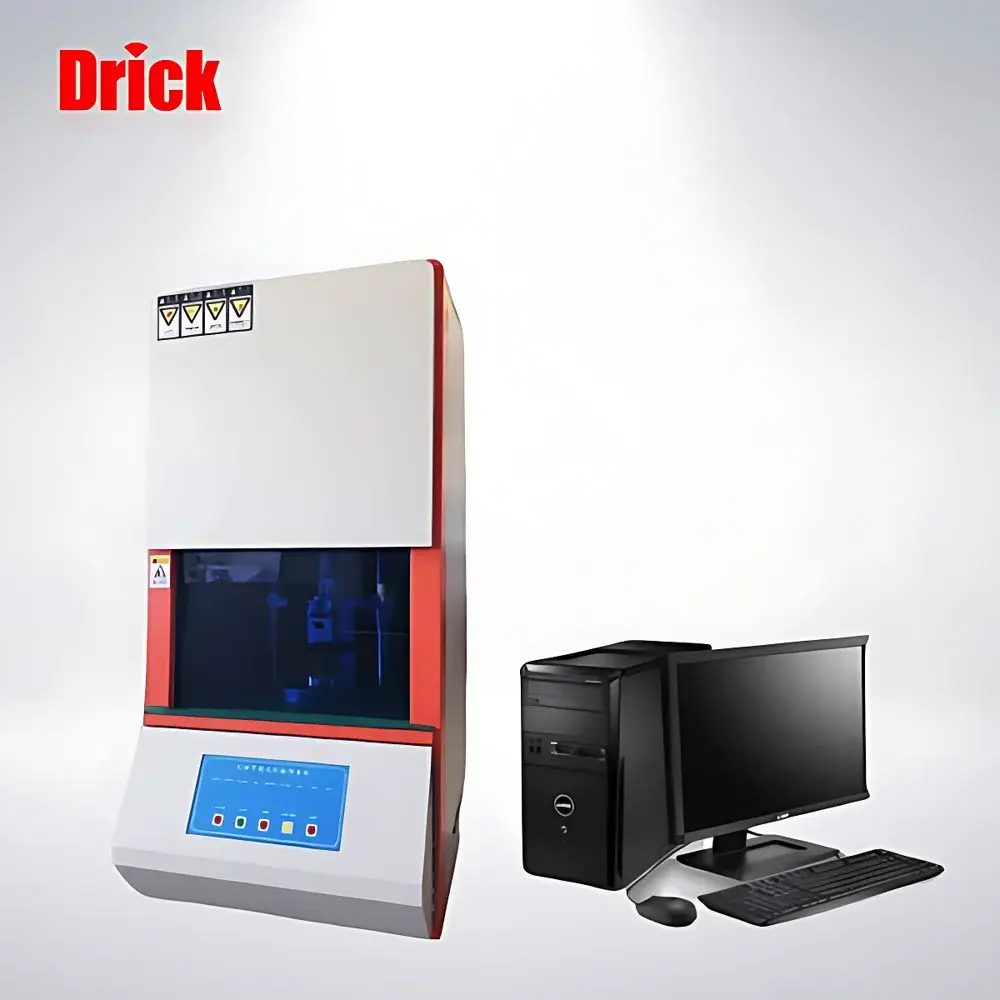
Drick LH-B Non-Rotating Rubber Vulcanizometer Compliant with ASTM D5289–95
| Brand | Drick |
|---|---|
| Origin | Shandong, China |
| Manufacturer Type | Direct Manufacturer |
| Country of Origin | China |
| Model | LH-B |
| Control Temperature Range | 100–200 °C |
| Temperature Stability | ≤ ±0.2 °C |
| Torque Measurement Range | 0–20 N·m |
| Oscillation Frequency | 1.7 Hz (100 rpm) |
| Oscillation Amplitude | ±0.5° or ±1° |
| Die Cavity Design | Monsanto-type |
| Output Parameters | ML, MH, ts1, ts2, t10, t30, t50, t70, t90, vulcanization curve, temperature profile |
| Standards Compliance | ASTM D5289–95, ISO 6502:1991, GB/T 16584–1996 |
| Power Supply | AC 220 V ±10% |
| Dimensions (L×W×H) | 680 × 650 × 1100 mm |
| Net Weight | 350 kg |
Overview
The Drick LH-B Non-Rotating Rubber Vulcanizometer is a precision-engineered instrument designed for real-time characterization of rubber compound curing behavior under controlled thermal and mechanical conditions. Operating on the principle of oscillating-die rheometry, it applies a small sinusoidal torsional strain to uncured rubber within a sealed, temperature-regulated Monsanto-type cavity and measures the resulting torque response as crosslinking progresses. This enables quantitative determination of critical vulcanization kinetics—including scorch time (ts1, ts2), optimum cure time (t90), minimum and maximum torque (ML, MH), and cure rate indices—without mechanical interference from rotors or spindles. The system conforms strictly to ASTM D5289–95, ISO 6502:1991, and GB/T 16584–1996, making it suitable for QC laboratories, R&D departments, and rubber formulation validation in compliance-driven environments.
Key Features
- Adaptive high-precision PID temperature control system with platinum resistance thermometer (Pt100) feedback, capable of maintaining cavity temperature within ±0.2 °C across the full 100–200 °C operating range.
- Self-tuning algorithm dynamically adjusts PID parameters in response to ambient fluctuations and line voltage variations, ensuring rapid thermal equilibration (<10 minutes from ambient to 180 °C).
- Non-rotating oscillating die configuration eliminates rotor-induced shear history, preserving native compound structure and delivering high reproducibility for comparative batch testing.
- Dual-amplitude operation (±0.5° and ±1°) allows flexibility in sensitivity selection—lower amplitude for highly filled compounds; higher amplitude for low-viscosity or low-crosslink-density systems.
- Integrated data acquisition architecture features synchronized sampling of torque, temperature, and time at ≥10 Hz resolution, with onboard buffering and lossless transfer to host PC via industrial RS-485 or USB interface.
- Front-panel controls and software GUI provide identical functional mapping—enabling seamless transition between manual operation and automated test sequences without retraining.
Sample Compatibility & Compliance
The LH-B accommodates standard ASTM/ISO-compliant rubber test specimens (typically 3.5–4.5 g) placed directly into the preheated Monsanto cavity. Its design supports natural rubber (NR), synthetic elastomers (SBR, BR, EPDM, NBR, CR), thermoplastic elastomers (TPEs), and filled/unfilled formulations—including carbon-black-, silica-, and oil-modified systems. All measurement outputs—including ML, MH, ts1, t50, t90, and delta torque (MH–ML)—are traceable to internationally recognized calibration protocols. The instrument meets essential requirements for GLP-compliant rubber testing laboratories, including audit-ready data integrity, timestamped raw-data logging, and user-access-level controls aligned with FDA 21 CFR Part 11 principles (when operated with validated software version).
Software & Data Management
The bundled Windows-based application provides a fully configurable interface for test setup, real-time visualization, post-acquisition analysis, and report generation. Each test session automatically stores raw torque/time/temperature arrays in a relational database with metadata tagging (operator ID, sample ID, test date, cavity temperature, amplitude, frequency). Users may overlay multiple curves for comparative analysis, apply baseline correction, export ASCII or CSV files for statistical process control (SPC), and generate PDF reports compliant with internal QA templates or customer submission requirements. Audit trail functionality records all parameter modifications, result edits, and print/export events with immutable timestamps—supporting ISO/IEC 17025 documentation workflows.
Applications
- Quality control of incoming raw materials and production batches against specification limits for scorch safety and cure state.
- Accelerated aging studies evaluating thermal stability and reversion behavior across temperature gradients.
- Formulation development for sulfur-cured, peroxide-cured, and metal-oxide systems—correlating torque profiles with crosslink density measured via swelling or DSC.
- Process validation for extrusion, calendering, and molding operations where scorch margin directly impacts line efficiency and scrap rate.
- Teaching and fundamental research in polymer physics labs studying network formation kinetics, activation energy estimation (via Arrhenius analysis), and filler–polymer interaction effects.
FAQ
What standards does the LH-B vulcanizometer comply with?
ASTM D5289–95, ISO 6502:1991, and GB/T 16584–1996 are fully supported through hardware design, calibration methodology, and software reporting logic.
Is the instrument suitable for use in regulated pharmaceutical or medical device manufacturing environments?
While not classified as GMP-grade instrumentation out-of-the-box, its data integrity architecture, user access controls, and electronic record capabilities enable qualification for use in rubber component testing supporting ISO 13485 or ICH Q5A workflows when validated per site-specific protocols.
Can the LH-B operate unattended for extended test series?
Yes—the system supports queued test execution with automatic cavity cooling between runs, programmable dwell times, and fault detection (e.g., open-circuit sensor, over-temperature condition) triggering safe shutdown and event logging.
How is torque calibration performed?
Calibration is executed using certified reference weights and lever-arm geometry verification per ASTM D5289 Annex A1; field recalibration requires traceable torque transducer and documented procedure per laboratory SOP.
Does the software support multi-language interfaces?
The default interface is English; localized versions (German, Japanese, Korean) are available upon request and require separate validation for regulatory deployment.
Related Products





