
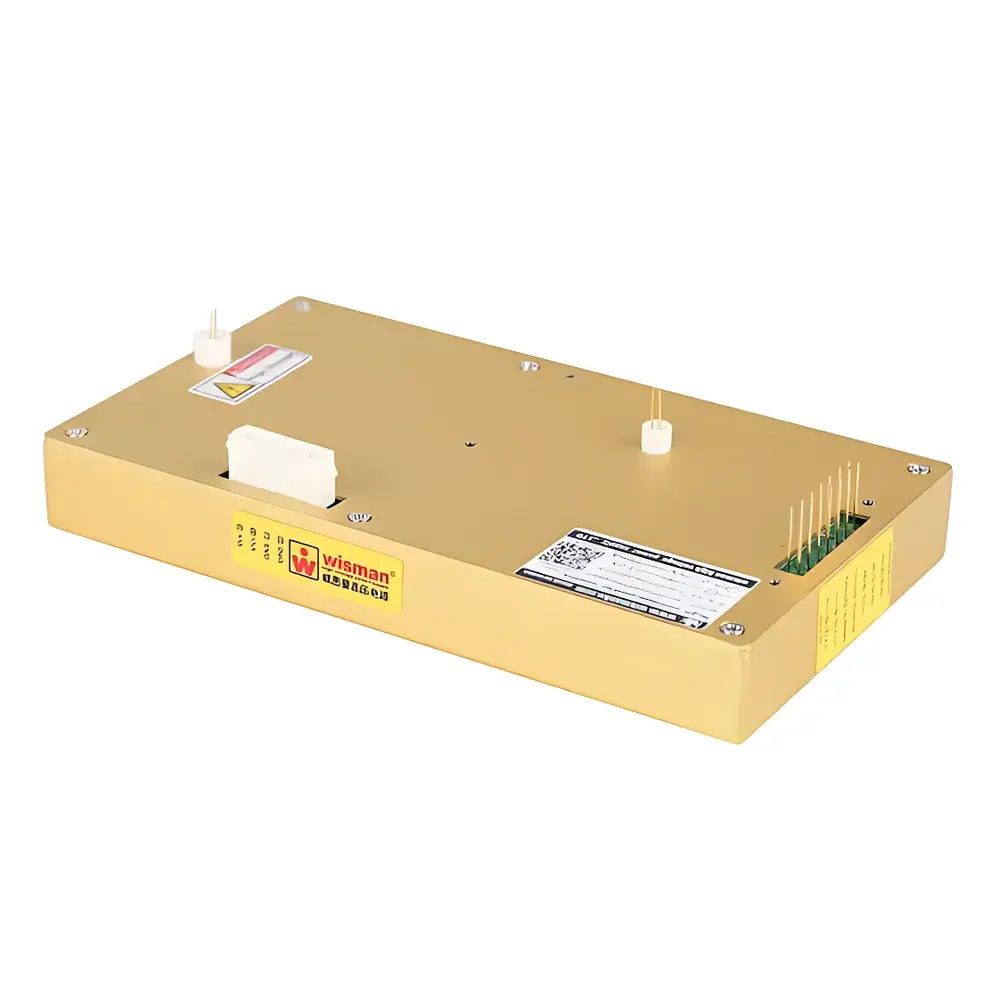
Wiseman MUC Series High-Voltage DC-DC Power Modules (60 kV, 250 W)
| Brand | Wiseman |
|---|---|
| Origin | Shaanxi, China |
| Model | MUC |
| Output Voltage Range | 250 V – 60 kV |
| Output Power Options | 60 W / 125 W / 250 W |
| Output Current Range | 1 mA – 2 A |
| Input | DC 24 V |
| Voltage Regulation | ±0.01% (line & load) |
| Temperature Coefficient | 25 ppm/°C (optional 15 ppm/°C) |
| Ripple | ≤0.1% RMS |
| Stability | <0.01%/8 hr, <0.02%/24 hr (after 30-min warm-up) |
| MTBF | >200,000 hrs at 65°C |
| Protection | Short-circuit, arc detection, current limiting |
| Compliance | CE Marked |
| Communication Interface | Optional RS-232 / RS-485 |
| Operating Temperature | –10°C to +65°C (extended options available) |
| Environmental Rating | MIL-STD-810G compliant (shock: 20 G, vibration: 10 G, thermal shock: –40°C to +65°C) |
| Applications | Mass spectrometry, pulsed power systems, electron/ion beam instrumentation, capacitor charging, semiconductor testing, high-voltage insulation testing, medical devices (e.g., nanoknife), and scientific research platforms |
Overview
The Wiseman MUC Series represents a family of compact, high-reliability DC-DC high-voltage power modules engineered for precision OEM integration in demanding scientific and industrial applications. Designed around zero-current resonant topology and advanced high-voltage insulation techniques, the MUC series delivers stable, low-noise output across a wide voltage range — from 250 V up to 60 kV — with selectable power ratings of 60 W, 125 W, and 250 W. Its thin-profile, surface-mount technology (SMT)-based architecture enables exceptional power density without compromising electrical isolation or thermal robustness. The module operates from a single 24 V DC input and supports both unipolar and bipolar output configurations, making it suitable for applications requiring either high-current sourcing (e.g., capacitor charging) or symmetric high-voltage biasing (e.g., push-pull amplifier stages). As a critical subsystem in mass spectrometry systems, the MUC provides the regulated acceleration and ion focusing voltages essential for consistent resolution and signal-to-noise performance.
Key Features
- High-power-density design: SMT-based construction ensures minimal footprint and optimal thermal dissipation across all models.
- Ultra-stable regulation: Voltage stability better than ±0.01% under line and load variations; temperature coefficient as low as 15 ppm/°C (optional).
- Low-output ripple: ≤0.1% RMS ensures minimal noise coupling into sensitive detector or beam-control circuits.
- Rapid transient response: Fast rise time with negligible overshoot supports dynamic load conditions typical in pulsed operation.
- Comprehensive protection suite: Integrated short-circuit, arc-fault, and overcurrent protection with automatic recovery.
- Extended reliability: MTBF exceeding 200,000 hours at 65°C ambient, validated per MIL-STD-810G environmental stress protocols.
- OEM flexibility: Standard RS-232/RS-485 digital interface optional; custom voltage/current combinations and mechanical form factors available upon request.
- Certified compliance: CE-marked for EMC and safety; designed to meet IEC 61010-1 requirements for laboratory equipment.
Sample Compatibility & Compliance
The MUC series is routinely deployed as the high-voltage supply for quadrupole and time-of-flight mass spectrometers, where precise, drift-free acceleration potentials directly impact mass accuracy and reproducibility. It also serves as the primary bias source in electron microscopy column electronics, ion implantation test fixtures, and dielectric withstand testers used in cable and component qualification per ASTM D149 and IEC 60270. All units are constructed using UL-certified insulating materials and conform to creepage/clearance requirements defined in IEC 62368-1. While not inherently 21 CFR Part 11 compliant, the optional digital interface supports audit-trail-capable system-level integration when embedded within GLP/GMP-compliant instrument architectures.
Software & Data Management
Although the MUC module operates autonomously as an analog-regulated device, its optional RS-232 or RS-485 interface enables remote monitoring and control via ASCII command protocol. Integration-ready firmware supports readback of real-time output voltage, current, temperature, and fault status — facilitating automated calibration routines and predictive maintenance logging. When embedded in larger analytical platforms (e.g., benchtop MS systems), the module’s telemetry data can be aggregated into centralized instrument management software that complies with ISO/IEC 17025 traceability requirements. No proprietary drivers or cloud dependencies are required; communication is implemented using standard serial protocols compatible with LabVIEW, Python (pySerial), and MATLAB environments.
Applications
- Mass spectrometry: Ion source acceleration, detector dynode chain biasing, and reflectron voltage control.
- Pulsed power systems: Capacitor charging for laser flashlamps, pulsed electron beams, and electromagnetic launchers.
- Scientific instrumentation: Electron/ion optics biasing, electrostatic lens arrays, and particle accelerator pre-acceleration stages.
- Industrial testing: High-potential insulation verification, partial discharge detection, and aging studies of dielectric materials.
- Medical devices: Nanoknife (irreversible electroporation) generators and X-ray tube filament supplies (in hybrid configurations).
- Semiconductor characterization: Gate oxide stress testing, breakdown voltage mapping, and charge trapping analysis.
FAQ
Is the MUC series suitable for use in vacuum environments?
Yes — vacuum-compatible variants (designated with “–V” suffix) are available upon request. Standard units require atmospheric pressure for convection cooling; vacuum versions incorporate enhanced thermal interface design and may include hermetic sealing.
Can the MUC module be operated in bipolar mode with independent positive and negative outputs?
The MUC supports true bipolar output configurations, but requires external interconnection of two matched modules or use of factory-configured dual-rail variants. Independent regulation per polarity is not supported in single-module operation.
What is the minimum startup voltage required on the 24 V DC input?
The module requires a nominal 24 V ±10% input; under-voltage lockout activates below 21.6 V to prevent unstable regulation.
Does Wiseman provide calibration certificates traceable to NIST standards?
Calibration reports with measurement uncertainty budgets are available as an optional service. Traceability to national standards is achieved through Wiseman’s ISO/IEC 17025-accredited internal metrology lab.
Are there restrictions on mounting orientation or airflow requirements?
Units are qualified for horizontal mounting with ≥1 m/s forced airflow across the heatsink surface. Vertical mounting is permitted only with derating above 50°C ambient and confirmation of thermal margin via IR imaging during qualification.



