
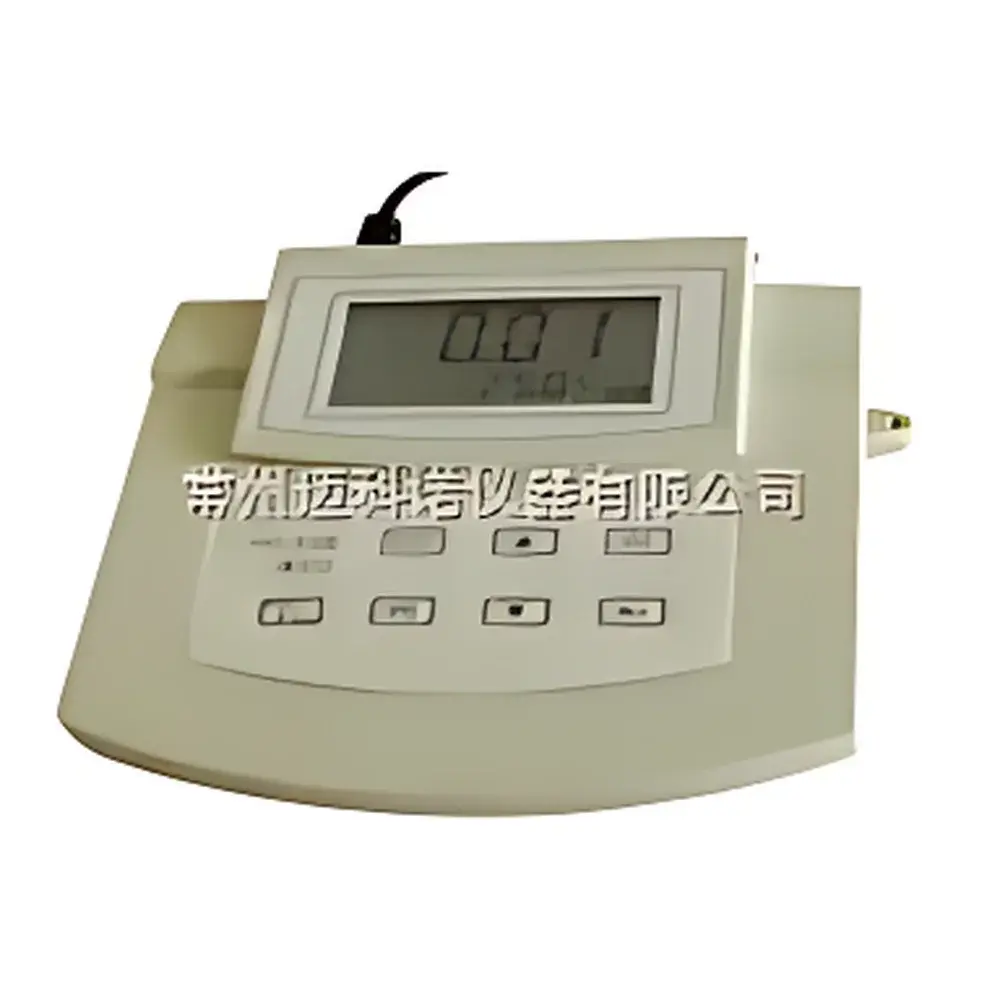
DWS-51 Sodium Ion Concentration Meter
| Origin | Zhejiang, China |
|---|---|
| Manufacturer Type | Distributor |
| Origin Category | Domestic |
| Model | DWS-51 |
| Quotation | Upon Request |
| Sample Introduction Method | Manual Immersion |
| Sensitivity | Not Specified |
| Spectral Library | Not Applicable |
Overview
The DWS-51 Sodium Ion Concentration Meter is a benchtop electrochemical analyzer engineered for precise potentiometric measurement of sodium ion activity in aqueous solutions. It operates on the principle of ion-selective electrode (ISE) potentiometry, utilizing a sodium-specific glass membrane electrode to generate a Nernstian response proportional to the logarithm of Na⁺ activity. The instrument outputs results in both pNa units (–log₁₀[Na⁺]) and concentration equivalents (g/L or μg/L), with built-in temperature compensation to correct for thermal effects on electrode potential. Designed for routine analytical workflows in academic laboratories, environmental monitoring stations, power plant water chemistry labs, and industrial quality control settings, the DWS-51 delivers reliable quantification of low-concentration sodium — particularly critical in high-purity water systems (e.g., boiler feedwater, semiconductor rinse water, and nuclear reactor coolant monitoring) where trace Na⁺ can indicate system contamination or resin breakthrough.
Key Features
- Dual-parameter digital display with blue backlight: simultaneously shows pNa value and sample temperature (°C)
- Direct pNa-to-concentration conversion function, supporting linear and logarithmic scaling across nine decades of [Na⁺] (23 g/L down to 0.023 μg/L)
- Manual immersion-based sample introduction — compatible with standard 100 mL beakers or electrode immersion wells
- Temperature compensation range: 0–60 °C, implemented via integrated Pt1000 thermistor sensor
- High-resolution readout: 0.01 pNa resolution with ±0.02 pNa basic error (±1 digit) and ≤0.03 pNa repeatability
- Stable electronic architecture: drift ≤0.02 pNa per 3 hours under continuous operation
- Compact benchtop form factor (200 × 210 × 70 mm, L×W×H); net weight 1.0 kg
- AC-powered operation: 220 V ±10%, 50 Hz; designed for ambient lab environments (5–50 °C, ≤85% RH, minimal vibration and magnetic interference)
Sample Compatibility & Compliance
The DWS-51 is optimized for clear, non-viscous, low-turbidity aqueous matrices including deionized water, steam condensate, boiler water, cooling tower water, and wastewater effluents. It requires proper electrode conditioning, regular calibration using certified Na⁺ standard solutions (e.g., 10⁻² to 10⁻⁶ mol/L), and ionic strength adjustment (typically with 0.1 M KCl or TISAB-type background electrolyte) to ensure Nernstian response and minimize junction potential errors. While not pre-certified to ISO/IEC 17025 or ASTM D1129, its operational methodology aligns with established ISE best practices referenced in ASTM D4192 (Standard Guide for Conducting Ion-Selective Electrode Measurements) and USP (pH and Ion-Selective Electrodes). For regulated environments (e.g., pharmaceutical water systems or power industry QA/QC), users must establish and document calibration verification, electrode performance checks, and system suitability criteria per internal SOPs.
Software & Data Management
The DWS-51 is a standalone analog-digital hybrid instrument with no embedded microprocessor-based data logging or USB/RS-232 connectivity. All measurements are displayed in real time and must be manually recorded. No proprietary software, spectral libraries, or electronic audit trails are included. Consequently, it does not support FDA 21 CFR Part 11 compliance features such as electronic signatures or secure data archiving. Laboratories requiring GLP/GMP-compliant documentation are advised to integrate external recording systems (e.g., validated lab notebooks or LIMS interfaces) and implement procedural controls for result transcription, calibration log maintenance, and electrode history tracking.
Applications
- Monitoring sodium breakthrough in mixed-bed ion exchange resins used in high-purity water generation
- Quality assurance of ultrapure water (UPW) in microelectronics fabrication facilities
- Corrosion-related sodium ingress detection in steam-cycle condensate systems
- Environmental analysis of surface water and groundwater for salinity assessment
- Teaching laboratories: demonstration of potentiometric principles, Nernst equation validation, and ISE calibration protocols
- Industrial boiler water chemistry control per ASME PTC 19.11 and EPRI guidelines
FAQ
What type of sodium electrode is required for use with the DWS-51?
A dedicated sodium-selective glass membrane electrode with integrated reference junction is required; compatibility depends on standardized BNC or DIN connector interface and recommended filling solution (e.g., 1 M LiAc or NaNO₃).
Does the DWS-51 support automatic temperature compensation (ATC)?
Yes — it accepts input from an external Pt1000 temperature probe and applies linear compensation across 0–60 °C.
Can the DWS-51 measure sodium in non-aqueous or high-salinity samples?
No — it is validated only for aqueous solutions. High ionic strength (>0.1 M total dissolved solids) or organic solvents may cause significant deviation from Nernstian behavior and require matrix-matched calibration.
Is calibration verification required before each analysis?
Per ISO 8655-5 and general ISE practice, at minimum a two-point calibration (e.g., 10⁻³ M and 10⁻⁶ M Na⁺) is recommended before each batch of samples, with verification using a mid-range check standard.
What maintenance is needed for long-term reliability?
Daily rinsing with deionized water, periodic rehydration of the glass membrane (≥2 h in 0.1 M NaCl), and annual replacement of the reference electrolyte and junction sleeve are essential for stable performance.




