
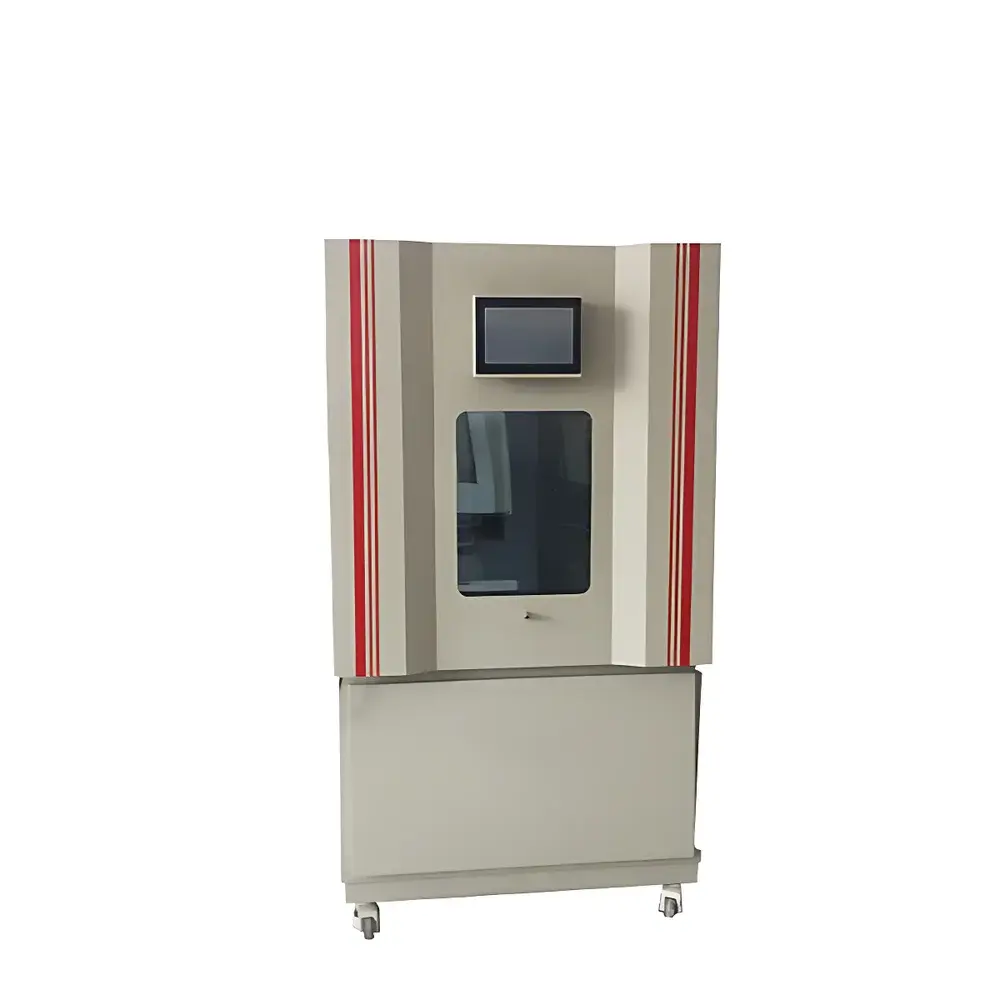
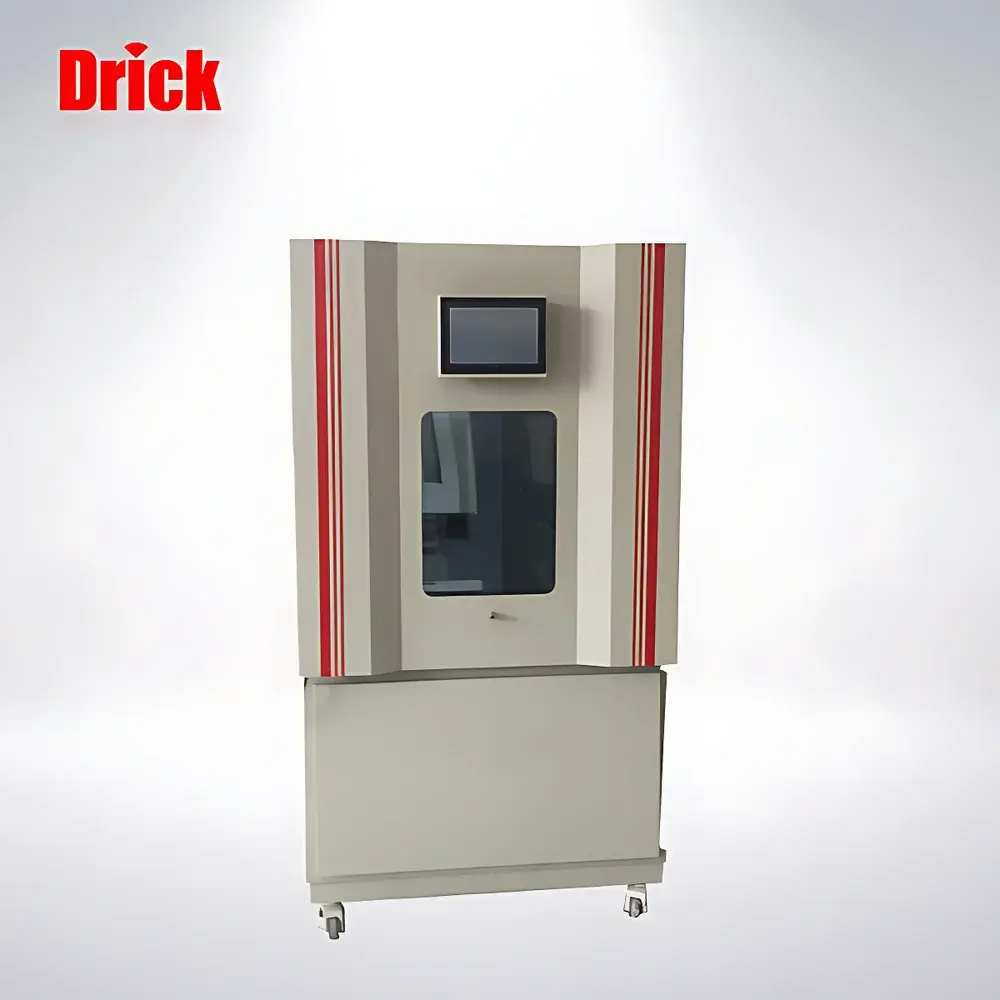
Drick DRK-1m³ Formaldehyde Emission Climate Chamber with Touchscreen Interface
| Brand | Drick |
|---|---|
| Origin | Shandong, China |
| Manufacturer Type | Direct Manufacturer |
| Country of Origin | China |
| Model | DRK- |
| Principle | Photometric Method (Acetylacetone Colorimetric Assay) |
| Internal Volume | (1.00 ± 0.02) m³ |
| Temperature Range | 10–40 °C (±0.5 °C uniformity) |
| Humidity Range | 30–80 %RH (±3 %RH control accuracy) |
| Air Exchange Rate | 0.2–2.0 h⁻¹ (±0.05 h⁻¹ resolution) |
| Air Velocity | 0.1–2.0 m/s (continuously adjustable) |
| Sampling Flow Rate | 0.25–2.5 L/min (±5 % accuracy) |
| Chamber Leak Rate | <1×10⁻³ m³/min at 1000 Pa overpressure |
| Background Formaldehyde | ≤0.006 mg/m³ |
| Thermal Insulation | High-efficiency rigid polyurethane foam (≥R-25 equivalent) |
| Noise Level | ≤60 dB(A) during operation |
| Continuous Operation | ≥960 hours (40 days) |
| Power Supply | 220 V AC, 50 Hz, 16 A |
| Rated Power | 3 kW |
| Operating Power | ~2 kW |
| Dimensions (W×D×H) | 1100 × 1900 × 1900 mm |
| Control Interface | 7-inch industrial touchscreen HMI |
| Humidity Control Method | Dew-point-based saturation control |
| Temperature Sensor | Imported thin-film Pt1000 (Class A, ±0.15 °C) |
| Structural Material | Mirror-finish 316L stainless steel interior |
| Safety Protections | Dual-stage overtemperature/low-water-level alarms for chamber and dew-point reservoir |
Overview
The Drick DRK-1m³ Formaldehyde Emission Climate Chamber is an engineered environmental test system designed to quantify formaldehyde emission rates from building materials and furnishings under standardized, reproducible conditions. It operates on the principle of dynamic environmental chamber testing—where a precisely defined sample surface area is exposed to controlled temperature, relative humidity, air exchange rate, and airflow velocity. Released formaldehyde partitions into the chamber air, is periodically sampled via calibrated suction, and quantified using photometric analysis (acetylacetone colorimetric method per ISO 16000-3 and ASTM D6007). This method conforms to the fundamental requirement of simulating real-world indoor microclimates while ensuring metrological traceability. The chamber serves as the primary physical platform for compliance verification against regulatory limits in GB 18580–2017, EN 717-1, and ASTM D6007, supporting both quality assurance in manufacturing and third-party certification laboratories.
Key Features
- Mirror-finish 316L stainless steel test chamber interior—chemically inert, non-porous, and non-adsorptive to formaldehyde, eliminating memory effects and ensuring measurement fidelity.
- Dew-point-based humidity control architecture—eliminates condensation on chamber walls, maintains RH stability within ±3 %RH, and avoids uncontrolled water vapor interference in sampling streams.
- Integrated forced-air circulation system with laminar-flow baffle design—ensures spatial uniformity of temperature (±0.5 °C) and humidity (<±3 %RH) across the entire 1 m³ volume.
- Industrial-grade 7-inch resistive touchscreen HMI with embedded real-time data logging—enables direct parameter setting, dynamic curve visualization (temperature, RH, dew point), and alarm-triggered event stamping.
- Modular PLC-based control system with imported components—including Pt1000 Class A temperature sensors, high-accuracy mass flow controllers for air exchange, and corrosion-resistant solenoid valves—designed for >10,000-hour mean time between failures (MTBF).
- Comprehensive safety interlocks: dual independent thermal cutoffs, dew-point reservoir low-water detection, overpressure leak monitoring, and automatic shutdown upon sensor fault or parameter deviation beyond preset thresholds.
Sample Compatibility & Compliance
The DRK-1m³ chamber accommodates flat-sheet specimens up to 1 m² surface area—including particleboard, MDF, plywood, laminate flooring, carpet systems (with underlay and adhesives), and engineered wood composites. Its geometric and operational specifications align strictly with national and international normative frameworks: GB 18580–2017 (formaldehyde limit for wood-based panels), GB 17657–2013 (test methodology), EN 717-1 (environmental chamber method for formaldehyde), ASTM D6007–02 (small-scale chamber protocol), and LY/T 1612–2004 (1 m³ chamber technical requirements). All critical performance parameters—including background formaldehyde concentration (≤0.006 mg/m³), air leakage rate (<1×10⁻³ m³/min), and thermal insulation integrity—are verified per ISO 16000-9 Annex B and validated through annual third-party calibration reports. The system supports GLP-compliant documentation workflows when paired with optional audit-trail-enabled software modules.
Software & Data Management
The embedded control firmware supports automated sequence execution per standard protocols (e.g., 28-day equilibrium testing per GB 18580). Raw sensor data—including chamber temperature, RH, dew point, air exchange rate, and sampling timestamps—is logged at 10-second intervals and stored locally on industrial-grade SD card (16 GB, FAT32 formatted). Export formats include CSV and PDF summary reports with embedded metadata (operator ID, sample ID, test start/end time, calibration certificate numbers). Optional PC-based software (DRK-DataLink v3.x) provides advanced features: multi-chamber synchronization, statistical trend analysis (moving average, confidence interval bands), automatic calculation of emission rate (mg/m²·h) per ISO 16000-3 Annex C, and export-ready templates compliant with CNAS-CL01:2018 reporting requirements. All electronic records maintain immutable timestamps and support 21 CFR Part 11–compatible user authentication when deployed in regulated QA/QC environments.
Applications
This climate chamber is deployed across R&D laboratories, national inspection institutes (e.g., CNAS-accredited testing centers), and OEM quality control departments for: formaldehyde emission profiling of new adhesive formulations; pre-market validation of low-emission composite panels; batch-release testing of flooring products prior to domestic or EU export; forensic analysis of indoor air quality complaints linked to renovation materials; and method development studies investigating VOC co-emission behavior (e.g., co-release of formaldehyde and acetaldehyde under varying RH profiles). Its robust thermal and humidity control also enables extended-duration studies on aging-related emission kinetics—supporting durability assessments required by green building rating systems such as LEED IEQ Credit 4.4 and China’s Green Building Evaluation Standard GB/T 50378.
FAQ
What is the minimum sample size required for valid testing?
A representative specimen of 1.0 m² total surface area is mandatory per GB 18580–2017 and EN 717-1. Edge-sealing with aluminum foil tape is required to expose only the designated area.
Does the system include formaldehyde analysis instrumentation?
No—the DRK-1m³ chamber is a sample exposure and air-sampling platform only. Quantitative analysis requires external equipment: a spectrophotometer (e.g., UV-Vis at 412 nm) and calibrated absorption bottles per ISO 16000-3.
Can the chamber be used for other VOCs besides formaldehyde?
Yes—its stable environment and clean stainless-steel interior support testing of TVOC, benzene, toluene, and xylene emissions when coupled with appropriate sampling (e.g., DNPH cartridges) and analytical methods (GC-MS or HPLC).
Is remote monitoring supported?
Standard configuration includes RS485 Modbus RTU interface for integration into facility-wide SCADA systems. Ethernet/WiFi connectivity is available via optional communication gateway module.
What maintenance intervals are recommended?
Daily visual inspection of seals and water levels; quarterly verification of temperature/RH sensor drift using NIST-traceable reference probes; annual full recalibration including air exchange rate verification with certified flow meters.







